

The Bank of Israel said Thursday that the Haredi draft exemption law being advanced in the Knesset will not result in enough soldiers enlisting to fill the country’s security needs or reduce the economic costs of reserve duty.
Weighing in on the hot-button issue, the central bank said that the “wording of the law is deficient in a way that will not result in the recruitment of Haredim that meets security needs while reducing economic costs.”
The proposed legislation, presented by Knesset Foreign Affairs and Defense Committee chairman MK Boaz Bismuth two weeks ago, would continue to grant military service exemptions to full-time yeshiva students while ostensibly increasing conscription among graduates of Haredi educational institutions. It enables full-time yeshiva students who do not engage in any other vocation to be granted yearly deferments from enlistment, but removes various provisions from a previous version that were intended to ensure that those registered for yeshiva study are actually doing so.
The report released by the bank on Thursday named two central problems with the proposed law: the recruitment targets, and the weakness of the financial penalties for draft-dodging. It also questioned the effectiveness of the sanctions proposed to force compliance, noting that penalties for avoiding conscription – including the inability to obtain a driver’s license or housing subsidies, or to leave the country – would expire at age 26.
The Bank of Israel assessed that the economic cost incurred by a reservist leaving his day job for a month and performing military duties is approximately NIS 38,000 ($11,840), reflecting the “immediate cost of lost productivity” and “future harm to productivity growth as a result of loss of experience and/or promotion at work.”
Get The Times of Israel’s Daily Edition
by email and never miss our top stories
By signing up, you agree to the terms
The bank pointed out that, “in contrast, the economic cost of recruiting a young Haredi man for compulsory service is very low, because in most cases conscription does not replace participation in the labor market.” Rather, conscription itself may ultimately lead ultra-Orthodox citizens to join the labor market after their release, the bank added.

Ultra-Orthodox soldiers from the Hasmonean Brigade take part in a ceremony, after completing seven months of basic and advanced training, at the Western Wall in Jerusalem’s Old City on August 6, 2025. (Chaim Goldberg/Flash90)
Therefore, the economic benefit of conscripting a young Haredi man for 32 months of service — the current mandatory period for Israeli men — is estimated at NIS 22,000 ($6,850) per month of service on average, “if, as a result, the scope of employment of the young Haredi man who enlists is comparable to that of a non-Haredi Jew,” according to the bank’s statement.
Some 80,000 ultra-Orthodox men aged ages 18-24 are currently believed to be eligible for military service but have not enlisted. The Israel Defense Forces has said it urgently needs 12,000 recruits due to the strain on its standing force and reservists against the backdrop of the war in Gaza and other military threats.
The bank estimated that the recruitment of 20,000 ultra-Orthodox men to the IDF — an annual enlistment of 7,500 over a period of 34 months — would eventually reduce the annual economic cost of reserve duty by at least NIS 9 billion ($2.8 billion), some 0.4% of Israel’s GDP.
The report suggested that the recruitment targets laid out in the current legislation will not make a significant difference.
The first recruitment target – which would cover the time from the law’s passage until June 2027 – will, in practice, provide an annual recruitment of 4,900 new soldiers to the army, the bank said, excluding some 10% of draftees who would enter civilian-security roles rather than the military itself. The bank noted that since July 2024, about 3,000 Haredim have been conscripted, emphasizing how modest the proposed increase would be from the status quo.
Only after the fifth year would 50% of Haredi men eligible for conscription serve, bringing the total to about 7,000 new recruits annually, the bank noted. It pointed out that the enlistment targets don’t specify roles for those being drafted, nor the draftees’ age, despite the urgent need for soldiers in combat roles, which not all recruits are fit for.

Haredi Jews protest and clash with police during a protest against the drafting of ultra-Orthodox Jews to the Israeli army, Jerusalem, May 5, 2025. (Chaim Goldberg/Flash90)
Responding on X to the bank’s report on Thursday, Opposition Leader Yair Lapid declared that “continuing to pay NIS 60 billion a year to draft dodgers is complete madness.”
“We will use that money to lower the cost of living for the middle class. We will not allow this law to pass,” Lapid said. “We will not allow the cost of living to continue to rise and the burden on the working and serving public to increase.”
Lapid is referring to allocated subsidies for the ultra-Orthodox community, including funding for yeshivas and yeshiva students. He frequently cites estimates that the failure of Haredim to enlist carries an annual cost to the economy of NIS 60 billion ($18.6 billion).
Yashar party chairman Gadi Eisenkot wrote a letter on Thursday to Prime Minister Benjamin Netanyahu and members of the Knesset Foreign Affairs and Defense Committee laying out his opposition to the bill.
The law is “dangerous for the security of the State of Israel” and “dismantles the framework of the people’s army,” argued the former IDF chief of staff, who previously served as an observer in Netanyahu’s now-defunct war cabinet.
“As a military man for most of my life, as chief of the general staff under your government, and someone who has sat at the crossroads of security decision-making for years, I am stating unequivocally that the conscription law currently under discussion… harms the IDF’s exclusive mission: defending the State of Israel, ensuring its existence, and victory in war,” Eisenkot continued.
Eisenkot described his letter as a “serious strategic warning for Israel’s security and the values of Israeli society, similar to the one I sent you in August 2023, almost two months before the failure of October 7.”
In late 2023, Eisenkot warned that the government’s judicial overhaul and the reservist protests against it would have a negative impact on the IDF.
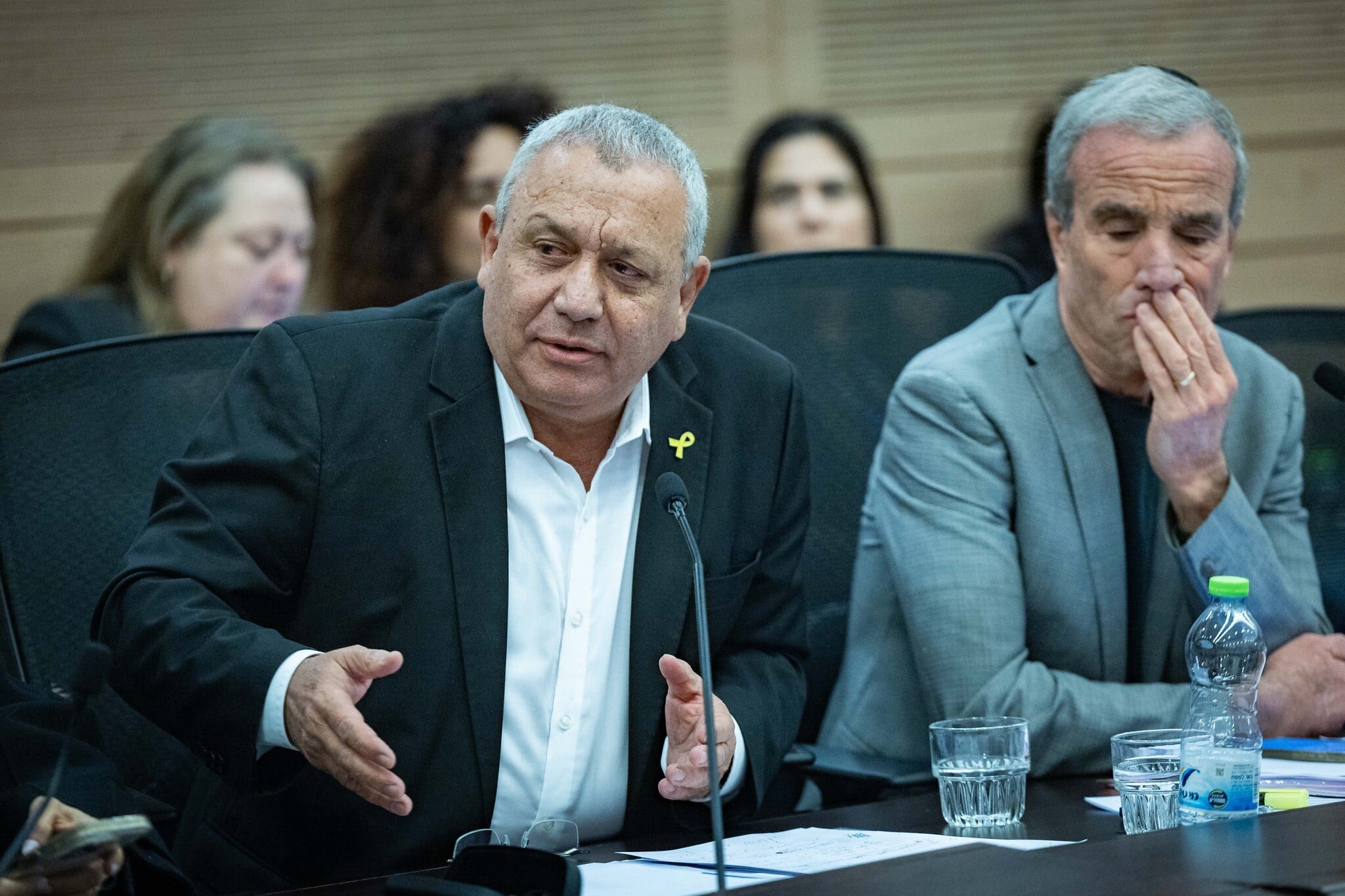
Gadi Eisenkot attends a Foreign Affairs and Defense Committee meeting at the Knesset in Jerusalem on December 9, 2025. (Yonatan Sindel/Flash90)
By contrast, Religious Zionism MK Simcha Rothman took issue with the Bank of Israel for issuing the report, arguing in a tweet that it doesn’t have the requisite expertise to weigh in on the issue.
“I didn’t know what I thought about the draft law, and then came the report by the experts on social processes and recruitment targets at the Bank of Israel,” Rothman wrote.
“I am eagerly awaiting the letter from 100 doctors saying that the law harms health,” he quipped, arguing that the “only truly professional and important message that has actually been examined and researched, the Shkedi Committee, is completely absent from the public discourse.”
That committee, led by a former commander of the Israeli Air Force, Maj. Gen. (res.) Eliezer Shkedi, laid out how the country could effectively recruit and integrate members of the ultra-Orthodox community into the IDF, including through the adoption of Haredi-oriented service tracks. The IDF has several such tracks, including the recently established Hasmonean Brigade.
“Recruitment will come when the IDF builds the appropriate frameworks for it, and the purpose of the law should be to allow this important process of drafting and integration to take place — not to interfere with it,” Rothman added.

MK Simcha Rothman, right, leads a hearing of the Constitution, Law and Justice Committee at the Knesset in Jerusalem, November 17, 2025. (Yonatan Sindel/Flash90)
His comments appeared to be at odds with other members of his party who have heavily criticized the bill. In a press conference last week, Immigration Minister Ofir Sofer condemned the “shameful law” and pledged to vote against it, even if it cost him his cabinet position.
On Wednesday evening, the party denied reports that it agreed to support the bill after consultations with senior rabbis, declaring that it would “vote only for a law that will bring about real and rapid enlistment of Haredim into the IDF, in order to meet Israel’s security needs and ease the burden on the fighters and their families.”
The bill is a top demand by Netanyahu’s ultra-Orthodox government partners, who seek to protect the longstanding exemptions, after the High Court of Justice ordered the government in June 2024 to start conscripting Haredi men.