
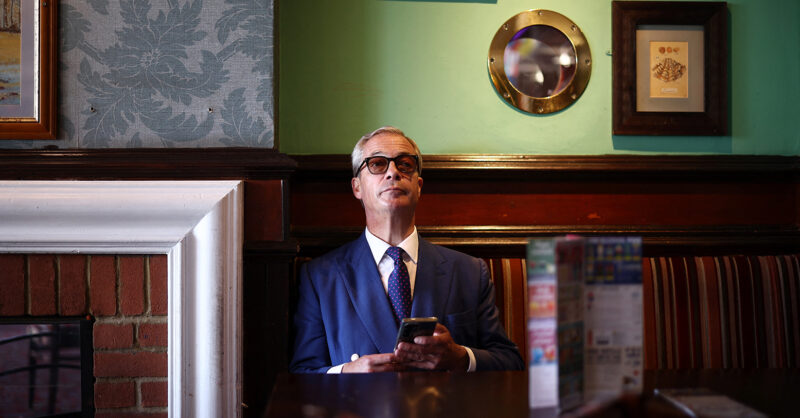
Photo by Henry Nicholls / AFP via Getty
Forgive the asterisks, but they’re necessary where Nigel Farage is concerned. W*gs and P*kis. This was how he used to speak about ethnic minorities. Around 20 of his former classmates have come forward with detailed tales of his school-boy racism. Around half of those have been willing to be named – of whom I am one.
Farage has denied these claims. In a statement a Reform spokesperson told the New Statesman: “These latest attacks are a naked attempt to discredit Reform and Nigel Farage.
“Instead of debating Reform on the substance of our ideas and policies, the left-wing media and deeply unpopular Labour Party are now using 50-year-old smears in a last act of desperation.
“The British public see right through this witch hunt.”
But it’s important to clear up a few things.
First, this did not happen, as Farage has suggested, 49 years ago – when he was 12. As Michael Crick has detailed in his biography of the Reform leader, One Party after Another, the stories about him cover his entire school career, right through to his departure as a young adult of 18. Second, this is not a matter of “playground teasing”. If Farage thinks snarling at a Jewish pupil that Hitler was right, as reported in the Guardian, while mimicking the sound of the gas chambers, is the equivalent of pub banter then sharing a pint with him must be a lot less fun than he would have us believe. Third, this is not a conspiracy. How come so many people have suddenly and miraculously remembered their schooldays now, ask the conspiracy theorists?

Treat yourself or a friend this Christmas to a New Statesman subscription for just £2
Well, ever since Farage has been in the public eye I’ve been telling whoever would listen about his past. The truth is nobody was much interested. Now that the polls show him as favourite to become the country’s next Prime Minister, it’s hardly surprising that, finally, all aspects of his life are coming under scrutiny, including the part that I am able to tell.
On the whole, my recollections of Dulwich are happy ones.
I spent much of my time playing chess.
It had, then, a mostly friendly but highly competitive intellectual atmosphere – producing some of the best academic results in the country. Forty-nine pupils from our year, if memory serves, won places at Oxbridge.
Farage was a middling student, and as befits a maverick, chose not to attend university and instead went into the City to work as a commodities trader.
And I have a confession. Farage is the most prejudiced person I’ve ever met. But when I knew him (really from the ages of 14-16, our paths then diverged at A level), I didn’t dislike him. Although I’m Jewish, I was not the target, unlike others, of anti-Semitic abuse.
I feel ashamed now that I didn’t do more to call him out. My excuses are weak. It was a different time, when the National Front were on the rise, and football terraces were full of skinheads giving Nazi salutes. And I suppose I was cowardly.
And, yes, we were much younger and it was a long time ago. So does any of this matter now? His biographer Michael Crick agrees that “he was horribly anti-Semitic” at Dulwich but insists that Farage is not a bigot: “I don’t believe he’s an anti-Semite now,” he told the BBC Today programme.
But anybody who knew him as a schoolboy understands that white nationalism was the central component to his precocious political ideology. And when he said, as he did last year, that Rishi Sunak is “not patriotic. Doesn’t believe in the country, its people, its history or frankly even its culture,” we hear an echo.
He may have learnt to modify his outbursts, but it’s very hard for those who witnessed his behaviour to believe that those racist instincts don’t lurk just beneath the surface even now.
The immediate trigger for the Farage deluge, of course, was the deputy Prime Minister David Lammy’s claim – before he backtracked – that Farage “flirted with Hitler Youth”.
I have, as a journalist, made programmes about memory, and I am aware of how fragile and unreliable it is.
There are many memories of my distant past that I’m not confident about. But there are others of which I’m certain. There are some things one doesn’t forget. Given what I know, my advice to working journalists is this.
If you get the chance, ask Farage whether he has ever supported extremist political parties. I notice how careful he is with his wording. He says he has never been a member of an extremist party. Let’s take him at his word, but was he a schoolboy enthusiast for the neo-fascist National Front? Questions to ask, and questions to answer.
The New Statesman understands Nigel Farage denies these claims.
[Further reading: Nigel Farage’s American dream]
Content from our partners