
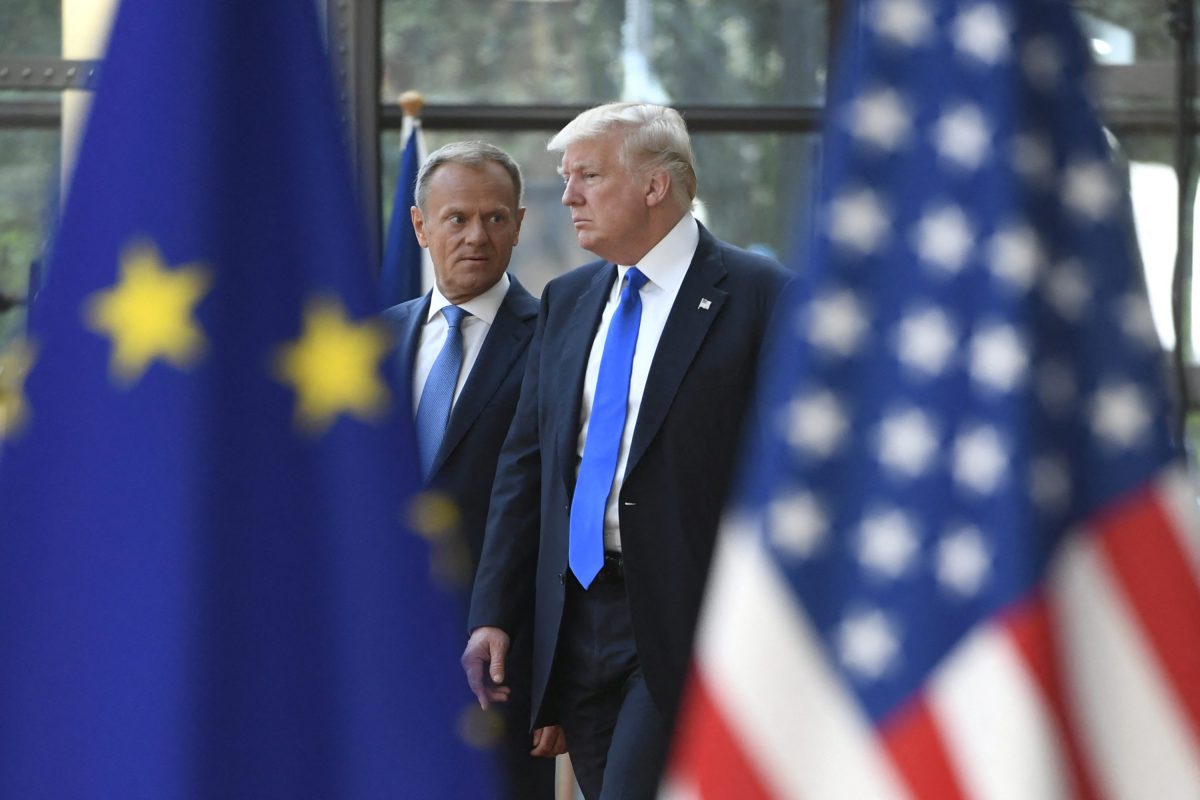
President Donald Trump says Europe is “decaying,” run by “weak” leaders “destroying their countries.” That was the takeaway from his interview with Politico, an epitaph for the continent’s migration policy, strategic posture and governing class. It ricocheted across capitals; in London, Prime Minister Keir Starmer stood up in the House of Commons to insist Europe is “strong and united” behind Ukraine.
Trump likely has five priorities that he has consistently indicated, with some justification, most of Europe is failing to meet: growth, defense spending, energy investment, conservative social policy, and a hard-line immigration stance. Yet there is one country that appears to meet these, and it might not be the one you expect. In 2017 he praised its “spirit of courage,” even quoting the historic chant—”We want God”—as proof that national and religious confidence was still live in Europe. Put those pieces together and there is one country that maps curiously well onto his vision. It’s Poland. And, astonishingly, Poland is projected to overtake Japan—once seen as America’s greatest industrial threat, including by Trump himself—in one measure of living standards next year.
Common Knowledge
Trump has framed the stakes as civilizational, warning Europeans at the U.N. this autumn that they are “destroying your countries” and, on a summer stop in Scotland, that migration is “killing Europe.” Yet even as he paints the continent in funereal tones, he nods toward exceptions with “strict” border policies—Hungary and, especially, Poland. “Weak” Europe versus a handful of strongholds.
Critics answer with their own declaratives. Starmer told the U.K. Parliament that Europe “remained strong and committed to freedom and democracy,” rebutting the decline sermon from across the Atlantic. Le Monde, France’s paper of record, put it more bluntly in an editorial: “Trump’s United States is now a threat to democracy in Europe.”
On the nationalist right, Trump’s line lands as validation. American conservatives flew to CPAC Poland in May for the conference’s first-ever Warsaw edition; U.S. figures urged voters to back a Trump-aligned candidate and cast the election as a “battle for Western civilization.”
Uncommon Knowledge
Run Trump’s five-point test against Poland and the picture that emerges is less “decay” than velocity—cultural and economic.
Start with growth. On a purchasing-power basis, the IMF puts Poland around $55,000 per head in 2025, up dramatically since EU accession. On this measure it could overtake Japan as soon as 2026. Jobs tell the same story. Poland had among the lowest unemployment in the EU—about 2.6 percent—in early 2025.
On defense, Poland easily exceeds the NATO target of 2 percent spending, at over 4 percent of GDP in 2025. Prime Minister Donald Tusk has talked openly about 5 percent as the new normal.
On energy investment, Poland is making 60-year bets that many richer countries struggle even to permit. On December 9, 2025, the European Commission approved state aid for Poland’s first nuclear power plant, to be built with Westinghouse AP1000 reactors; Tusk said work would start “now.” It came after Intel announced a multibillion-dollar assembly and test campus near Wrocław.
So much for the economic indicators. Culturally, Poland’s domestic settlement is exactly the sort of package MAGA praises. The country has had a near-total abortion ban since 2021 and a 2024 bill to allow over-the-counter access to the morning-after pill was vetoed. It also writes large pronatalist checks: the flagship child benefit rose to PLN 800 (around $220) per child per month from 2024 and is broadly available.
On immigration, yet again Poland echoes Trumpian rhetoric. It built a 5.5-meter steel wall along much of the Belarus frontier and fortified a 130-mile electronic barrier with thousands of sensors and cameras. A prominent Polish lawmaker once boasted that it had allowed “zero” Muslim migrants. However, it also ran one of the West’s largest refugee integrations in modern times, by allowing nearly one million Ukrainians to register in the country since Russia’s full-scale invasion.
Put these strands together and the outlier looks less like an anecdote and more like a pattern. A country Trump routinely praises has: living standards rising fast enough to plausibly pass Japan on a PPP basis; joblessness in the EU’s basement; a defense effort that leads NATO on share of GDP; an energy plan willing to place century-scale bets; borders hard enough to satisfy the most restrictionist talking point; and a refugee integration large and successful enough to boost GDP rather than depress wages.
The catch is that real countries are messy. Poland is aging, and fertility remains low. Fiscal deficits continue to alarm. The border hardening has had a human cost at the Belarus line, and rights groups—and Polish courts—continue to litigate the state’s measures.
The cultural through-line, though, is unmistakable—and explains why Poland has become a destination for American conservative pageantry. At CPAC Poland, U.S. speakers talked about a “battle for Western civilization.” That may scandalize liberals. It is also revealing. For one corner of American politics, the European exception to “decay” is not Switzerland’s wealth or Denmark’s welfare state, but a country that mixes rearmament, family subsidies, energy building, hard borders, and selective openness for neighbors.
That does not vindicate every policy in Warsaw. It does, however, simultaneously complicate and reinforce the story Trump tells about European “decay.”
If you’re enjoying Uncommon Knowledge, please share. If you have suggestions for future editions or feedback, email subscriber.feedback@newsweek.com. We want to hear your voice.