
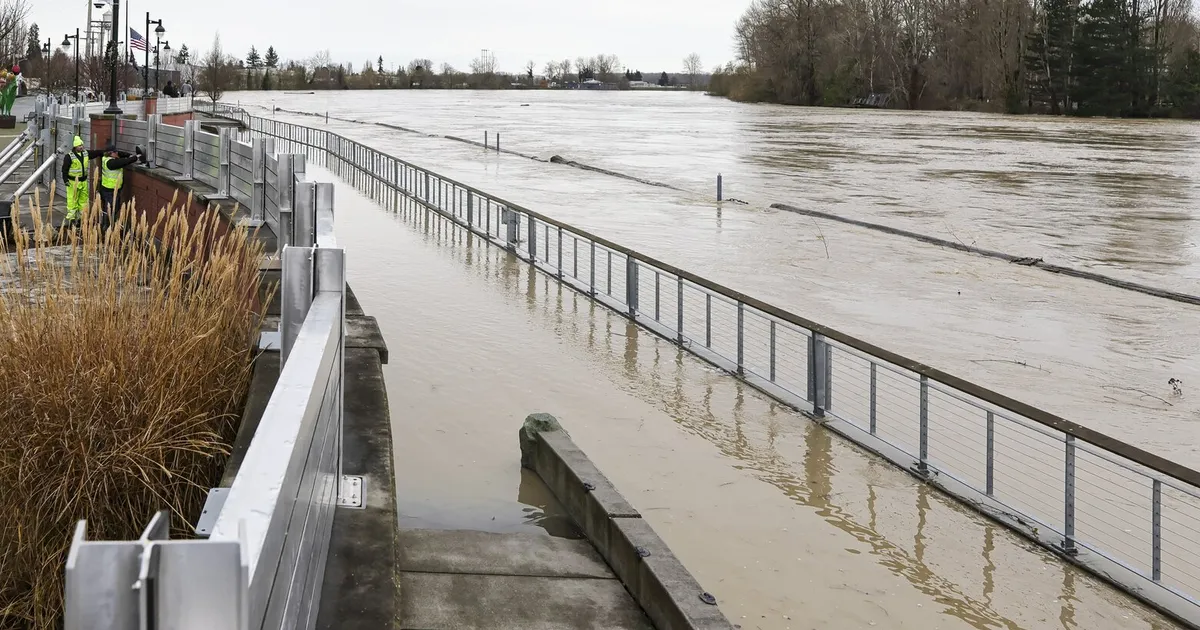
MOUNT VERNON — Cresting floodwaters of the Skagit River were moving steadily downstream toward the largest cities in the county as local, state and federal officials warned of potentially grave and catastrophic danger.
Some 78,000 people live within the Skagit’s floodplain, and all were told to get out before it’s too late.
In Mount Vernon, police and fire crews went from door to door Thursday, warning of the deluge that’s headed their way. Floodwalls and levees will be put to the test like never before, and Gov. Bob Ferguson said he’s trying to persuade the federal government to listen to its own forecasters.
“We need their assistance,” Ferguson said Thursday afternoon at a news conference on the Skagit Valley College campus, advocating for federal disaster aid.
Rainfall weakened across the region but the water built up over days of torrential rain from an atmospheric river was still making its way to the ocean. The crest of the water was expected to arrive in Mount Vernon Friday morning, about a foot higher than record levels.
No one has been reported to have died in the flooding as of Thursday evening.
Many in the area are quick to remember the extreme flooding of 2021, how the river crept up the sides of the downtown floodwalls.
Of the evacuees, around 3,800 people are going to need some sort of emergency shelter to escape the floodwaters, said Julie de Losada, chief of Skagit County’s Department of Emergency Management. That number may increase, depending on how high the floodwaters rise, and she urged those who have been told to leave their homes to stay away until public officials sound the all clear.
All eyes on levees
One of the largest areas of concern is a series of levees along the Skagit River. Some are leaking in places.
And yet people still aren’t heeding the warnings throughout the area, Skagit County Commissioner Lisa Janicki said.
“What I did see, that is nuts, is people walking, walking their dogs on the tops of these dikes that may fail,” Janicki said.
The Skagit River floodplain includes miles of dikes and levees, built over decades, that, most of the time, form a barrier between flood waters and protected land — cities, buildings, farmland.
Some are actual walls, like the concrete and steel floodwall in downtown Mount Vernon that was completed in 2019. Prior to the wall’s completion, protecting the downtown from flooding frequently required hundreds of volunteers placing thousands of sandbags along the waterfront.
But many dikes and levees across the floodplain are just earthen berms, protected from erosion by riprap or vegetation.
Skagit River levees to be tested
Miles of levees and dikes in the Skagit Valley will be tested as floodwaters crest. Nearly 80,000 people who live in the floodplain have been told to evacuate.
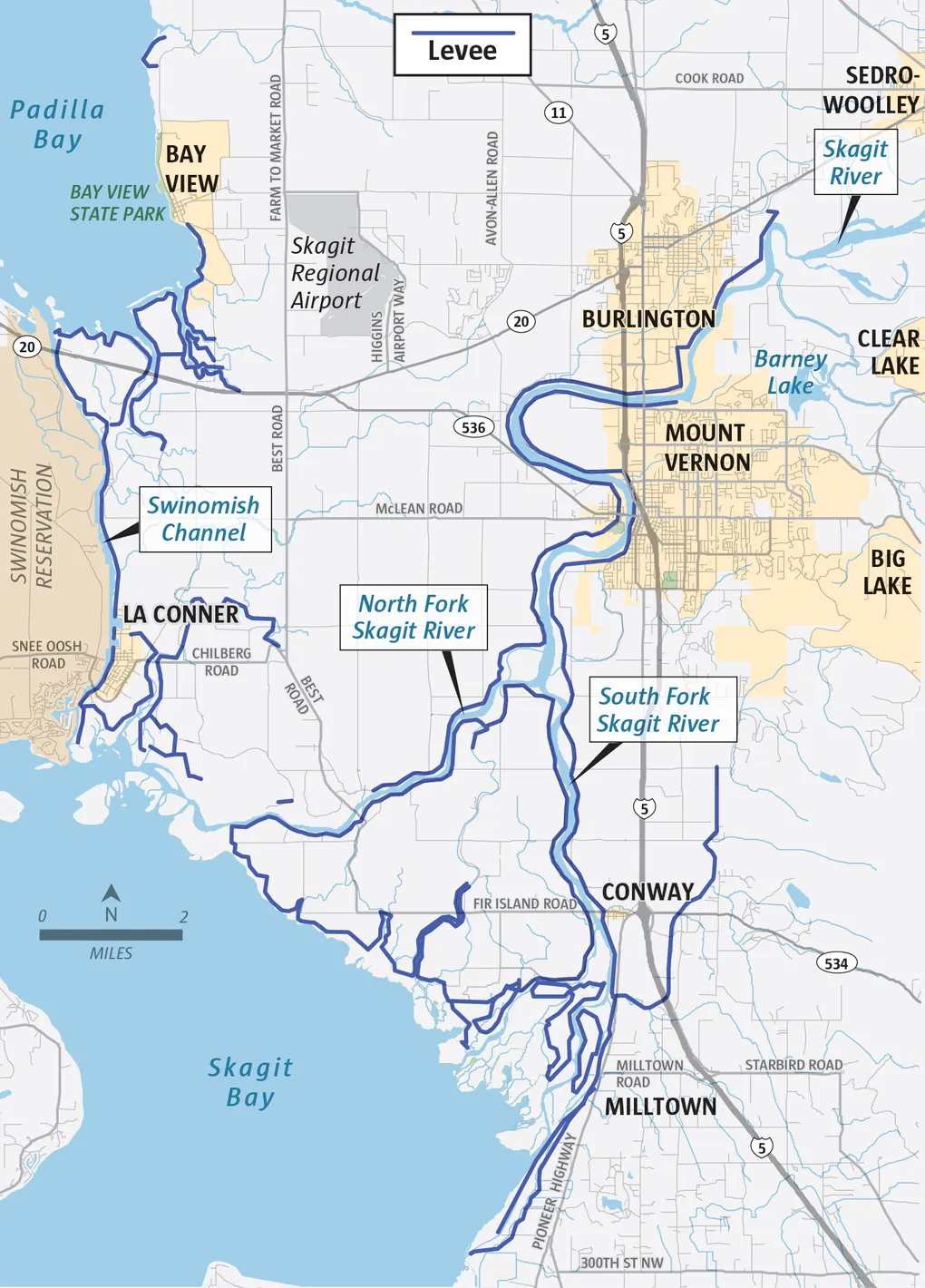
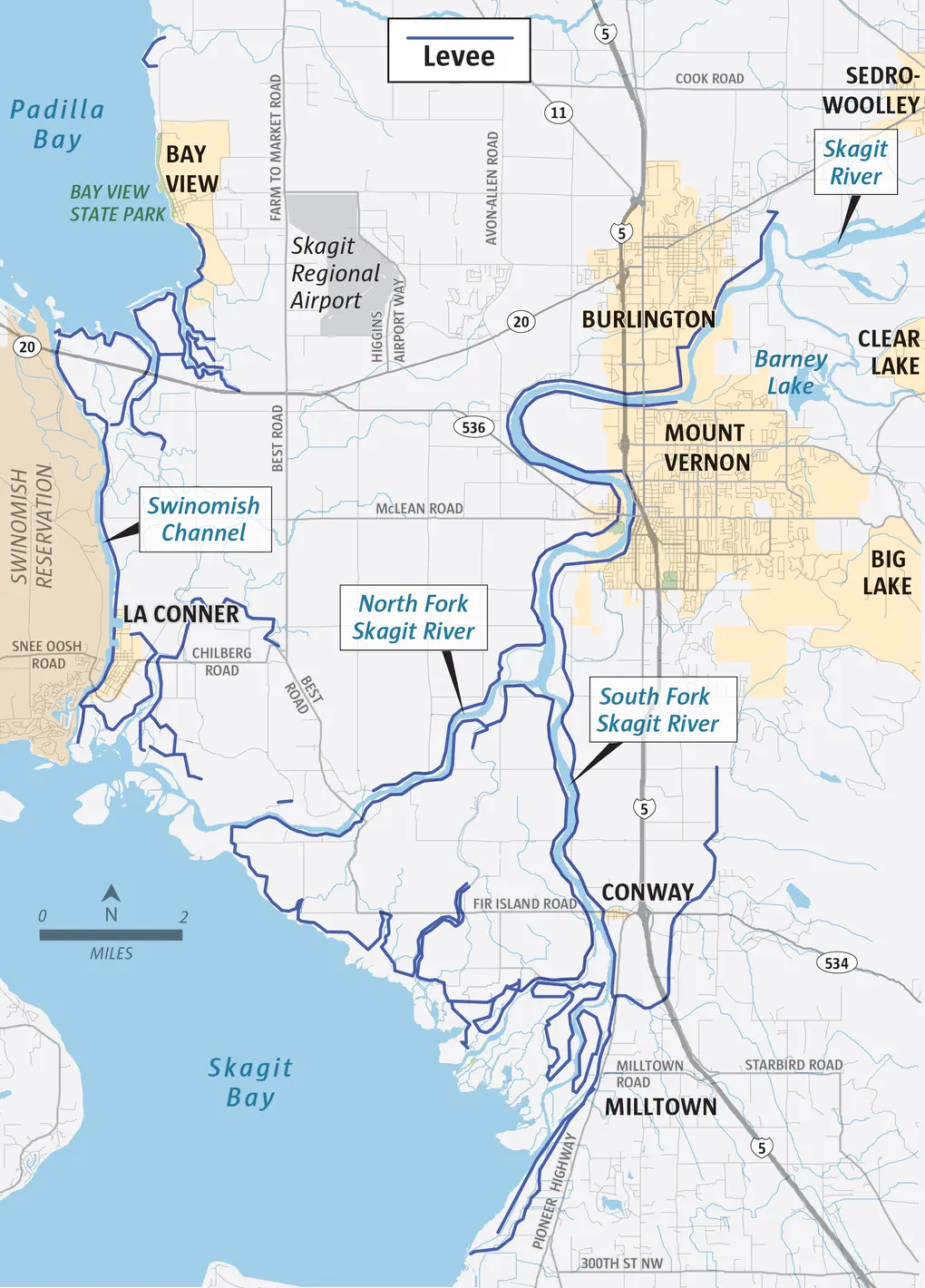
It’s a system that has continually been expanded and rebuilt since the first dikes were built in the late 19th century.
The National Weather Service has issued a flash flood watch for a potential levee failure on the Skagit, somewhere downstream of Sedro-Wooley, all the way to the mouth. That’s an area that passes Burlington, Mount Vernon, Skagit City and Conway.
Skagit County and the U.S. Army Corps of Engineers began a decades-long study in 1997 into the region’s flood risks. Titled the Skagit River General Investigation, it stalled out in 2015, with the county accusing the Corps of going over budget and past deadlines.
“After 18 years,” the county’s then-public works director wrote, “we are still awaiting a final plan.”
Many of the levees in the area needed to be repaired after the 2021 floods, said Robert Ezelle, director of Washington’s Emergency Management Division. This is the first time they’ve been tested seriously since then.
And the test is likely to be more intense than the floods four years ago. River water is likely to reach the very top of the levees.
Towns brace for peak
Thursday morning crews walked along sections of the Mount Vernon floodwall while the river crept ever upward. Nearby, Vera and Dave Nunnally surveyed the scene. The couple said they watched as the floods rose in 2021. Even then, when the waters fell short of the floodwalls’ uppermost edges, the river gushed from underneath the barrier, they said.
The couple is fortunate, they said. They live on high ground in the Eaglemont area, southeast of town. But others are bracing for the worst.
Many businesses downtown closed their doors, piling sandbags a few feet high outside in the hopes of warding off whatever waters might spill their way.
After the afternoon news conference, Mount Vernon Mayor Peter Donovan said he’d be watching the area closely. The bridge downtown along West Division Street will likely have to be closed once the floodwaters reach 36 feet. They’re higher than 32 feet now and expected to rise past 39 feet by Thursday night.
That’s one of the reason city crews are moving from door to door in the lowlands, Donovan said. They want people to make sure they have all the emergency information available — in English and Spanish — and to try to persuade them to evacuate.
Taking shelter (or not)
More and more people filtered into the emergency shelter set up on high ground at Mount Vernon’s Bethany Covenant Church as the sky fell dark Thursday. Workers stacked boxes of bottled water, meals and “comfort kits” in the church’s hallways.
Staffers collected medical and dietary information for those who walked in, many of whom spoke little or no English.
Betsy Robertson, a communications director for the Red Cross, said perhaps 51 people slept in the shelter Wednesday night. Who knows how many might return Thursday or Friday?
Nancy Winterstein said Thursday evening she knew it was time to leave her home in the lowlands when the neighbors told her they were packing up and heading out.
She threw a few things into a duffle bag and hopped into her car but didn’t know where to go. A nearby hospital might do the trick, Winterstein thought. The parking lot is safe, they have 24-hour staff and a bathroom inside if she needs one. Not too bad of an idea, if she doesn’t say so herself.
“For an old fart, I do OK,” Winterstein said with a laugh.
Thursday night, Winterstein will stay on the cots within the Red Cross shelter. It’s not ideal, but it’s safe and it’s warm.
Often, an emergency shelter isn’t anybody’s first choice, Robertson said. But people don’t have to come to a shelter to spend the night. They can pop in just for a little while.
Some just don’t want to leave their homes at all.
The levee around River Bend Road is too steep for Tim Harvey to climb but he caught a glimpse of the rising flood driving over bridges around town. He lives on the third floor of an apartment complex in the floodplain and local officials even knocked on his door to tell him to evacuate, but Harvey said he’s not interested in leaving.
Harvey’s on dialysis and needs the critical medical service three times a week. He figures he can visit a hospital in town if he can’t go to his regular place up north.
But what if he’s stuck at home? He doesn’t know. He’s got a bit of food and water there.
Who knows how this will turn out, he said.
“I might have beachfront property,” Harvey said.
Federal aid uncertain
The floods aren’t just a concern in Skagit County either, Ferguson said. Communities in Lewis and Yakima counties are seeing damage as well. Portions of Pierce County were told to evacuate too.
Ferguson said he’s been in contact with officials at the Federal Emergency Management Agency asking for federal funding to help respond to and recover from the flooding.
Under President Donald Trump, federal emergency officials have become increasingly loath to grant requests for emergency funding, especially in left-leaning states like Washington. Such was the case after a powerful bomb cyclone ripped through Washington last November, causing an estimated $34 million in damage over six counties.
Ferguson said Washington will need federal aid in this emergency too and he’s been working to persuade FEMA officials to agree, asking them to consider the government’s own predictions.
These floods are potentially catastrophic and threaten the lives of people in the area, Ferguson said, citing National Weather Service predictions.
“Those aren’t my words,” he said. “That’s the federal government.”
So far, federal officials haven’t granted Washington’s request for help but Ferguson said he’ll keep trying.
Conrad Swanson: 206-464-3805 or cswanson@seattletimes.com: Conrad Swanson is a climate reporter at The Seattle Times whose work focuses on climate change and its intersections with environmental and political issues. David Gutman: 206-464-2926 or dgutman@seattletimes.com: David Gutman covers local politics and King County government at The Seattle Times, reporting on how leaders and institutions impact the lives of everyday people.