
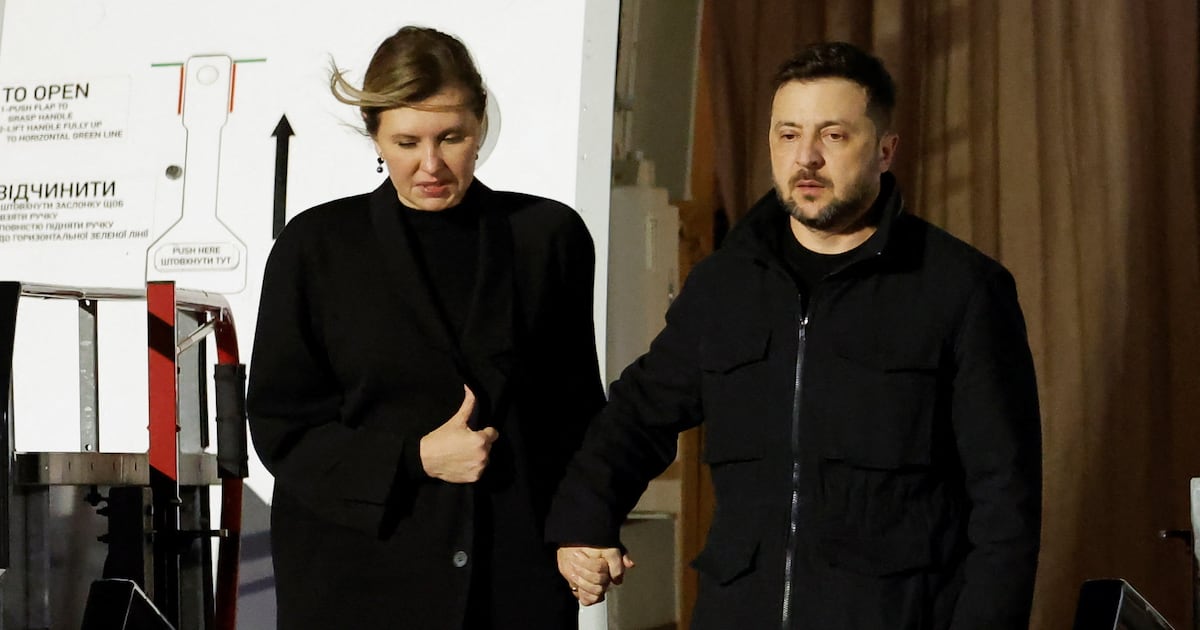
The State agency responsible for running air traffic control in the Republic was not informed of the presence of drones on the approach to Dublin Airport on the night Ukrainian president Volodymyr Zelenskiy landed in Ireland.
This meant no warnings or other information could be shared with the pilots of aircraft approaching the airport at the time, some of which were carrying hundreds of passengers.
AirNav, which runs air traffic control in the Republic that includes flights in and out of Dublin Airport, has confirmed to The Irish Times it was not informed of the drone activity on the night of Monday, December 1st.
“AirNav Ireland received no reports of drone activity during the visit of President Zelenskiy to Ireland,” the agency said in response to queries about whether the pilots of incoming planes were warned of the drone activity.
 Podcast – 4 stories in 11 minutes: Daniel Aruebose inquiry upgraded to homicide, and more
Neither the Department of Transport nor the Irish Aviation Authority responded to queries.
The revelation is likely to raise questions around how the incident in the skies over Dublin Bay was handled on the night and about the sharing of crucial safety and security information with the relevant State agencies once the drones were first spotted by Defence Forces members.
It comes as Minister for Defence Helen McEntee confirmed plans to spend €1.7 billion on defence in the period to 2030.
The investment is aimed at better equipping the State for the rapidly changing international security environment almost four years after Russia invaded Ukraine and as European countries are forced to respond to hybrid attacks and disruption.
The defence package includes measures to enhance the capability of the Defences Forces in identifying airborne threats and those at sea, including underwater where subsea cables vital to internet and communication are located.
Ireland’s defences are regarded as among the weakest in the European Union and the incident last week, after Mr Zelenskiy’s aircraft had landed, has embarrassed the Republic internationally.
It also exposed the scale of the State’s vulnerabilities, especially in dealing with drones, just over six months out from Ireland assuming the EU presidency.
The package of Defence Forces spending announced by Ms McEntee yesterday at the Curragh Camp, Co Kildare, includes €19 million for an accelerated programme of anti-drone technology in time for the EU presidency, starting next July.
Ms McEntee said the technology would “identify but also neutralise” rogue drones in an era of “changing threats” as the EU presidency approached.
“There was identification of drones in the skies at certain times,” she said, referring to Mr Zelenskiy’s State visit last week.
“There is a review under way at the moment. I think what we’re seeing here is what’s being reflected right across the EU.”
She said that “in many instances” the drones were flown “to disrupt” and have led to hundreds of millions of euro worth of disruption caused in the EU.
Overall, there will be a 55 per cent increase in defence spending over the next five years, rising to €300 million in 2026 and €360 million by 2029.
A long-promised military radar programme will commence next year and be completed in 2028, aimed at detecting airborne threats.
Towed array sonar – a cable of hydrophones towed behind a surface ship that is used to detect submarines – will be acquired as part of the package.
The package will also include a Sonobuoy project, which is dropped from a ship or aircraft to detect submarines or other underwater activity, including threats to subsea cables.
The P60 fleet of Naval Service offshore patrol vessels will also be extended.
The Air Corps will acquire four Airbus H145M helicopters, replace the PC-9M aircraft fleet by 2030, take delivery of the Falcon 6X strategic aircraft, with “progress” also promised towards acquiring eight Super Medium helicopters.
There is also €400 million committed for “investment in Defence Forces infrastructure, including accommodation, offices, gyms, aircraft hangars and naval berthage”.
A further €175 million will be spent on “IT, transport, engineering and ordnance systems”.