
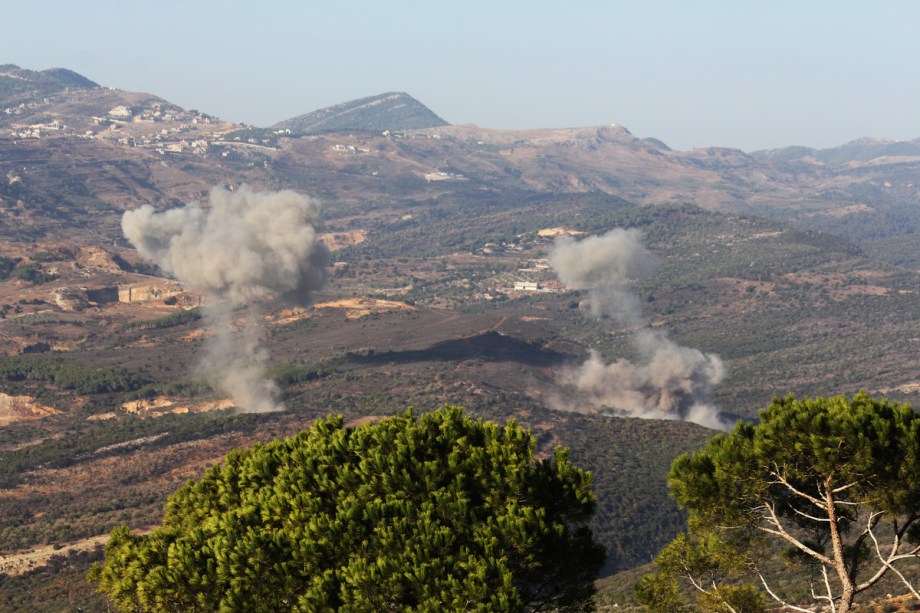
Between October 2023 and October 2024, Israel carried out 195 white phosphorus strikes across southern Lebanon, including in populated areas, researcher Ahmad Baydoun reported. The last recorded attacks occurred on 31 October 2024 in Al Khiam. Human Rights Watch says using airburst white phosphorus in populated areas violates international humanitarian law.
The incendiary chemical has inflicted severe harm on civilians, causing painful burns, respiratory injuries, and displacement. Amnesty International warns that burns covering as little as 10 percent of the body can be fatal. “Residents are concerned about the extreme toxicity of white phosphorus fumes and solid remnants,” says environmental researcher at the American University of Beirut, Abbas Baalbaki. “White phosphorus is a highly reactive substance that even reacts with oxygen in the air. It ignites by itself at low temperatures.”
As a result, Israel’s use of white phosphorus bombs has ignited fires all around south Lebanon, including houses, buildings, and land areas belonging to farmers, burning at least 918 hectares and preventing 90 per cent of livestock farmers from accessing their lands, according to the Food and Agriculture Organization of the United Nations and the Lebanese Ministry of Agriculture. “It has destroyed vast expanses of forested land, disturbing the ecosystem balance in all these regions,” says Dr Rami Zurayk, a professor of Ecosystem Management and researcher at the American University of Beirut.
The impacts of white phosphorus have raised concerns about its effects on the environment, including fears of soil and crop contamination, which has led people to avoid buying products from the south, according to Joseph Bechara, a Lebanese wildfire and forest management expert working for the Lebanon Reforestation Initiative (LRI). However, after further research into the impact of white phosphorus, many researchers are saying the concerns aren’t as dire as people may think, concerns that have been perpetuated through the media.
“There is no indication that white phosphorus has a durable and long-term effect on the soil, and there is no evidence of phosphorus levels that can pose any problem in plants or products,” reported Dr Zurayk. This was echoed by other researchers working with the Lebanese Ministry of Agriculture, including Becharra, who stated that phosphorus is a natural element and only harmful if it exists in high concentrations. Dr Mohamed Abiad, Director of the Laboratories for the Environment, Agriculture, & Food at AUB, added that soil amendments can treat the white phosphorus. Phosphorus itself is often used as a fertilizer, meaning plants can absorb it. “If phosphorus is high [in the soil] you can add nitrogen and potassium to amend it,” he says.
Dr Zurayk, Bechara, and Dr Abiad have all been conducting preliminary testing to identify the impacts of Israel’s consistent bombing of southern Lebanon has had on the environment and soil of the region. While they have determined that the white phosphorus from Israeli munitions will not have long-lasting effects on the soil, they are concerned about the presence and accumulation of heavy metals that are usually present in bombing sites, including those associated with all Israeli shellings and any kind of military activity, not just white phosphorus munitions.
The main heavy metals that could impact the food chain are barium, zinc, copper, cadmium, arsenic, chromium, and lead. These heavy metals can leach into soil and groundwater, impacting soil health by killing microorganisms and disrupting their function. Furthermore, according to Dr Zurayk, the outcome of some heavy metal accumulation may be confounded by the heavy use of fertilizers in the area, which carry impurities with them.
Perhaps the biggest concern is that these heavy metals can be carcinogenic. “The problem is that they are very stable and end up in the food supply chain because plants absorb heavy metals, especially in leafy vegetables that we eat. They are associated with cancer and public health issues,” says Dr Abiad.
This comes at a time when the frequency of new cancer cases in Lebanon has risen by 162%, with mortality rates increasing by 80 percent, since 1990, according to a global study co-authored by Ali Mokdad, a chief strategy officer of population health at the University of Washington. However, although preliminary testing has been conducted, not enough sufficient research has been undertaken to reach a conclusive agreement. “Products are not necessarily contaminated and so far, are safe to eat, but we will do tests to understand the impact of heavy metals,” says Bechara.
Dr Zurayk, Dr Abiad, and Bechara have been working with farmers and local actors in southern Lebanon to collect samples of topsoil from bombing sites and their surrounding areas. Then, they analyze the soil sample and assess potential pollutants based on previous research. Still, there have been several difficulties with collecting data. “There are two main problems with preparing the samples,” says Zurayk. “We don’t have centralized facilities, dedicated staff, money to do the samples, and troubleshooting for the instruments,” he said.
As a result, two sets of instruments have been developed for two universities: the American University of Beirut and the Lebanese University. In addition, when it comes to analyzing organic pollutants, which are residues from combustion or pollutants that have not yet been combusted, they require an instrument with a standard that has been difficult to acquire due to sanctions and standards for explosives.
Bechara adds that they’ve been working with agriculture ministry employees to teach them to standardize the protocol sampling. The most significant obstacle to collecting data, however, has been the continued presence of the Israeli military in the south of Lebanon.
“We cannot reach areas because of Israel. The safety of the people getting samples is in question,” says Dr Abiad.
Dr Zurayk adds that the Israelis are preventing access to land in order to empty and uproot villages near the border zone between two and five kilometers. “They consistently blow the villages up, target people, and shoot aimlessly at anything with automatic fire generally in the area,” he says.
As a result, much research has been done remotely and slowly. “We rely on the army and make sure they are present with all our projects,” says Bechara. Many farmers either have burnt land or are unable to access their lands because of ongoing military activity, including Israeli drones and unexploded munitions. This is especially true for olive orchards, which have been challenging for farmers to access and harvest their crops.
Countless olive trees have been damaged by the shelling, resulting in an olive harvest yield that was only 20 per cent of last year’s yield, a severe setback for many farmers. This, alongside the views of many in Lebanon to avoid products in the south, is one of the main impacts on agriculture, stated Bechara.
In terms of land recovery and reforestation, it’s too early to establish anything concrete, according to experts. While there have been initiatives such as “Together for the Olives of the south,” an agroecological center that distributes olive trees to different farmers, it’s been challenging to focus on restoration as Israel continues to bomb the south of Lebanon, despite the November 2024 ceasefire.
Despite the risks, researchers continue their work. “We’ve landed a grant for further analysis,” Abiad said. “Hopefully, early next year, we will sample the soils for heavy metals and phosphorus.”
The views expressed in this article belong to the author and do not necessarily reflect the editorial policy of Middle East Monitor.