
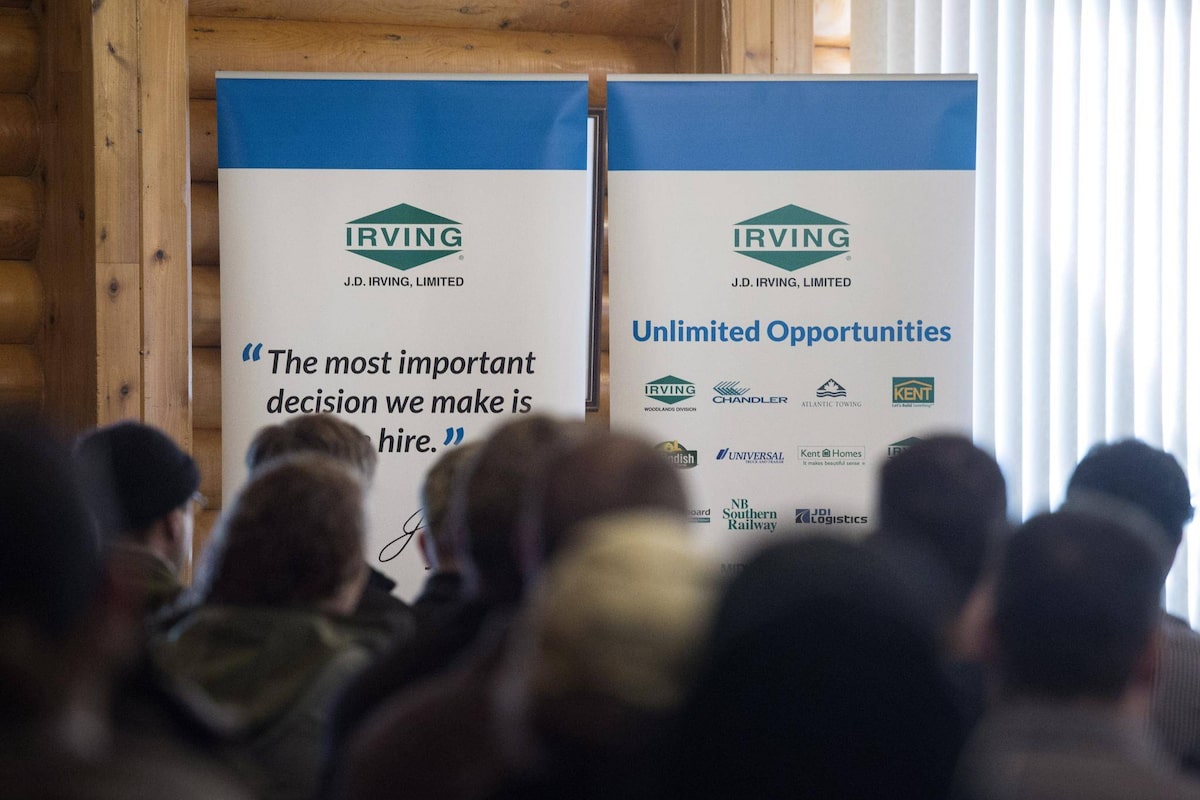
Large private-sector firms including J.D. Irving Ltd., Acadian Timber GP Inc. and H.J. Crabbe & Sons Ltd. led the appeal after being put on notice that the Wolastoqey Nation may want privately owned industrial lands returned.Darren Calabrese/The Canadian Press
New Brunswick’s Court of Appeal has ruled that an Indigenous group cannot seek a declaration of Aboriginal title over private property, saying the harm to private property rights would undermine Canada’s efforts at reconciliation with First Nations.
The decision Thursday overturns a lower-court ruling that would have allowed the Wolastoqey Nation to lay claim to privately owned industrial lands as part of their broader Aboriginal title case. It is in strong contrast with a recent B.C. Supreme Court ruling that has cast private property rights into question.
“In my view, a declaration of Aboriginal title over privately-owned lands, which, by its very nature, gives the Aboriginal beneficiary exclusive possession, occupation and use, would sound the death knell of reconciliation with the interests of non-Aboriginal Canadians,” Justice Ernest Drapeau wrote in the judgment released Thursday.
Supreme Court considers cases of overlapping Aboriginal title
The trial on the Wolastoqey’s claims for Aboriginal title to lands, airspace, foreshore, lakes and rivers covering the western half of New Brunswick can now begin. But industrial land owners in the vast claim area are no longer at risk of losing their properties after the court concluded that private ownership cannot co-exist with a declaration of Aboriginal title.
Publicly owned, or Crown land is rightly on the table, the appeal court concluded, and the province may be liable for compensation to the Wolastoqey for properties in the claim area that are registered as fee simple lands.
Large private-sector firms including J.D. Irving Ltd., Acadian Timber GP Inc. and H.J. Crabbe & Sons Ltd. led the appeal after being put on notice that the nation may want privately owned industrial lands returned.
The courts can make a finding that Aboriginal title exists on private lands, Justice Drapeau clarified, but that does not carry the full weight of a declaration of title. A finding is not enforceable, while a declaration is a court order that can be enforced – and appealed.
The ruling leans heavily toward compensation rather than the threat of expropriation to settle land claims that touch on private lands.
“A judicial declaration of Aboriginal title would confer those ownership rights, and I am unable to see how those rights can co-exist with the very same rights vested in fee simple owners,” the 114-page judgment concludes.
“In my view, remedial justice favours compensation from the Crown over dispossession of private fee simple owners in all cases,” Justice Drapeau wrote.
The ruling could open the province to a costly settlement. New Brunswick’s Minister of Justice and Attorney-General Rob McKee declined an interview Thursday. In a written statement, he said his government needs time to review the court decision.
“That said, our position remains the same: the place to resolve title claims and achieve reconciliation is the negotiating table.”
Justice Drapeau’s ruling contradicts a B.C. Supreme Court decision in August that recognized Aboriginal title on lands that are held by private landowners.
Eby accuses courts of jeopardizing B.C. economy, resource projects
In British Columbia, Justice Barbara Young declared that the Cowichan Tribes of Vancouver Island have Aboriginal title to roughly 800 acres in a developed area in Richmond. Justice Young concluded in her Aug. 7 decision that fee simple title and Aboriginal title can co-exist, but she also found that Aboriginal title is “a prior and senior right to land.”
David Rosenberg, the lawyer for the Cowichan, said the two courts have reached a “fundamental difference of opinion.” The result, he noted, is that a declaration of Aboriginal title can be granted over private land in B.C., but not so in New Brunswick.
The Cowichan decision is being appealed, and B.C. Premier David Eby has raised concerns that the court has put certainty for private property owners at risk. He promised his government will provide guarantees to affected homeowners and business owners in the claim area so they can continue to access necessary financing.
While Justice Drapeau‘s conclusions provide some new clarity around the limits of Aboriginal title claims on private lands, it’s likely both cases will end up, eventually, before the Supreme Court of Canada.
Opinion: To recognize aboriginal title is not to abolish property rights, but to uphold them
“It’s an important decision, but it’s not the end of decisions on this issue,” said University of Saskatchewan law professor Dwight Newman, the Canada Research Chair in Indigenous rights in constitutional and international law.
He predicted the Wolastoqey land claims trial ahead will be lengthy, so a potential appeal to the Supreme Court of Canada is still a long way off.
The ruling “stands in some contrast” to the Cowichan decision, he said. “It’s significant to see this different perspective between the courts.”
The B.C. government has made clear it expects the Cowichan decision to be appealed to the country’s highest court and has asked that the case be expedited. However, that process is still expected to take years to complete.
In a statement, the Wolastoqey said it intends to appeal the decision to the Supreme Court of Canada.
The Court of Appeal “categorically denied the Wolastoqey Nation the ability to seek a declaration of Aboriginal title over any lands held in fee simple,” the statement reads. “The Wolastoqey Nation is deeply disappointed by this decision, including its mischaracterization of our claim and their interpretation of the decision being appealed from.”