
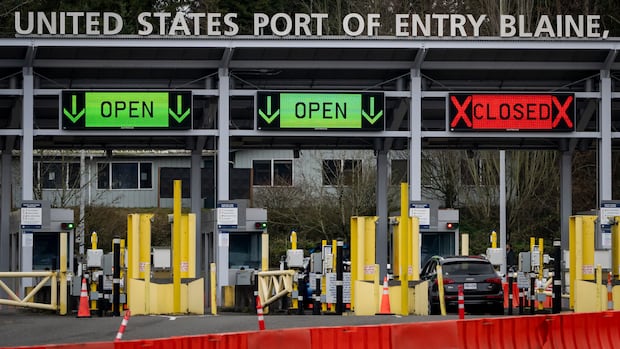
The drop in Canadian tourism to the United States in response to U.S. President Donald Trump’s actions is hurting American businesses in several states, a new report by a congressional committee has found.
The report, prepared by the Democrat minority of the U.S. Congress’s joint economic committee, warns that states along the Canada-U.S. border are being hit hard.
“In 2024, Canadian tourism contributed $20.5 billion to the U.S. economy and supported 140,000 American jobs,” wrote the authors of the report. “The negative impacts of President Trump’s tariff policies have been particularly stark in states along the U.S.-Canada border, which have many businesses that rely on short-term visits by Canadians.”
The report also cites Trump’s comments about annexing Canada, rounds of tariffs on Canadian goods and his decision to repeatedly break off trade talks.
“This has disrupted diplomatic, economic and trade relations between the United States and Canada — which in turn has hurt U.S. businesses that depend on visitors from Canada,” it says.
WATCH | Tariffs have caused anxiety in border communities since last winter:
Uncertainty around tariffs frustrates U.S. border town
In the border community of Plattsburgh, N.Y., many people say they have been frustrated by the uncertainty surrounding the threat of 25 per cent tariffs on Canadian goods.
The report says the number of passenger vehicles crossing the border between January and October dropped by nearly 20 per cent compared with 2024, with declines ranging from more than 10 per cent in Alaska to more than 28 per cent in Vermont.
“Businesses throughout the region are also reporting fewer tourists, more vacancies and lower sales,” says the report.
The joint economic committee, set up in 1946 to study economic policy, is composed of both senators and members of the House of Representatives. It includes both Republicans and Democrats, with each side regularly publishing reports that don’t include the other.
The committee’s reports inform members of both the Senate and the House of Representatives on economic questions.
Sen. Maggie Hassan, ranking member of the committee and a Democrat from New Hampshire, said the report documents the impact of Trump’s actions.
“Going back for generations, Canadians have visited New Hampshire and many other states along the U.S.-Canada border to see family or friends, stay in our hotels, share a meal at our restaurants and shop at our stores,” Hassan said in a statement.
“However, in the wake of President Trump’s reckless tariffs and needless provocations, fewer and fewer Canadians are making trips to the United States, putting many American businesses in jeopardy and straining the close ties that bind our two nations.”
 U.S. senators Maggie Hassan, Lisa Murkowski, Ron Wyden and Catherine Cortez Masto are seen on Parliament Hill in July. (Adrian Wyld/The Canadian Press)
Hassan was also part of a four-senator delegation that travelled to Ottawa in July where they met with Prime Minister Mark Carney and several Canadian cabinet ministers to discuss ways to repair relations between the two countries.
The committee’s eight-page report, made public Wednesday, outlines the toll that the Canadian boycott of travel to the U.S. has taken on 11 U.S. border states, with state-by-state data and testimonials from a wide variety of business owners.
For example, in Hassan’s home state of New Hampshire, officials reported a 30 per cent decrease in Canadian visitors — and reservations for state-run campgrounds were down 71 per cent in the first five months of 2025. One hotel owner in North Conway reported 30 per cent of their rooms were empty during some summer weekends that usually sell out.
Kyle Daley, owner of Soloman’s Store in West Stewartstown, N.H., told the committee that the “usual parade of vacationers heading to Old Orchard Beach simply didn’t show up this year.”
“The friction at the border is no longer just a headline; it is an empty parking lot and a threat to our livelihood,” Daley said.
In Maine, border crossings by passenger vehicles from Canada were down around 25 per cent in the first 10 months and Maine’s CAT Ferry, which connects Bar Harbor and Nova Scotia, reported its business was down 20 per cent over the summer.
Among the business owners in Maine who took a hit was Old Orchard Beach’s Moshe Agam.
“It’s like a 50 per cent [drop off] because not too many Canadians.… The worst year we’ve had. We’ve never had a year like that, even worse than COVID.”
In Montana, Canadians accounted for nearly 80 per cent of international visitors in 2024 and contributed $170 million US to Montana’s economy. In 2025, border crossings were down 19 per cent in the first 10 months of the year. Some businesses noticed a 25 per cent drop in Canadian travel and a 44 per cent decrease in Canadian credit card spending. A Montana hotel reported a $38,000 US loss after a Canadian sports team cancelled its reservation which included 70 rooms and a 200-person dinner.
“We need signals from both governments that cross-border friendships and economic partners matter, and without that no amount of marketing is going to help,” Diane Medler, executive director of Discover Kalispell in Montana, told the committee.
‘Long-lasting damage’
In Washington state, the number of passenger vehicles crossing the border was down 24 per cent and cities like Spokane reported a 33 per cent drop in visitors. Ridership on the Clipper Navigation ferry service between Vancouver and Seattle was down 30 per cent, forcing the company to lay off a quarter of its workforce.
Businesses in New York also reported cutting employees. For example, the North Country Chamber of Commerce, which serves the northern part of the state, reported in June that 83 per cent of businesses in the area had noticed a drop in Canadian customers, leading 35 per cent to cut staffing.
“Seventy per cent of businesses blamed the political climate and tariff policies for this drastic decrease,” says the report.
Some business owners, like Christa Bowdish of the Old Stagecoach Inn in Vermont, who was forced to lay off employees and reduce hours, told the committee she feared the damage will be lasting as Canadians find other destinations.
“It’s not just the tariffs,” she said in the report. “This is long-lasting damage to a relationship and emotional damage takes time to heal.”