
About once a decade, travel expenses and politicians’ access to entitlements crash their way into the headlines, usually to the discomfort of a government as the opposition ratchets up pressure for a ministerial scalp.
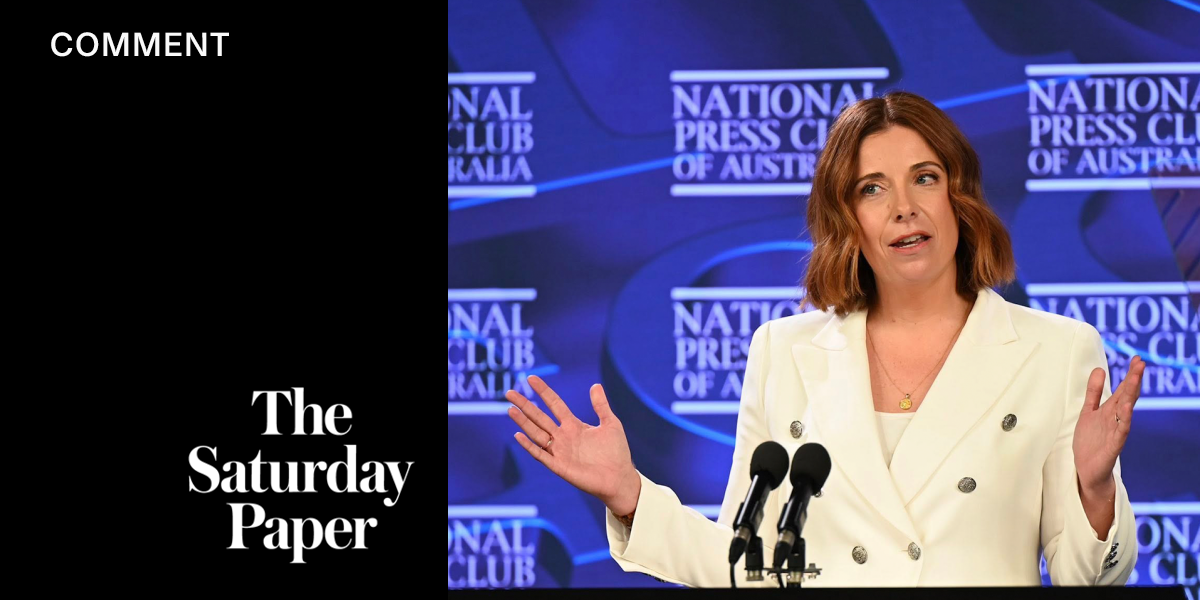
The latest uproar was sparked by evidence in Senate estimates that Minister for Communications and Minister for Sport Anika Wells had spent nearly $100,000 on airfares for herself and two staffers to attend a forum in New York on the sidelines of the United Nations General Assembly.
The opposition leapt on the revelation, criticising Wells for spending all that money to give a “six-and-a-half-minute speech” that Prime Minister Anthony Albanese could have given, promoting Australia’s world-leading social media ban for children under 16. The ban came into effect on Wednesday.
Wells is a major architect of the legislation and spent her time in New York holding meetings with world leaders and delegates interested in following Australia’s lead. Albanese says, as a middle power, it helped that “we have others in our corner” taking on the tech giants.
All of that went by the board for an opposition too long dominating the headlines with its disarray over the net zero emissions target and the spectacular defection of Barnaby Joyce to One Nation. The flight costs presented an early Christmas gift, especially in a week when the government confirmed its energy rebates would be dropped by the end of the month and the Reserve Bank of Australia kept interest rates on hold.
It was a gift that kept on giving, too, as journalists began scrutinising Wells’s declarations to the Independent Parliamentary Expenses Authority (IPEA).
By midweek the opposition had listed 13 instances where Wells’s private and official business appeared conflated, which it claimed were in breach of ministerial standards, if not the parliamentary guidelines. Shadow finance minister James Paterson went further, saying they were in breach of “community standards”.
Particularly contentious was family reunion travel, where the minister billed taxpayers for flying her husband and kids to Thredbo for a skiing weekend and for having her husband accompany her to three AFL grand finals. Each instance coincided with her official work as minister for sport.
One senior minister notes that the category of family reunion “will never pass the tabloid test”. The category allows for three return business class flights a year for travel between the member of parliament’s home and a destination other than Canberra. The category allows nine flights for partners and three flights for each dependent child to and from Canberra.
Special Minister of State Don Farrell, who this week was hit with questions about his own travel, says the category allows single parents, young mothers and carers to more easily serve in parliament.
Albanese says Wells has three young children. She gave birth to twins while in office and he thinks it’s a good thing “that parliament is more representative than it used to be”.
One colleague says “Albanese has sprinkled stardust on Wells” and is not about to cave in to the Liberals or to media pressure.
Wells insists all of her expenses are within the rules and has submitted them again to the IPEA for a further audit … Eight years ago, Sussan Ley quit as health minister in the Turnbull government after controversy over her travel expenses. She was found to have breached the guidelines on one occasion with a trip to Queensland’s Gold Coast.
Former Labor leader Bill Shorten says Wells is the victim of a “pile-on” and the sport portfolio was liable to attract “great scrutiny”. He said: “Who’d want to be sports minister? If you don’t go, you’re not interested in sport, you’re un-Australian.” And if you do go, he said, “you’re just enjoying yourself”.
The problem for ministers, or any politician, according to one seasoned MP, is that “any entitlement not available to ordinary workers attracts the sort of reaction now being generated”.
Wells will, like many of her colleagues past and present, learn from this current furore. One former cabinet minister says he simply avoided using the entitlement for his children.
Perceptions – or the current political buzzword “optics” – are everything in politics. There is some consternation in Labor’s ranks that Wells did not pay more attention to that.
A running total of Wells’s expenses over the past three years was, according to the opposition, about $130,750. Hardly surprising for a minister carrying out her duties domestically and internationally.
Wells insists all of her expenses are within the rules and has submitted them again to the IPEA for a further audit. She says her job is not to question the rules but to operate within them, and she does.
Eight years ago, Sussan Ley quit as health minister in the Turnbull government after controversy over her travel expenses. She was found to have breached the guidelines on one occasion with a trip to Queensland’s Gold Coast.
Ley maintained she followed the rules, but, under pressure from the then Labor opposition and her prime minister, she resigned. Ley admitted she may have failed the political “pub test”. Turnbull set up the IPEA in response to the Ley episode, with guidelines that are still operating.
The attack on Wells for the American trip ignores that it was approved by Albanese and it was booked late because the minister was delayed in Australia dealing with the Optus triple-zero crisis. Its eye-watering cost is explained by the protocols on ministerial travel, which demand that all tickets be “fully refundable”, a demand driven by the uncertainty of ministerial diaries. The cheapest Qantas Red e-Deals are out of bounds.
Analysis of IPEA data by the ABC found Wells is a long way down the list of politicians for use of entitlements. She is ranked 34th for family reunion travel, 17th for international travel and 23rd overall for all entitlements.
At his Monday news conference, Treasurer Jim Chalmers, relaying cabinet’s decision not to continue the $75-a-quarter subsidy for electricity bills, faced some hostile questioning in light of Wells’s “spending like it’s Black Friday” on trips, skiing and dinners.
Chalmers was circumspect in his answer. He said he understood why “people are interested in it” and he understood why people are “concerned about it”. When pressed on whether he was concerned, the treasurer avoided answering. Instead, he repeated that Wells was acting “within the rules” that are policed independently and at arms-length from politicians.
Still, a “scandal” over expenses paid to well-remunerated ministers was a jarring note at the precise time when the treasurer was foreshadowing more “difficult decisions” in next week’s Mid-Year Economic and Fiscal Outlook.
Chalmers said the rebate decision “marks a shift in the way that we are delivering cost-of-living relief”. He said it wasn’t easy, but it was “the right call”.
The shift goes to structural measures such as a rejuvenated Medicare, lowering health costs, along with cheaper medicines and the next round of tax cuts due mid next year and the year after.
Room in the budget has to be found to fund these initiatives, with public sector efficiencies and trimming or abandoning programs that are not delivering. The latter is a prospect that has public servants on edge.
Negotiations with the states are continuing as the struggle to bring down the costs of the National Disability Insurance Scheme proves no easy task.
Deloitte Access Economics says the sort of fiscal consolidation the treasurer is seeking will not be achieved without urgent, radical tax reform. It nominates areas to be targeted, including lowering the corporate tax rate, broadening the GST, an inheritance tax and reducing the capital gains tax concession.
Chalmers is showing no appetite for any of that and says the upcoming MYEFO will not be a mini budget – although there will be further savings.
The Reserve Bank’s decision to leave interest rates at 3.6 per cent while at the same time opening up the prospect of rate hikes next year sent shudders through the government and borrowers.
Fuelling the anxiety was the RBA governor, Michele Bullock, saying she didn’t think “there are interest rate cuts on the horizon for the foreseeable future”. She added that the question to ask was: “Is it just an extended hold from here or is [there the] possibility of a rate rise? I couldn’t put a probability on those.”
Bullock said these are two things the board will be looking at closely into the new year.
Prompting the uncertainty is the difficulty the bank is having in discerning what is temporary inflation and what is persistent. The December quarter statistics, to be released in late January, are expected to throw more light on this conundrum.
There are differing views among leading economists, with some forecasting a rate hike next February, while others say rate cuts can’t be ruled out, especially if the private sector continues to take more of the heavy lifting away from governments on the demand side.
One Nation’s Pauline Hanson won’t be sweating on more cost-of-living relief. The defection of Barnaby Joyce from the Nationals boosts her outfit in the parliament to party status.
Now with five members, her salary as leader will increase by $100,000 to $340,900.
That is not the only good news for the far-right party leader. Polling analyst William Bowe says One Nation’s surge in the polls means the party is set to win extra seats at the next election, mostly at the expense of the Nationals.
Bowe says modelling based on the latest polling from RedBridge Group/Accent Research and Freshwater Strategy, which records 18 per cent national support, could see One Nation pick up eight Liberal and National seats and three Labor seats.
Don’t pay the ferryman just yet on that.
This article was first published in the print edition of The Saturday Paper on
December 12, 2025 as “Don’t pay the ferryman”.
For almost a decade, The Saturday Paper has published Australia’s leading writers and thinkers.
We have pursued stories that are ignored elsewhere, covering them with sensitivity and depth.
We have done this on refugee policy, on government integrity, on robo-debt, on aged care,
on climate change, on the pandemic.
All our journalism is fiercely independent. It relies on the support of readers.
By subscribing to The Saturday Paper, you are ensuring that we can continue to produce essential,
issue-defining coverage, to dig out stories that take time, to doggedly hold to account
politicians and the political class.
There are very few titles that have the freedom and the space to produce journalism like this.
In a country with a concentration of media ownership unlike anything else in the world,
it is vitally important. Your subscription helps make it possible.
Send this article to a friend for free.
Share this subscriber exclusive article with a friend or family member using share credits.

Used 1 of … credits
use share credits to share this article with friend or family.
You’ve shared all of your credits for this month. They will refresh on January 1. If you would like to share more, you can buy a gift subscription for a friend.
SHARE WITH A FRIEND
? CREDITS REMAIN
SHARE WITH A SUBSCRIBER
UNLIMITED
Loading…