
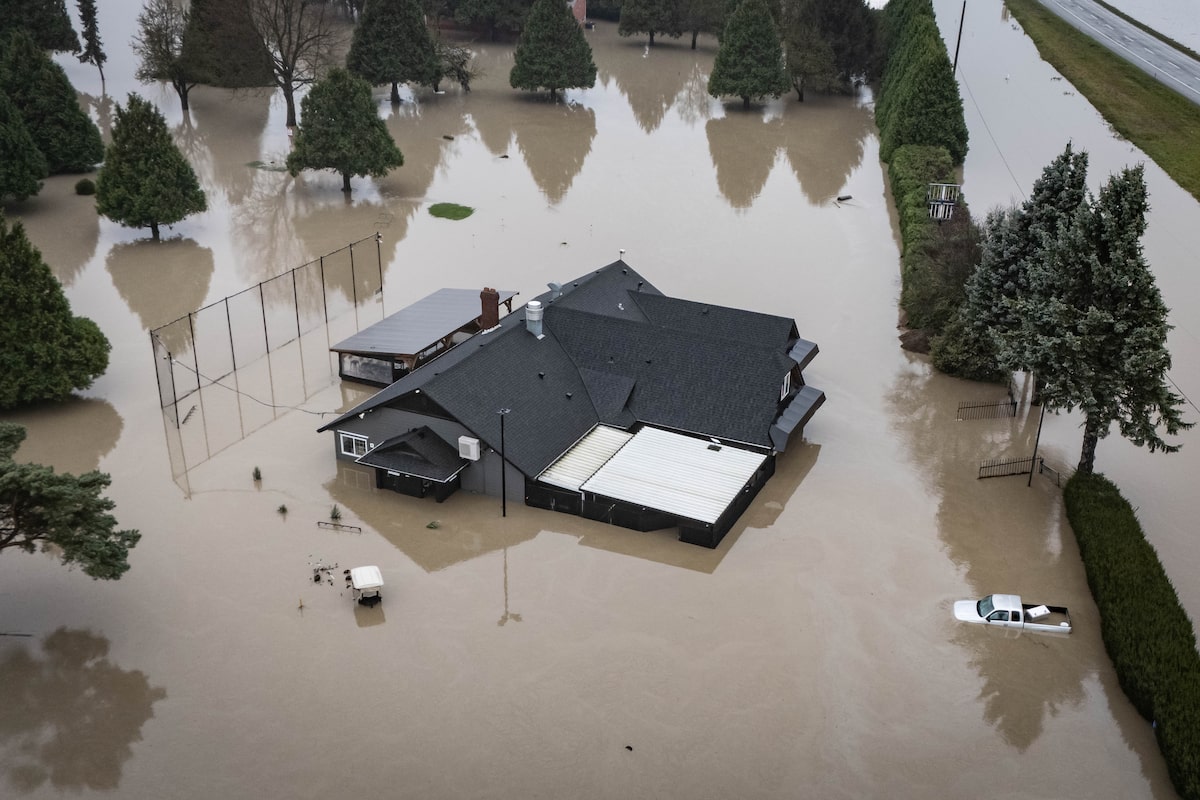
Floodwaters surround a house in Abbostford, B.C., on Friday, where 450 properties remain under evacuation order and another 1,700 are on evacuation alert.ETHAN CAIRNS/The Canadian Press
Flood waters began to recede from the Fraser Valley on Friday, leaving residents and farmers to assess damage and demand answers as to why more hasn’t been done to heed lessons from the devastating B.C. floods of four years ago.
Poultry farmer Corry Spitters said this year’s flooding rose to within an inch of one of his chicken barns.
“If that water entered the barn, it would have been game over,” he said.
Four years ago, he lost 200,000 chickens to the 2021 deluge. In the aftermath, federal and provincial ministers visited one of his farms and promised to improve the situation.
“And nothing has been done,” he said.
Abbotsford Mayor Ross Siemens shared similar frustrations. He lashed out at the federal government on Friday, saying since the 2021 flood, Abbotsford and neighbouring municipalities have identified an array of new infrastructure necessary to prevent a repeat scenario, but funding requests for those projects were largely ignored by higher levels of government.
“We don’t need empty promises from the federal government that they have our back,” he said. “I’m profoundly disappointed.”
As of Friday, the heavy rains of this week left 450 properties under evacuation order and another 1,700 on evacuation alert, with the majority in Abbotsford, according to B.C.’s Emergency Management Minister Kelly Greene.
More rain is in the forecast for the weekend.
Four years ago, the Nooksack River in Washington State overflowed its banks, sending a pulse of water across the border and into Abbotsford.
The 2021 flood caused more than $280-million in damage, killed hundreds of thousands of farm animals and cut off transportation links between Metro Vancouver and the rest of the country.
Earlier: Flooding displaces hundreds in B.C.’s Fraser Valley as some highways reopen
That scenario was repeated this week, albeit on a smaller scale, as water from the Nooksack flowed into the area Thursday and Friday.
Two chicken barns were inundated overnight, said B.C. Agriculture Minister Lana Popham, who declined to provide numbers of lost livestock.
Officials said there was at least one helicopter rescue, but no people were reported injured during the flood.
Casey Pruim, an Abbotsford dairy farmer and chair of BC Dairy, said his farm hasn’t been affected by the flooding, but buildings at nearby farms have been filled with water.
“It’s extremely disappointing, more than anything else, to see these families and these farms go through this four years ago … and then do nothing about it except give lip service,” said Mr. Pruim.
Outflows from the Nooksack River have been coursing into British Columbia’s Fraser Valley. It’s a familiar scene for many residents, four years after catastrophic floods that also stemmed from cross-border water flows that poured into the Sumas Prairie.
The Canadian Press
Spokespeople for Eleanor Olszewski, Canada’s Minister of Emergency Management and Community Resilience, did not respond to interview requests in time for publication.
In Victoria, B.C. Premier David Eby said flood-mitigation projects were undermined because Ottawa failed to deliver promised funding to help reduce risks in the Sumas Prairie, the region that encompasses Abbotsford.
“The challenge we’ve had with the federal government has been commitments that they made around the larger, multibillion dollar projects that are required in the Sumas Prairie to prevent this from ever happening again,” said Mr. Eby.
“We had very clear commitments from the previous prime minister that they would fund this, and of course, the money never showed up.”
He said his government’s investments in forecasting, implemented after 2021, provided more warning to prepare for this week’s floods.
B.C. Premier David Eby in Surrey, B.C., last month.ETHAN CAIRNS/The Canadian Press
But other municipal politicians said the province has also not followed through with commitments to improve flood-protection measures.
Delta Councillor Dylan Kruger, who was the chair of a Metro Vancouver flood task force, said the province has noticeably improved its communications about logistics and co-ordination since the 2021 floods.
However, he said, the provincial government has come up with zero money for the huge costs involved in improving flood-management infrastructure.
Delta needs $3-billion to cover its flood-infrastructure deficit, he said.
“We continue to get the same message. ‘There is no funding, we’re in an austerity time.’”
Mr. Eby said his government has not abandoned its commitment to flood protection work, but he said there are many other pressing demands on resources.
“We can’t do all the things all at once,” he said.
Meanwhile, homeowners who were promised a national flood insurance program more than three years ago are still waiting.
Months after the November, 2021, floods across B.C., the federal government promised to establish a country-wide insurance program for homes in high-risk flood areas. Bill Blair, then-minister for Emergency Preparedness, said he expected the program to be in place by the end of 2023. The promise has been renewed since, but the plan is still not in place.
Mr. Siemens, the Abbotsford mayor, implored the federal government to work on a treaty with the U.S. that would force Washington State to address northward flooding from the Nooksack.
He compared the circumstances to the Columbia River Treaty struck between the two countries in the 1960s, largely to prevent flooding throughout Washington State.
“This needs to be part of an international treaty with the U.S.,” he said. “We cannot continue to take this water.”