
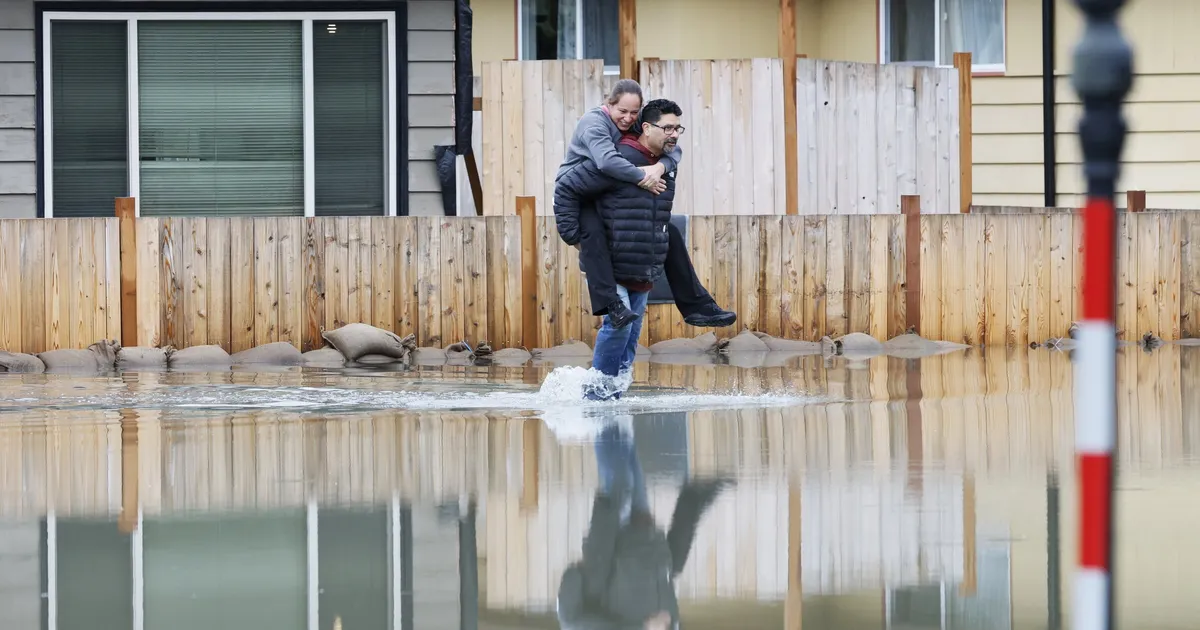
SKAGIT COUNTY — The sun set Thursday over the soggy and worried people of Western Washington while the fast-running Skagit River, full of sediment and debris, swelled.
More than 78,000 people throughout the flood plain, including the low-lying communities of Mount Vernon and Burlington, had been told to evacuate. Some left for high ground, calling on friends and family. Others struck out for a Red Cross shelter. Some took their chances and hunkered down.
Everybody went to sleep wondering whether their world would be the same when they awoke.
The most dire predictions showed that the river might rise higher than 40 feet, enough to run over the top of Mount Vernon’s floodwall and stress the area’s levees like never before, authorities warned.
But as daylight crept over the region Friday, the cities still stood. The raging river waters breached neither flood walls nor protective levees and, so far, no deaths have been reported. These communities let out a collective sigh of relief as the worst of these record-setting floods seemed to have passed, the waters now receding.
To be sure, these floods did wreak havoc across Western Washington. Emergency workers rushed to rescue people trapped in their trailer homes and vehicles. Homes and businesses are still flooded. Roads and highways are washed out, and many remain closed. Ski seasons are delayed, and Leavenworth even canceled its fabled annual Christmastown festival through the weekend.
But by all accounts, this flood could have been much worse. Local and state officials braced for catastrophe and death, urgently requesting help from the federal government to defray growing costs.
Preparing for the atmospheric river
Heading into this week, forecasters warned of a major storm system that would remain over the Pacific Northwest for days, dumping inches upon inches of rain.
Early signs of flooding arose across the region. Pooling water, stranded vehicles, even some trapped people. Meteorologists and climatologists wondered whether any of the precipitation would arrive as snowpack, a sore sight for a drought-parched state.
Quickly, however, attention turned to the rising levels of the Skagit and Snohomish rivers, among many of the region’s other waterways.
Crews in Mount Vernon began putting a series of metal slats along their downtown stretch abutting the Skagit. This floodwall guarded off the swollen river in 2021, and they’d rely on it once more.
But as the rain fell, concerns grew.
By the middle of the week, local and state officials prepared for as many as 100,000 people who might need to flee rising waters. Levees along the river are designed for floods so severe they can be expected every 25 years or so, but this one was projected to be much worse. Most expected a flood so strong, the likes of it would only be seen once a century.
A rising tide
Gov. Bob Ferguson headlined a news conference Thursday morning with other emergency managers and public officials. They warned of the danger ahead and asked people to stay away from the floodplains.
Early projections showed the river would likely crest around 40 feet in Mount Vernon, a level that would have sent water pouring over the top of the city’s flood walls. Engineers worried the levees might not hold. Already, they were seeping water in some places.
All the while, the human element remained a challenge. Many left town, but others stayed, some even walking along the tops of the very levees that might have failed.
Police and fire crews marched door to door, urging more residents to evacuate, offering all the information they could in English and Spanish. County officials said they anticipated nearly 4,000 people might have no place else to go. The Red Cross established several shelters.
Near Concrete upriver, the Skagit crested at just over 41 feet that morning. The pulse of water was expected to flow to Mount Vernon within 24 hours.
By the time the governor wrapped up the news conference, the muddy and debris-filled river lapped at the city’s flood walls. In some places, water gushed in from under the slats.
The river would reach its apex sometime in the night.
High-water mark
Around 1 a.m., the Skagit rose to a record 37.7 feet in Mount Vernon, just over the previous high-water mark of 37.4 feet, set in 1990, according to the U.S. Geological Survey.
While the flood did set a record, the waters fell shy of the worst-case scenario that emergency officials warned. Some seepage continued through the levees and flood walls, but both held fast. Mount Vernon spokesperson Candy Galindo confirmed that while some areas and roadways have been inundated, there had not been any major flooding in the city.
Precisely why the river’s crest fell shorter than expected is difficult to say so soon after the flood, said Steve King, a hydrologist in charge at the federal Northwest River Forecast Center. Forecasts are based on real-time models, which are constantly adjusted. They use historical data (beginning in 1981) and incorporate a variety of factors, including precipitation, temperature, snowmelt, soil saturation, reservoir and dam controls.
“At these historic levels, there’s a lot of uncertainty about how water is going to spread across the surface,” King said. “We’re only as good as our observed data sets. With these historic events, you’re flying in uncharted territory.”
The center in which King works forecasts around 400 different points around the region, manually tuning its models as conditions change constantly.
Even though the river didn’t rise as high as originally predicted, the danger was real.
‘There’s water inside!’
In Burlington, Monica Mendez, 40, woke up to a call from her 17-year-old son around 4 a.m. Friday saying, “Hey! There’s water inside!”
Her family and many others around her decided to stay despite evacuations. Most of the area’s homes avoided damage as of Friday morning, but some residents like Mendez, who lives alongside Gages Slough, which is connected to the Skagit River, weren’t as lucky.
When water started pouring into the basement of her home, Mendez and her family sprang into action. She and her son tried sealing the doors with towels and whatever they could find but quickly realized the water was coming in too hard and fast to stop. They grabbed his electronics from his basement room and ran upstairs while her husband moved the family’s car and motorcycle out of the garage and onto the street.
“It was so hard because it was so dark still in the morning, so you cannot see the level of the water,” Mendez said.
Within two hours, the water went from their ankles to chest-high, and around 6 a.m., the water was still rising, Mendez said. Some of her neighbors evacuated, but Mendez and her husband decided to stay. Her dad came over with sandbags to prevent the water from getting into higher levels of the house. Around 10 a.m., it seemed the worst of the flooding was over, and Mendez said it seemed like it was time to eat some breakfast.
“We’re really blessed because we didn’t lose any lives,” Mendez said.
Returning home
The Skagit remained high Friday evening. And more rain is likely in the days ahead.
A second but less severe atmospheric river is expected to arrive late Sunday into Monday. The fresh round of widespread moderate to heavy rainfall will likely cause Washington rivers to rise again, according to the National Weather Service.
Emergency managers have warned those who evacuated to stay away until they sound the all-clear.
For the 10,000 people in Burlington, the evacuation order was partially rescinded Friday morning.
Andy Wheeler returned to his home Friday afternoon to pick up some food from his freezer. He stepped out onto his flooded driveway in sneakers, socks and shorts, the water coming up above his ankles. Water inside the house was 3-4 inches deep, he said, but he and his wife had picked up most of their belongings off the floor.
His main concern was whether the Koi fish in their backyard pond were still there. They still don’t know whether the fish survived.
Wheeler and his wife have called Burlington home for 20 years. These floods are the cost of living near a Western Washington river.
“If I never wanted to get flooded, I’d live in Arizona or something,” Wheeler said. “But I don’t want to live there. I like to live here.”
Greg Kim: 206-464-2532 or grkim@seattletimes.com: Greg Kim is a Project Homeless reporter at The Seattle Times who writes about homelessness and the systems that intersect with it, especially housing.Conrad Swanson: 206-464-3805 or cswanson@seattletimes.com: Conrad Swanson is a climate reporter at The Seattle Times whose work focuses on climate change and its intersections with environmental and political issues.
Brendan Kiley: 206-464-2507: Brendan Kiley is a reporter at The Seattle Times, primarily for its Pacific NW magazine.