
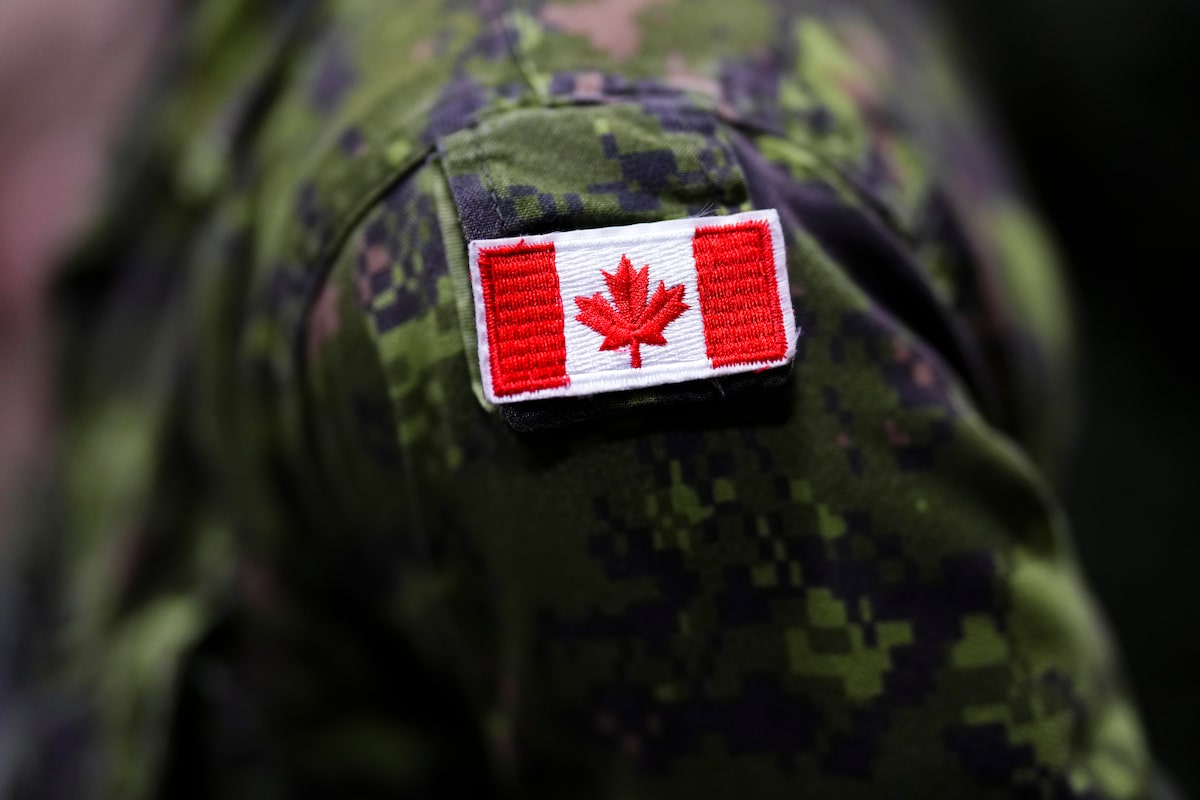
The RCMP arrested and charged four men in connection with an alleged terrorist plot in Quebec, two of whom were active members of the Canadian Forces.Sean Kilpatrick/The Canadian Press
The commander of the Canadian army, Lieutenant-General Michael Wright, says extremism is a problem and hurts the Forces’ credibility, but that he doesn’t know how deep it might run in his organization after two soldiers were recently charged in connection with an alleged terrorist plot.
Early in July, four men, two of them Canadian Armed Forces members, were arrested in connection with alleged terrorist activity that included creating a militia and forcibly taking over a plot of land north of Quebec City. Three of the accused, including a soldier, were charged with one count of facilitating terrorism while a second soldier faces weapons charges.
Lt.-Gen. Wright said such incidents are “eroding our cohesion and eroding our credibility.” Comparing extremists to insects, he said that “regardless of the number of events, we need to take whatever action we can to make sure they never get into the house.”
Extremism not a problem unique to Canadian military, McGuinty says
In an interview Wednesday, Lt.-Gen. Wright said he’s endeavouring to map out the extent of the problem and recently told his division commanders that he expects any soldier who knows of extremist behaviour to step forward and report it.
He said it’s difficult to identify people with extreme views “until they, in some way, shape or form, make themselves visible to us” in the Forces.
“Given the fact that we just had two serving soldiers arrested for extremism, extremism is a problem. The scope of that problem is something that for me to say any more would be speculation,” the commander said.
“It is somewhat troubling to me that we don’t know how deep the problem may run across the Canadian army, across the Canadian Armed Forces, or across Canadian society,” Lt.-Gen. Wright said.
The commander said incidents such as the one in Quebec also jeopardize the military’s ability to attract recruits as large historical investments are being funnelled into defence spending in Canada.
Prime Minister Mark Carney in June pledged to boost defence spending to 3.5 per cent of gross domestic product by 2035, an increase of upward of $50-billion in additional annual funds by 2035. Another 1.5 per cent has been pledged for defence-related infrastructure.
“We need to attract and retain top talent to deliver on our modernization effort and extremism threatens that work because it corrodes trust: between teammates, with the public and our allies,” Lt.-Gen. Wright said.
“Without that trust, we can’t recruit and retain that top talent, retain operational credibility, or earn the societal support needed for the generational investments in defence we are asking the Canadian population to get behind.”
The RCMP has not made public whether any of the people who were training with the accused men were also affiliated with the Canadian Armed Forces.
The army commander said there is a spectrum of “hateful conduct” that the Forces have clearly prohibited, which ranges from extremist conduct such as alleged terrorist activity to incidents such as the “Blue Hackle Mafia,” where an Ottawa-based army reserve unit allegedly posted hateful comments on a now-shuttered Facebook group.
Lt.-Gen. Wright said military police have now taken over the investigation into the group.
Extremism, though, he said, will be more challenging to investigate. He said the Canadian army will have to work with the rest of the Forces and the Department of National Defence and the national-security community in Ottawa.
“This is one where we need to do something about it,” he said, “and I need to talk to the experts, both within the army, but specifically in other elements of the Canadian Armed Forces, in the Department of National Defence to find out, what are our options to define the scope of the problem and do what we can to eradicate it.”
The army commander said he finds extremism disgusting and that Canadians soldiers who are prepared to fight for the country should also be courageous enough to report signs of extremism around them.
“I can’t even come up with a strong enough word for extremists in the Canadian army,” he said.
“It shouldn’t only be me who’s irate. It should be every single member of the Canadian army,” the commander said, adding later: “If I’m expecting soldiers to have the courage to go into combat, I’m expecting them to have the moral courage to call out inappropriate behaviour.”
Lt.-Gen. Wright pointed out a measure last year that the Forces took to help with screening of new recruits. A new Military Personnel Instruction in late December, 2024, created a probationary period for new recruits.
It would allow training commanders to release individuals who display hateful or discriminatory behaviour before they reach what the military calls the “occupational functional point” when they are deemed ready for their first employment in that role.
“If we find out that you are exhibiting behaviour that runs contrary to the values and ethics of the Canadian Armed Forces, you can be released. This is not one where one has to go up to Ottawa and ask for permission to release.”
Lt.-Gen. Wright has served as commander of the Canadian army since July, 2024.