
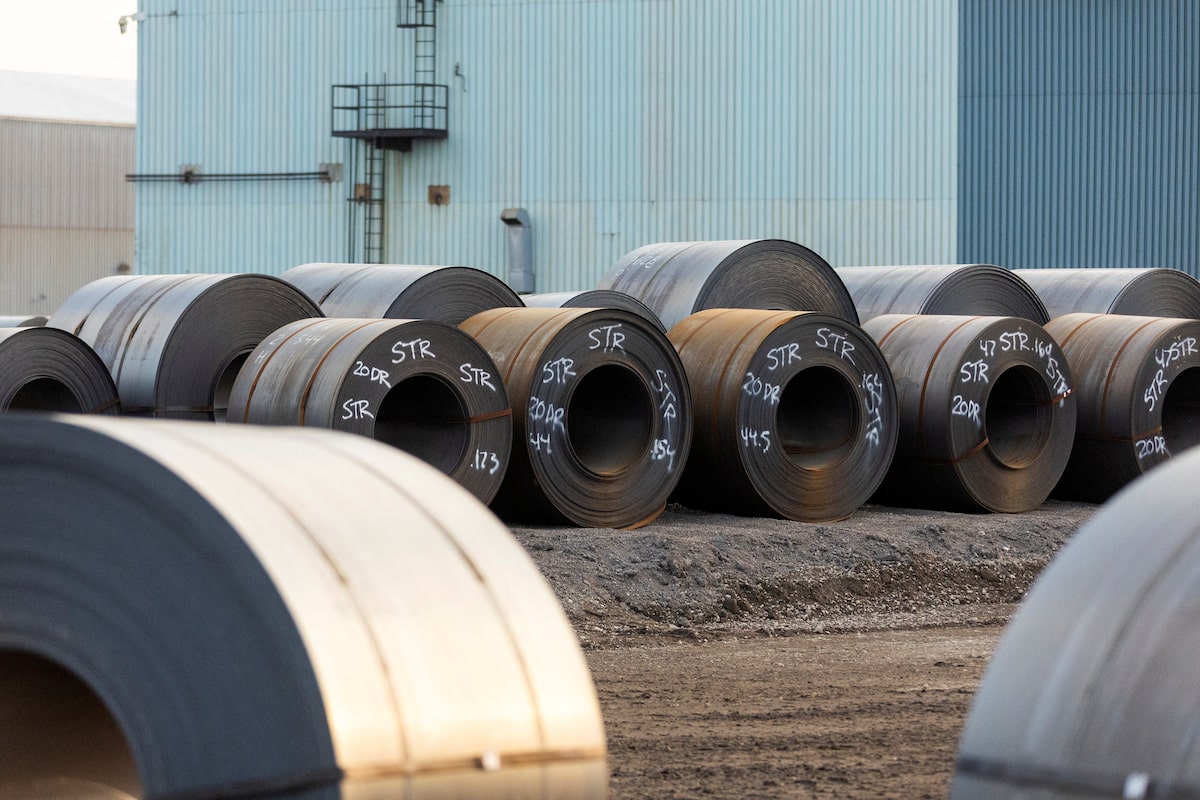
Ottawa’s latest measures are a godsend for beleaguered Canadian steel producers such as Algoma Steel Group Inc, ArcelorMittal Dofasco and Stelco.Nick Iwanyshyn/Reuters
With Canadian steel exports to the United States in free fall, Ottawa has taken a series of escalating steps to shore up demand for the country’s steel mills by restricting imports of foreign-made metal.
These protectionist measures, which will be further tightened in the coming weeks, have been lauded by Canadian steel producers, who have seen their business models upended by U.S. President Donald Trump’s 50-per-cent steel tariff.
But the measures are also drawing criticism from steel users, particularly in Western Canada, who warn of shortages and rising costs for construction materials and manufacturing inputs if they’re forced to buy from Eastern mills rather than bringing in product by ship at world prices.
In effect, the federal government is responding to U.S. protectionism with its own turn inward, forcing a marriage between different regional steel markets that have mostly operated independently for decades.
This is changing the Canadian market in real time, and it is surfacing long-standing grievances between steel producers and steel buyers in different regions – some that benefit from protection, and others that lose out.
Earlier: U.S. and Canada discussed tariff-rate quota for steel before trade talks halted
Ottawa’s hope is that by restricting imports and subsidizing transportation costs, the glut of metal in Eastern Canada will be able to find a home in Alberta and British Columbia – creating, over time, a new domestic equilibrium for a highly disrupted market.
But this could be a rocky adjustment.
“We have over 300 active projects. I can’t take the East Coast mills’ comments in the paper that they are ready and willing to supply Western Canada,” said Ron McNeil, chief executive officer of LMS Reinforcing Steel Group, one of B.C.’s largest rebar suppliers, which imports most of its raw steel.
“I can’t put our projects at risk. I can’t put our employees at risk. They have never proven that they can do this.”
The issue has come into sharper focus in recent weeks after Prime Minister Mark Carney announced plans to further restrict steel imports.
In the summer, Ottawa implemented a tariff-rate-quota, or TRQ, system for steel coming in from countries other than the U.S. This sets an import quota above which steel shipments face a 50-per-cent tariff, with the goal of capping import volumes.
The quota was initially set at 50 per cent of 2024 import levels for countries that don’t have a free-trade agreement with Canada – such as China, Turkey and Brazil – and 100 per cent of 2024 levels for countries that do have an FTA, such as South Korea, Vietnam and Germany.
Starting on Dec. 26, these quotas will be tightened to 20 per cent of 2024 levels for non-FTA countries and 75 per cent for FTA countries.
All told, the TRQs are intended to block out around 2.3 million tonnes of “offshore” steel, across a range of products, from hot-rolled steel, to metal pipes, to various forms of structural steel.
Ottawa is also adding a 25-per-cent tariff to a number of steel derivative products, and it is ending the remission system that allowed importers to avoid Canada’s 25-per-cent countertariff on U.S. steel if the metal was used as an input in Canadian manufacturing.
“I think that there is a short-term market adjustment,” Finance Minister François-Philippe Champagne said in an interview. “But I think over the long term Canada produces about 13 million tonnes of steel and consumes about 13 million tonnes of steel. So, I think that when it comes to a Buy Canadian policy, I think that we need to be favouring our Canadian steel industry.”
Opinion: What our forebears built, tariffs will break. We must defend our century of prosperity
For Canada’s beleaguered steel producers – including Algoma Steel Group Inc. ASTL-T in Sault Ste Marie, Ont., and ArcelorMittal Dofasco MT-N and Stelco STLC-T in Hamilton – these latest measures are a godsend.
Typically, around half the metal coming out of Canadian mills has gone south across the border into manufacturing and construction in the eastern and central United States. Mr. Trump’s tariff has fractured these supply chains.
Canadian steel exports to the U.S. are down around 30 per cent by volume compared to last year. And with so much excess capacity, the price of steel in Canada has plummeted. Algoma executives said on an October earnings call that their Canadian sales prices were down 40 per cent.
“Anybody who thinks that there is a shortage of supply is not paying attention,” said Catherine Cobden, president and CEO of the Canadian Steel Producers Association.
For Ms. Cobden and her members, Ottawa’s TRQs have opened up the potential to sell into Western Canada, which has typically been served by imports from Asia and the Pacific Northwest of the U.S., along with one mill in Alberta.
Scott Meaney, vice-president of sales and marketing at Gerdau North America, which operates two mills in Ontario and one in Selkirk, Man., said he’s been doing a lot more outreach in Western Canada, and that Gerdau’s Manitoba mill is ramping up rebar production to try to meet demand coming from B.C.
Push under way to get more Canadian steel into Centre Block overhaul
“When we were shipping out of the Manitoba mill a lot into Minnesota, we would do that and not turn our attention to supply into British Columbia,” Mr. Meaney said. “But today we can’t. And so we very much want to supply into British Columbia, into Alberta and Saskatchewan.”
On the other side of the equation, however, the decision to restrict imports and wedge open a national market for Canadian mills has not gone down well in B.C.
“It appears it’s a policy made in Ontario, for Ontario. And B.C. and Alberta are left picking up the tab,” Ravi Kahlon, B.C.’s Minister of Jobs and Economic Growth, said in an interview.
Mr. Kahlon said he met with Canadian steel producers in recent weeks, and wants to see more of their metal used in B.C.
But he said he is concerned that tightening TRQs before logistical and supply issues can be sorted out will simply drive up costs for B.C. builders and manufacturers and lead to shortages and project delays – particularly at a moment when the province is ramping up work on a number of major infrastructure projects.
“Our message to the steel producers was: Are you here to stay? Or are you here for a short time? And if we’re going to change our entire supply chain, we need to know that this is something that is going to be fulfilled into the future,” Mr. Kahlon said.
Part of the problem is transportation costs. According to several importers, it costs around $50 a tonne to bring steel across the Pacific and in through the Port of Vancouver. That’s compared to $150 to $200 a tonne to bring steel from Ontario to Vancouver by rail.
Ottawa now plans to subsidize the cost of shipping steel and lumber by rail, starting in the spring. This will involve the federal government paying Canadian National Railway Co. and Canadian Pacific Kansas City Ltd. directly, with the goal of cutting interprovincial freight rates by 50 per cent. Transport Canada has set aside $146-million for the program, but the costs could fluctuate depending on shipping volumes.
There is more than just transportation logistics at play, said Mr. McNeil of LMS.
“We enter fixed-price contracts that could go in excess of two years. Domestic mills generally work on 30-day pricing. It would be impossible to sign a fixed-price contract against a 30-day material cost. Offshore gives us the ability to buy much larger quantities and negotiate material that won’t show up in Western Canada for three or four months,” he said.
There’s also the thorny issue of price itself. Imported steel, particularly from Asia, is often several hundred dollars a tonne cheaper than steel produced in North America.
This is tied to excess capacity in the world steel market. China, whose heavily subsidized industry accounts for nearly half of global steel production, has seen its steel exports more than double since 2020, according to the Organization for Economic Co-operation and Development. India and countries in Southeast Asia are also rapidly building out steel production capacity.
Manufacturing meltdown: How Trump’s tariffs are squeezing Canadian factories
By 2027, global steel capacity will exceed demand by around 721 million tonnes, the OECD estimates.
For Canadian producers, this bulge of offshore steel is seen as an existential threat. They are quick to use Ottawa’s anti-dumping trade remedy system, and quick to criticize companies that source their metal from outside North America.
“They’re addicted to crack,” said Barry Zekelman, the CEO of Zekelman Industries, referring to cheap steel imports. His company has one steel tube production facility in Ontario and more than a dozen in the U.S.
“The reason we’re not interested in the B.C. market is because it’s all import… I want to supply them. But I can’t when I’m competing against tube from Taiwan or India or China,” said Mr. Zekelman, who is an outspoken advocate of Buy Canadian policies as well as being a vocal supporter of Mr. Trump. “And I can’t ship to B.C. when a railroad is a three-week lead time.”
Jim Ritchie, CEO of Vancouver-based Cascadia Metals Ltd., which imports flat rolled steel, shoots back at the idea that importers are doing anything wrong.
“They say foreign steel is illegal. It’s not illegal,” said Mr. Ritchie. “There’s a world market price for everything. It’s just that Canada is not competitive.”
One thing Mr. Zekelman and Mr. Ritchie agree on is that a quota system, such as the one imposed by Ottawa, is not a particularly good solution, as it distorts market pricing and sows chaos among importers.
The quota is allocated on a first-come, first-served basis every quarter. Mr. Ritchie said he’s seen steel traders from around the world trying to elbow their way into the B.C. market by claiming, falsely, that they can guarantee getting inside the quota.
Globe editorial: Ottawa must steel itself against tariffs
“If Carney would just come out and say, ‘Okay, we’re just putting 50-per-cent duty on everyone,’ well then we could pass that on to customers and we could blame the government. But instead, he just keeps salami slicing the quota so that it turns into a knife fight,” Mr. Ritchie said.
The TRQs do not apply to every steel product – only those which the government believes are made in Canada, based on consultation with the steel industry. Most I-beams used in construction, for example, aren’t subject to a quota because they aren’t produced domestically.
Still, Department of Finance officials said in a background briefing that they’ve received dozens of requests since the summer for items to be removed from the TRQ list by companies that say they can’t find a domestic source. The officials said they are compiling a list, but the final decision to add or remove products from the TRQs will be up to the Finance Minister.
Lurking in the background to all of this is Mr. Trump. A number of observers see Ottawa’s moves on steel as an attempt to align with the White House in the hope of getting relief from U.S. steel tariffs. The Trump administration has long argued that cheap Asian steel is being shipped into the U.S. through Canada and Mexico.
Before trade talks were called off in October, Washington and Ottawa were discussing the possibility of a TRQ system, in which Canadian steel shipments to the U.S. would face a 10-per-cent to 15-per-cent tariff inside a quota based on historical volumes, and a higher tariff above the quota. This would be instead of the flat 50-per-cent tariff currently in place.
That would be a relief for Canadian steel producers, who could resume supplying their traditional U.S. markets, albeit at a slight disadvantage. For them, a Fortress North America approach, which keeps out offshore steel while enabling north-south trade, is the way forward.
But steel buyers in Western Canada remain wary of getting left out in the cold.
“Western Canada is the sacrificial lamb for [Mr. Carney] to get that deal done,” said Mr. Ritchie. “He is not going to take his foot off the strict quotas because he needs to keep them on to keep Trump happy, which will starve Western Canada of competitive steel.”
With a report from Bill Curry