
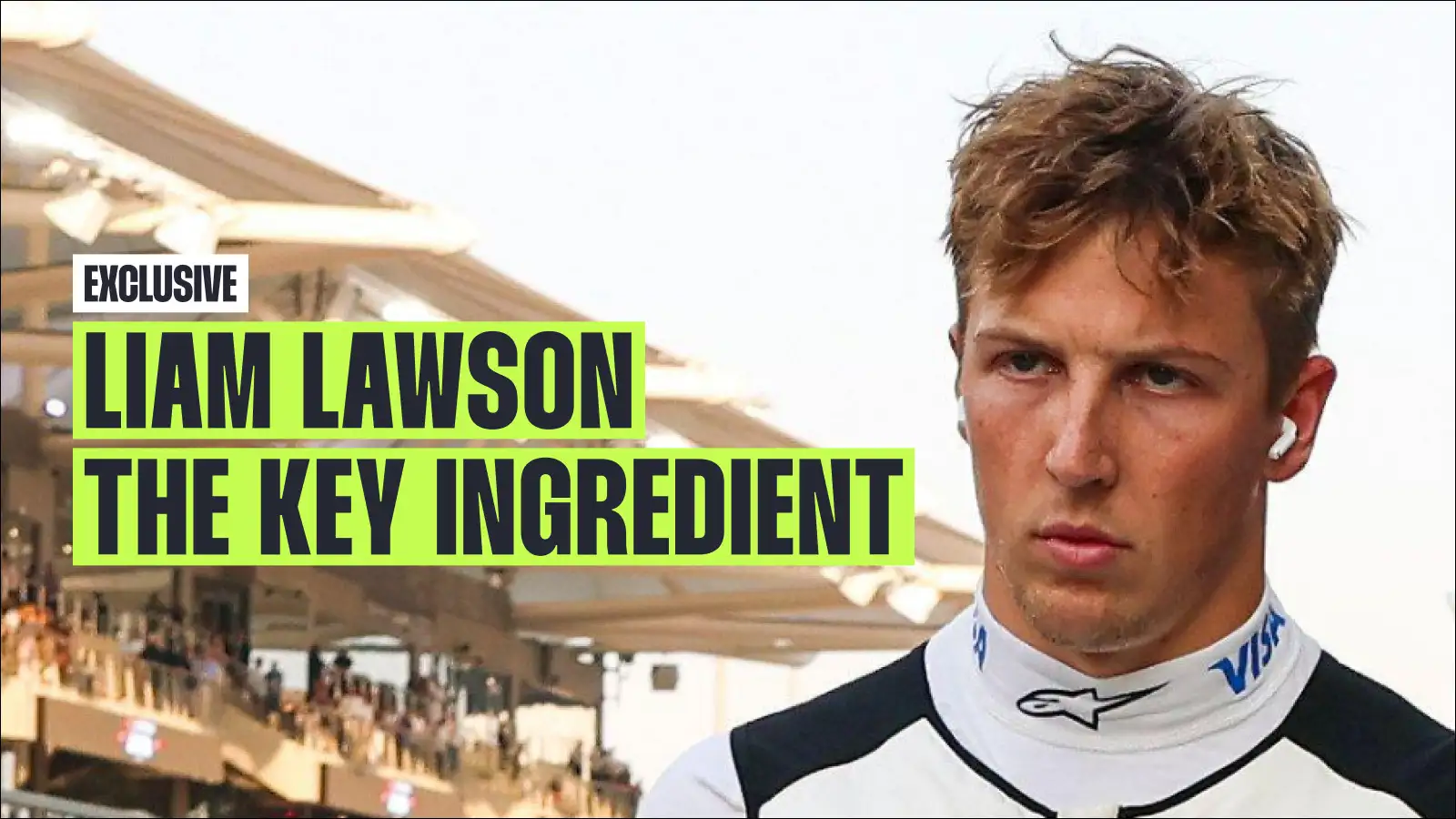
Success in Formula 1 requires talent, determination, the right people, a healthy helping of luck, and, arguably above all, consistency.
And that’s something Liam Lawson never had. At least, not until now.
Why F1 2026 offers Liam Lawson his greatest chance yet
The young New Zealander burst onto the F1 scene having almost been forgotten in 2023. In doing so, he became just the 10th Kiwi to compete in the world championship. More have walked on the moon than reached F1 from New Zealand.
But it’s often said, reaching F1 is the easy part; staying there is another challenge altogether. And that’s because it requires those ingredients to all come together, with long-term success typically built on a foundation underpinned by consistency and stability.
McLaren’s charge to the sport’s uppermost echelons was built on a solid and consistent foundation. A decade ago, so too was Mercedes. And a decade before that, Ferrari drove home the same message.
But at the end of Lawson’s first full season of F1, that foundation hasn’t been there. That consistency, that stability. He was thrust into the thick of it with no warning and expected to perform when Daniel Ricciardo was injured at the Dutch Grand Prix.
Given his chance, the feisty young Kiwi took it, with both hands. While it didn’t last, it placed him firmly in the conversation a year later – the less generous might even suggest Lawson’s 2023 efforts ended Ricciardo’s career.
Watch our drifting finale with V14
Such was the excitement Lawson generated within the halls of Milton Keynes. Aggressive, loyal, and patient. He is a product of the Red Bull driver programme who has served his time and been through the school of hard knocks. What has come out the other side is a combative, determined driver, an unrelenting presence on track.
It’s the sort of punchy approach that, historically, has caught the eye of those among the Red Bull hierarchy. And so it’s perhaps no surprise that when the senior squad was in the market for a driver to replace Sergio Perez at the end of F1 2024, it turned to its latest protégé.
His determination had been rewarded by the right people, and a little luck coupled with his immense driving talent thrust him into arguably the most difficult seat in Formula 1. But there was a key ingredient missing: consistency.
Ultimately, the move to promote Lawson proved too much too soon. In a difficult car against the best driver of his generation, he struggled. For his own good, he was relegated after just two races of the F1 2026 season. It was brutal move but on that, in hindsight, likely saved his career.
Over the races that followed, Lawson came to terms with the situation, even if he never really came to accept or agree with it. He hadn’t quite been broken, but he also wasn’t the same driver he’d been at the end of 2024. He was in a fragile place, and a return to Racing Bulls, a team for which he’d driven 11 races across two seasons prior to his Red Bull call up. It afforded him an opportunity to regroup and rebuild.
And eventually, it all clicked again.
Together with his engineer, Lawson made a discovery over the Monaco Grand Prix which, when fully implemented at the Austrian GP a few rounds later, reinvigorated Lawson’s season. He finished sixth that weekend, his best performance of the season and only his second points-paying result.
But it was a weekend vastly more important than the eight world championship points it attracted. It showed that Lawson belonged, that he hadn’t been defeated. His lowest point was behind him.
From there, it became easier. Points became more frequent and his Racing Bulls teammate Isack Hadjar, who’d had the measure of him to that point, had a far tougher task in besting his colleague.
From Japan to Canada, in the first six races that Hadjar and Lawson were paired, the Frenchman bested him on every occasion. From Austria, Lawson had his number. At year end, the head-to-head score was 14-7 in Hadjar’s favour. Put another way, in the final 13 races of the year, Lawson finished ahead more often than not (seven to six).
In a sport as cut-throat as Formula 1, and a programme as historically brutal as Red Bull’s has been, Lawson did enough to justify another season. He’d not only saved his career but set himself up with a critical ingredient for future success: consistency. For the first time in his comparatively brief F1 career, Lawson will head into the coming season not only with certainty, but familiarity.
“Not that you ever really have security in this sport, but it’s a step in that direction,” Lawson told PlanetF1.com in a candid and revealing interview.
“It’s been a very intense year with a lot of changes and things that weren’t expected. To go through it and now be given the opportunity to have another year? It’s taking everything I’ve learned from this year and beyond, being able to apply it next year, is going to be something I’m looking forward to.”
There had been question marks over Lawson’s future.\
When Arvid Lindblad received an FIA Super Licence dispensation earlier in the season, it was clear Red Bull saw the young English-Swede as the future. And with Hadjar performing so well out of the gates in his rookie year, it always seemed certain that he would be promoted to the senior team in place of Yuki Tsunoda.
And that left an apparent head-to-head battle for the remaining Racing Bulls drive. Would it be Lawson, or Tsunoda? For a time, it looked as though it would be the latter, with suggestions Honda was willing to come to the table to facilitate a deal. But ultimately, as had happened a year earlier, Lawson’s potential won out. But it was close. Closer than Lawson would have liked.
“It’s obviously a bit of a relief,” Lawson confessed of his 2026 confirmation. “Being secure for next year, the first part of the year, it’s what we’re thinking about a lot and what we’re trying to work towards.
“But at the same time, honestly, I’m just very, very excited to know that I have the pre-season, or the off-season, to be able to work with the team and prepare.
“It’s gonna be different,” he added. It’s just a great opportunity to be able to have another year, and I think it’s more exciting than anything at this stage.”
And so, almost three years after his F1 debut, having almost been cast aside midway through 2023, Liam Lawson has acquired another of the key prerequisites for success in 2026.
His talent earned him a place in the Red Bull driver programme; he had a healthy helping of luck to make it on to the grid; his energy and determination saw him grasp that opportunity when it finally arrived. And now, finally, he has consistency; a stable foundation on which to build his future with certainty, or at least as much as is ever available in F1.
Read next: Why accepting Max Verstappen superiority is key to Isack Hadjar success at Red Bull