
“There is no greater honor than seeing self-proclaimed superpowers kneel before an Iranian drone and copy it,” Abolfazl Shekarchi said.
The senior spokesman for Iran’s armed forces was referring to an announcement last week from the Pentagon that it would field a new fleet of one-way attack drones in the Middle East modeled on a captured Iranian Shahed.
Tehran’s reaction followed an announcement by US Central Command that it would deploy to the region the new drone squadron using LUCAS platforms—low-cost systems developed after US companies dismantled and reverse-engineered a damaged Shahed drone obtained years earlier.
CENTCOM said the drones can operate autonomously, launch from multiple platforms and are intended to beef up its supply of cheap lethal unmanned aerial vehicles which are widely viewed as the future of warfare.
Iran submitted the Shahed’s design to Russia for use in its full-scale invasion of Ukraine, which under the name Geran-2 has been mass-produced to wreak havoc on cities and battlefields there.
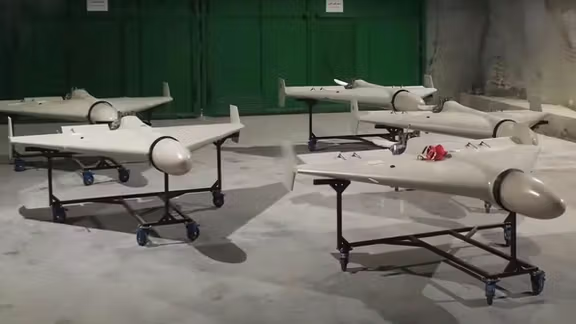 File photo of Iranian Shahed drones.
US defense officials told CNN and other outlets that the drone deployment marks an effort to “flip the script” after years in which Iran and its armed allies used cheap drones to strike US positions, including the 2024 attack in Jordan blamed on Iraqi militias that killed three American soldiers.
Washington’s belated push into mass-manufactured, expendable drones comes as low-cost platforms increasingly dominate conflicts from Ukraine to the Red Sea.
US officials have not disclosed the number of LUCAS drones now in the region, saying only that “many” are already deployed and more are coming.
At roughly $35,000 apiece, they remain far more expensive than models produced in Iran, China or Russia, raising questions among analysts about whether the Pentagon can scale fast enough or cheaply enough to match its adversaries’ output.
‘Thorn in the throat’
Iran’s military spokesman said the US and Israel’s recent threats against Tehran were “delusional,” insisting that the brief war in June had shown how such threats collapse “in the real field of battle.”
Shekarchi said Iran’s forces—particularly the Revolutionary Guard’s Aerospace Force—remain “a thorn in the throat of the hegemonic system.”
Defense analysts say the Shahed’s simple design and low unit cost compared with hundreds of thousands for Western equivalents have driven global efforts to produce cheaper unmanned systems.
Western governments have imposed multiple rounds of sanctions on Iranian drone manufacturers and procurement networks, accusing Tehran of supplying drones to Russia and regional armed groups.
Iran has denied direct involvement in combat operations abroad, saying its technology serves defensive purposes.