
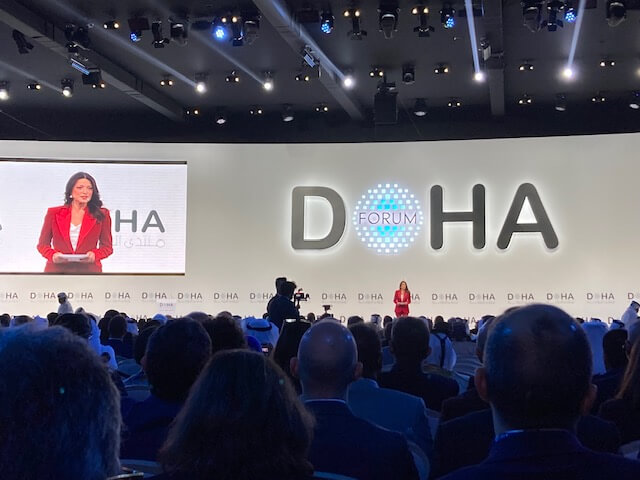
Justice in Action: Reflections on Doha Forum 2025
By Richard Ponzio
Director, Global Governance, Justice & Security Program
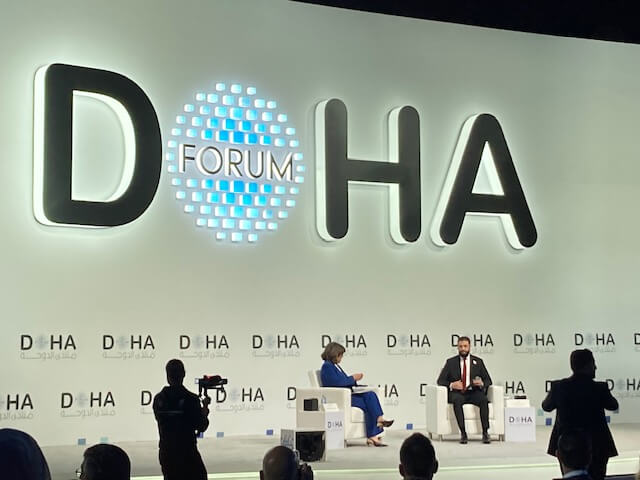
In reflecting on the Doha Forum 2025 on the theme “Justice in Action: Beyond Promises to Progress” two-days after the forum, on Human Rights Day 2025 (December 10), two powerful concepts – justice and rights – and their interconnectedness come immediately to mind as permeating many formal sessions and sidebar conversations at this year’s convening. In the Future of International Cooperation Report 2025, an intellectual collaboration between the Stimson Center, the Global Institute for Strategic Research, and Doha Forum to inform this year’s forum, our broad conception of justice combines procedural and retributive justice (formal judicial institutions and processes) with both distributive justice (how society allocates and manages its resources) and the informal dispute settlement and justice mechanisms found in most traditional societies.
From the opening session until Sheikha Moza bint Nasser’s (Chairperson, Qatar Foundation and Education Above All Foundation) closing ceremony reflections, many of the Doha Forum’s plenaries and expert roundtables engaging more than 450 speakers, alongside 6,500 participants from 170 countries, spoke to the need to overcome immediate crises and longstanding gaps pertaining to the political-judicial, socioeconomic, and environmental dimensions of justice, in diverse subject areas ranging from peace and security in Gaza, Syria, Sudan, and Ukraine, to stabilizing the climate, and fighting extreme poverty. This year’s Doha Forum exemplified how diverse cultures and traditions continue to hold justice dear.
At the same time, in introducing new governance approaches through UN Human Rights Council, Security Council, and regional human rights courts reforms (among a dozen other practical yet creative global and regional institutional and related innovations), our new report explored the varied interplay between justice and human rights, defined as universal, inalienable, and indivisible rights by virtue of being human. Enshrined in the Universal Declaration of Human Rights and International Human Rights Covenants, they include the rights to life, liberty, equality, education, and health. Human rights as commonly conceived and legally protected in the modern world depend largely on a society’s broad-based commitment to an expansive and dynamic understanding of justice.
The mutually reinforcing connections between justice and rights, and our report’s accompanying proposals for change and progress through enhanced global and regional collective action, were the chief focus of two Stimson and Global Institute for Strategic Research co-sponsored dialogues at this year’s Doha Forum (see elaboration below). A new Greater Middle East and North Africa research network is anticipated to follow from these conversations, to further consider the issues and institutions at the intersection of global and regional governance. This may include a possible focus on deepening the promotion and safeguarding of all rights (including economic, social, cultural, political, and civil rights) across the region, as well as robust monitoring to advance follow-through, within the Greater MENA context, to the September 2024 Summit of the Future in New York and November 2025 World Social Summit in Doha.
MENA Perspectives on Governance
By Rebecca Snyder
Research Associate, Global Governance, Justice & Security Program
The Doha Forum presented an opportunity to engage with actors across sectors and ideologies on the topic of justice. Aid cuts, increasing military expenditure, declining trust in multilateralism, and the role of negotiation were overarching themes in many sessions.
On Sunday, December 7, Stimson’s Global Governance, Justice, and Security program convened an extraordinary roundtable of experts on the theme of our Future of International Cooperation Report 2025, produced with the Doha Forum: “Justice in Action: Global & Regional Governance Strategies.” Looking across political-judicial, socioeconomic, and environmental justice, the discussion emphasized that the roots of injustice and inequality are deeply historical, requiring responses that reach both beyond multilateral frameworks and within them. While international law and justice-oriented systems exist, weak enforcement and double standards continue to undermine institutional credibility and justice. Gaza remains a critical litmus test for the moral authority of the international system and its ability to uphold and implement the rulings of the ICC and ICJ. Participants highlighted how the Global South champions the international rule of law and value of multilateralism, demonstrating that justice is achievable without the backing of great powers. Justice remains a global, moral, and legal responsibility demanding urgent action.
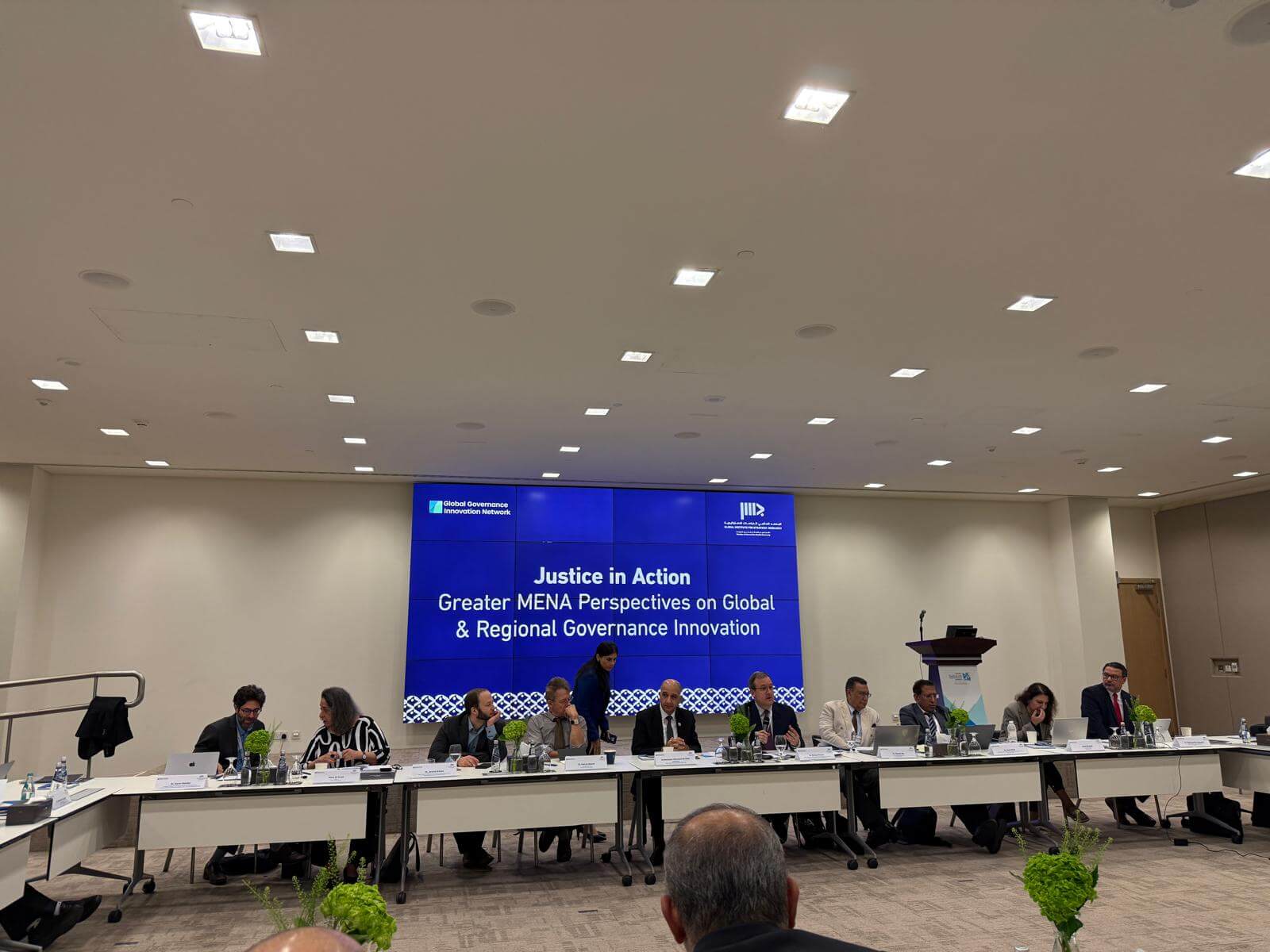
On Monday, December 8, the Global Governance Innovation Network in partnership with the Global Institute for Strategic Research at Hamad Bin Khalifa University convened a half-day Global Policy Dialogue on “Justice in Action: Greater MENA Perspectives on Global & Regional Governance Innovation.” The overarching goal was the creation of a Greater MENA network of researchers to engage on topics related to global governance, justice, and regional integration. Participants highlighted that justice in the region requires engagement with both State and non-State actors, robust documentation of crimes, and enforcement of decisions made by the ICC, ICJ, and other bodies of international law. While the League of Arab States has a human rights convention and military pact, both are underutilized and forgotten, emphasizing the need for a regional human rights court.
On the topic of establishing a Greater MENA research network, participants emphasized that the research agenda should focus on peace and justice, regional integration, new technologies (AI, social media, misinformation), and mapping atrocities. It was emphasized that bridging the gap between researchers and politicians and policy makers was vital, since many officials do not interact with think tanks and researchers often in an advisory capacity. It was also found that there is a gap in research highlighting cultural aspects linked to social justice, best practices of justice across the Global South and the region, and the leadership and history of human rights in the MENA region. Overall, it was concluded that the research network would convene an annual dialogue, quarterly online calls, produce an annual report of the work done in the year, and produce journal articles.
A Window into Geopolitics in Doha
By Julian Mueller-Kaler
Director, Strategic Foresight Hub
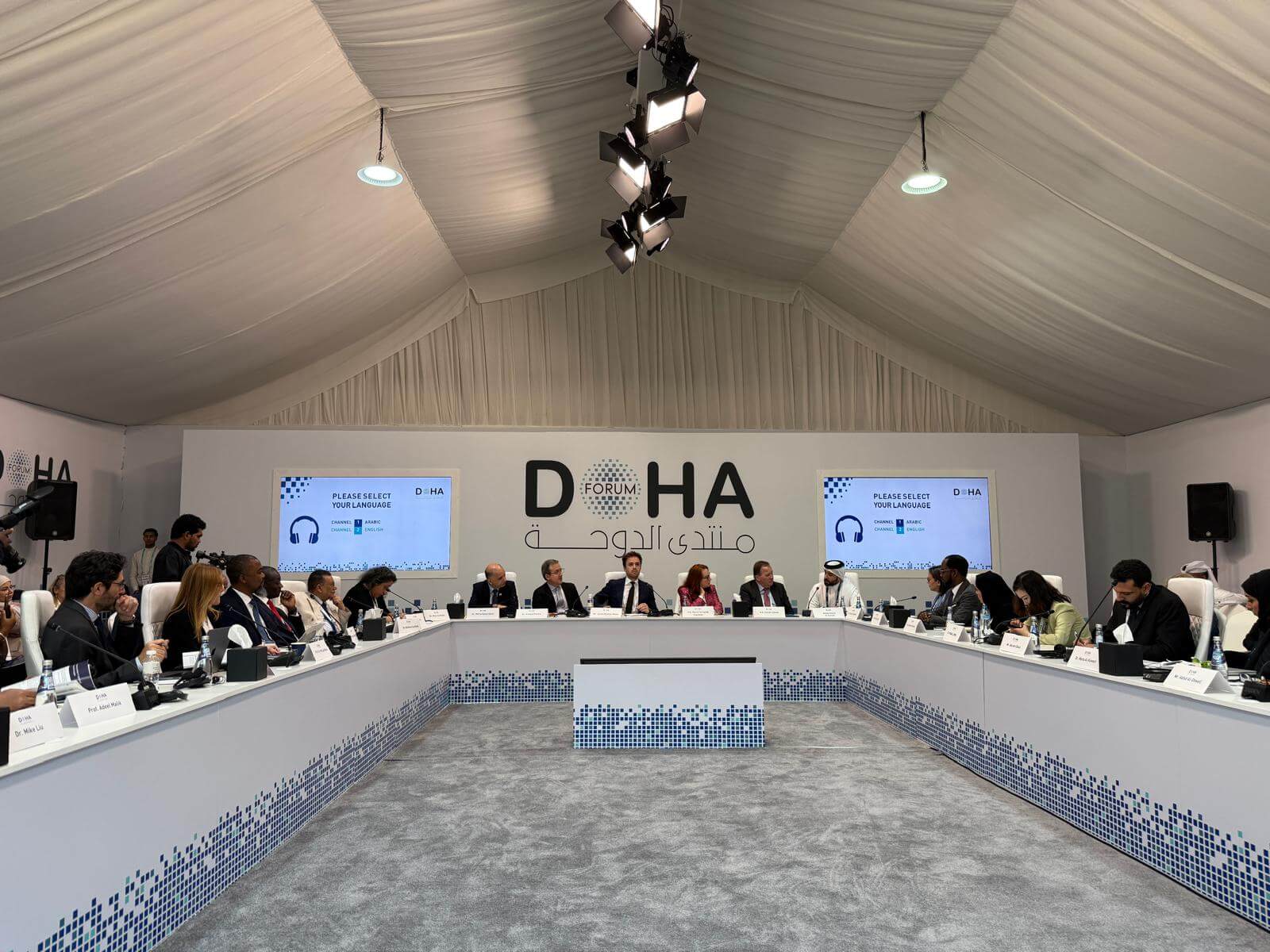
The Doha Forum provided a revealing snapshot of contemporary geopolitical realignments as well as the strategic calculations undertaken by states seeking to navigate and influence it. Among the most notable aspects of the convening was the juxtaposition of American political figures who, in a U.S. context, would be segregated, both institutionally and ideologically. The presence of establishment actors such as Hillary Clinton alongside representatives of the ascendant populist right, including Tucker Carlson and Donald Trump Jr., underscored Qatar’s deliberate cultivation of relationships across the full spectrum of American political possibilities. Their mere coexistence within the same forum – despite not sharing a stage – signaled a sophisticated form of anticipatory diplomacy: a recognition that the United States’ electoral volatility requires engagement with all potential centers of future influence.
The Forum’s large participant and speaker list further illustrated the extent to which the broader Middle East is positioning itself as an active architect of an increasingly multipolar order. The appearance of individuals as disparate as Bill Gates and the president of Syria pointed to the region’s growing confidence in convening actors who traditionally inhabit distinct or even antagonistic geopolitical spheres. This ambition stands in stark contrast to the near-total absence of Europe, both in terms of senior representation as well as substantive engagement. When Europe did appear, it did so largely in the form of Brussels’ most familiar reflexes. A panel with EU High Representative Kaja Kallas captured this dynamic with almost theatrical clarity. Her insistence that the United States remains a fully dependable transatlantic partner, that Russia is unambiguously losing the war and suffers economically, and that existing multilateral institutions remain adequate to the challenges ahead offered an almost textbook example of Europe’s enduring talent for epistemic insulation. At a forum designed to interrogate emerging realities, the EU’s contribution seemed to reaffirm its preference for reciting inherited assumptions rather than confronting geopolitical transformation. It’s a brutal and tragic insight, but the disjunction between the world as discussed in Doha and the world as imagined in Brussels could not have been starker.
Meanwhile, Qatar used the Forum to advance its own narrative as a mediator of global conflicts and a hub of post-hydrocarbon relevance. The sophistication of the event’s organization, coupled with its expanding scale, reflected a broader regional strategy to attract capital, talent, and geopolitical attention. The Middle East’s infrastructural ambition, investment capacity, and diplomatic assertiveness increasingly position it as a consequential actor in shaping twenty-first-century governance norms, irrespective of systemic differences with the West. The Doha Forum functioned as both a symbol and an instrument of this transformation, projecting an image of a region not merely adapting to global change but actively trying to influence its direction.
Taken together, the event’s architecture and discourse illustrated a geopolitical environment in which traditional hierarchies are eroding while new centers of influence are emerging with notable confidence. It also exposed the widening gap between actors prepared to engage with these shifts and those who remain anchored in outdated narratives. In this sense, the Doha Forum served simultaneously as a window into the world that is coming and a mirror reflecting the conceptual stagnation of those yet unwilling to see it.
The Future of China’s Role in Mediation
By Yun Sun
Director, China Program
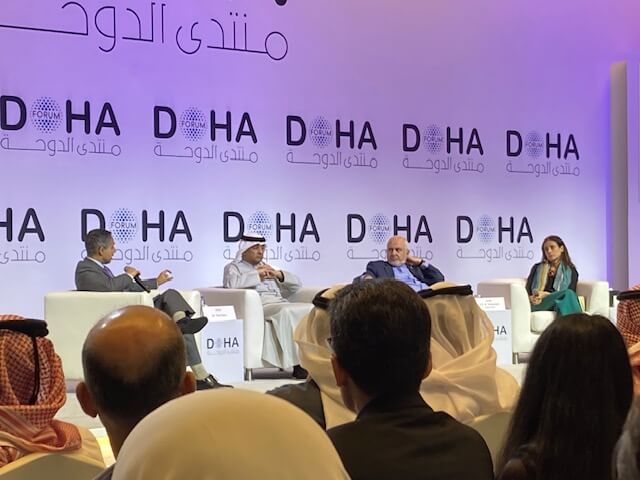
The Qatar Mediation Forum held alongside Doha Forum gathered some of the most important voices and brilliant minds in the field of conflict mediation. At a time of growing violent conflicts, great uncertainty, and mounting challenges for mediators, the future of multilateralism, the role of non-Western, untraditional mediation actors, and the different values and models reflected in conflict mediation are heatedly debated. Questions run rampant and deep on some of the most critical issues and dominant norms of conflict mediation. With dwindling funding and support, is the United Nations still the center of the multilateral approach to conflicts? Can it still afford it? With the rising transactional approach to conflict mediation, do values, norms, structures, and mechanisms still matter? If so, whose values and whose norms? Traditional Western mediators have very different views and approaches compared to many of their counterparts from the rest of the world, who sometimes have more effective ones.
In a world that’s preoccupied by great power competition, the lack of reference to China is an interesting but unsurprising omission. Despite China’s limited success in the Saudi-Iran deal of 2023 and the Beijing Declaration brokered among 14 factions of the Palestinian movement in 2024, Beijing is markedly and visibly missing in mediation efforts in the Gaza crisis and the Ukraine war. China’s lack of involvement is primarily the result of its geopolitical positioning, along with its inability to influence Israel and its unwillingness to use leverage against Russia. But China’s absence in efforts to end the two most violent and lethal conflicts in recent world history is astounding
Obviously, this is not the end of the story, and China will increasingly pursue a bigger role in conflict mediation beyond Gaza and Ukraine. But the two cases at hand demonstrate the limitation of China’s approach to conflict mediation, where great power realpolitik thinking trumps the pursuit of peace, and where the accommodation of individual actors’ grievances trumps principles enshrined in the United Nations Charter. China has been adept at turning the tables to point out American support for Israel, and elaborating on its neutrality on Russia to defend its position. But that is hardly the satisfactory answer the rest of the world is seeking.