
 Dinesh Madhavan

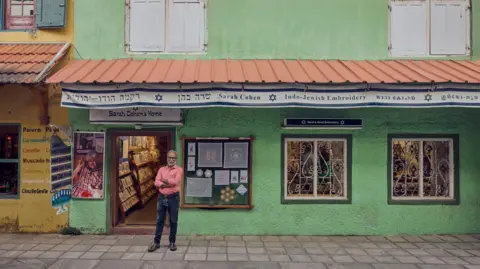
Thaha Ibrahim stands outside his embroidery shop in Jew Town, Kochi
Sarah Cohen’s Home.
That’s the sign welcoming anyone who walks into Thaha Ibrahim’s shop in a narrow cobbled lane in the southern Indian city of Kochi.
The bustling street, where vendors sell everything from antiques to Persian carpets and spices, is called Jew Town – some decades ago, every house on this street had a Jewish family, and the place was known as the Jewish quarter.
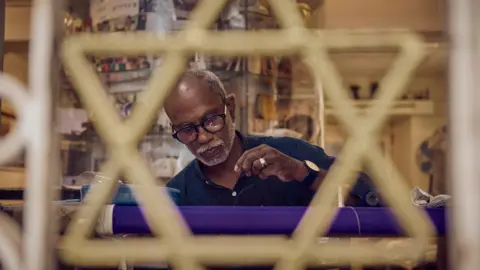
Thaha now runs the last Jewish embroidery shop in Kochi.
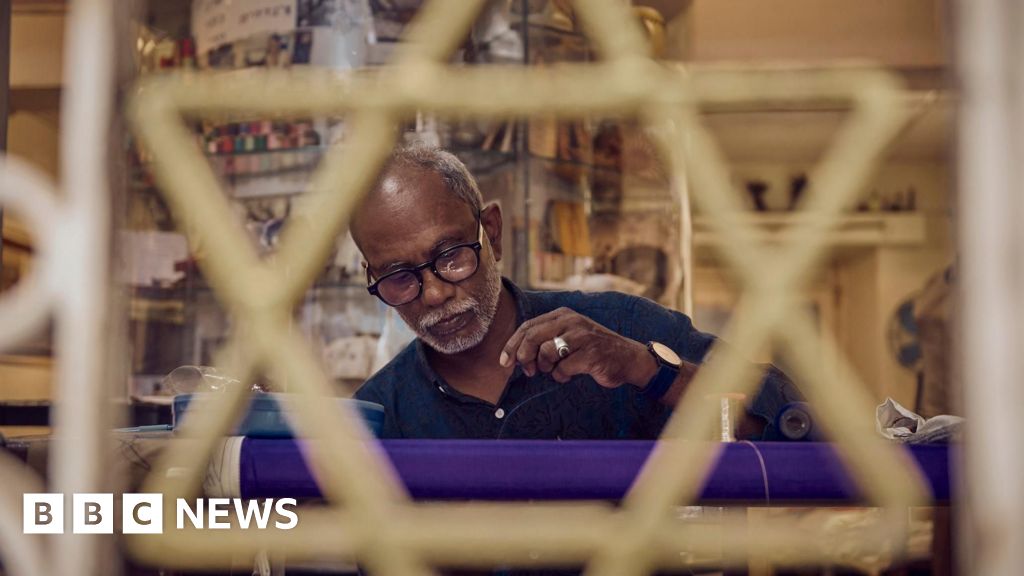
When some American tourists walked into the shop on a humid afternoon, Thaha, 55, was stitching a kippah, the traditional Jewish skullcap. The tourists gathered around a photograph on the wall which showed the then Prince Charles meeting the residents of Jew Town in 2013.
“That’s Sarah aunty,” Thaha told them, pointing at a woman with short white hair in the photo.
“This was Sarah Cohen’s home and embroidery shop.”
Sarah Cohen was part of a close-knit population of Jews whose ancestors settled down centuries ago in Kochi, once known as the Queen of the Arabian Sea for its importance as a port and a major spice trade centre.
Thaha has been running the shop since 2000 – first on Sarah’s behalf while she was still alive, and taking over fully in 2019, when she died aged 96.
“I was like a son to her. I spent more time looking after her than my own mother,” he says. “I’d buy her kosher food and fish, spend time at the shop which was also her home and leave only after closing up.”
The unusual friendship between Sarah and Thaha – a Jewish woman and a Muslim man from different economic backgrounds – spanned nearly four decades.
When Sarah died, she left her shop to Thaha. He, in turn, promised to keep her memory and legacy alive in Jew Town – a place which had 2,500 Jews in the 18th Century and is now down to just one.
“In a way, I’m also trying to make sure the Jewish community here is not forgotten,” says Thaha.
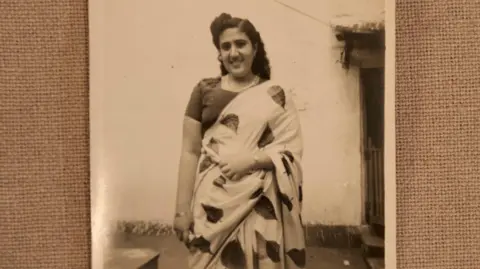 Courtesy Thaha Ibrahim
Sarah Cohen was part of a close-knit population of Jews whose ancestors settled down in Kochi
The most popular account of the arrival of Jews in Kerala dates back 2,000 years during the reign of King Solomon, the biblical king from the Old Testament.
They arrived as traders on the Malabar coast near the ancient port of Cranganore (now Kodungallur), later moving to Kochi. Their early settlements gave them the name Malabari Jews.
The next arrivals were Sephardic Jews fleeing Spanish persecution in 1492. Travelling via Portugal, Turkey and Baghdad, they reached Kerala, settled in Kochi, and came to be known as the Paradesi (foreign) Jews.
Together, the Malabari and Paradesi Jews became the Cochin Jews. They settled in Kochi, a long-time trading hub for the Portuguese, Arabs, British and Dutch, and lived under the protection of the Cochin king, which ensured their safety.
When Sarah was born in the early 20th Century, Jew Town was thriving. She and her husband Jacob, who was also born there, married in 1944.
Thaha met the Cohens by chance in the early 1980s. A school dropout at 13, he eked out a living by selling postcards to tourists.
Visitors to Jew Town would always go to the Paradesi synagogue, which was built in 1568 on land given to the community by the king of Cochin.
“There were lots of visitors and I would sell my postcards from morning till evening,” he says.
But one Sunday, when the owner of a warehouse where Thaha stored his postcards didn’t show up, Jacob offered him storage space in their home.
Sarah didn’t like this, and Thaha recalls she barely spoke to him for three years.
“I’d run errands for her husband at times. Or when I’d watch cricket on their TV from outside their window, he’d invite me in,” he recalls.
But one day she asked Thaha to help stitch a cushion cover for the synagogue. To their surprise, he had a natural knack for it – likely inherited from years spent assisting his tailor father.
“I didn’t know I could draw patterns and stitch,” he says.
 Dinesh Madhavan
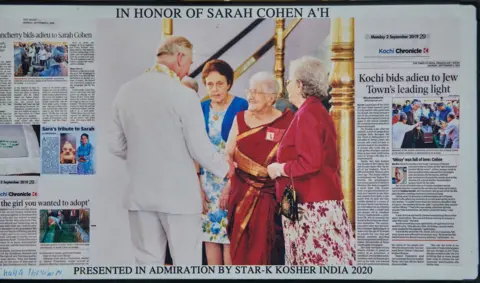
A collection of newspaper articles on Sarah Cohen’s life and death. In the centre is a photo of her (in a red saree) meeting the then Prince Charles in 2013
Thaha, then 19, helped Sarah open what is still known as “Sarah’s Hand Embroidery” from her living room. Here, she sold kippahs, challah covers (a special cloth used to cover bread) and menorahs (a candelabra used in Jewish worship).
“She taught me everything I know,” Thaha says.
He’s philosophical about his friendship with a Jewish family that has brought him much media attention over the years.
“The Jews and the Muslims in Jew Town didn’t interact much. They were wary of each other,” he says. “But Sarah aunty and Jacob uncle never made me feel like an outsider, despite our different backgrounds.” (South Asians commonly use the terms ‘aunty’ and ‘uncle’ to refer to older people)
Thaha’s parents didn’t object to the friendship because, as they saw it, the Cohens were helping their son find a purpose in life.
But while Thaha and the Cohens were getting closer, the town’s Jewish population dwindled – from 250 in the 1940s to 20 in the 1990s. Today, only one remains – 67-year-old Keith Hallegua, who used to work for a travel agency but has now retired.
Many families went to Israel after it became a country in 1948.
“Cochin Jews likely went to Israel because of the idea of going back to the homeland,” says Anna Zacharias, who is doing a doctoral thesis on the Jews of Kerala. “But there were also economic factors such as the pull of a better life. They also felt there was a shortage of suitable marriage partners in Kerala.”
But religious persecution was never a reason for Jews to leave multicultural Kochi, which had welcomed them for centuries. Some of the older Jews stayed on – including the childless Cohens.
 Dinesh Madhavan
Thaha stitches a kippah in his shop
Before Jacob died in 1999, he asked Thaha – who was married with three sons by then – to look after Sarah.
“I told Jacob uncle I will look after Sarah aunty if she allows me,” he says. “I said if she allows me because in Islam it’s important we honour a dying person’s wish. If not, we commit a sin.”
When Sarah’s health declined, Thaha moved his family closer to Jew Town so they could help look after her. When she died, Thaha got a casket cover with the Star of David for her coffin. He still regularly visits her grave at the Jewish cemetery.
Thousands of tourists visit Kochi every year, including many Jews.
“Jews from around the world come to Jew Town because of a sense of belonging,” says Anna Zacharias.
She points out that the Jews here survived for centuries and maintained their identity even in a majority Hindu city.
“Yet they were also integrated – for example, they spoke Malayalam, the local language,” she says.
She is also fascinated by how Thaha is keeping Sarah’s legacy alive.
“It’s exemplary to see how a Muslim man took care of a Jewish woman. He still maintains the traditions she followed religiously.”
Thaha has kept the shop the way it was when Sarah ran it. He shuts it on Saturday, the Jewish Shabbat.
“I’m a practising Muslim but I light a lamp on Friday evening to mark the start of Shabbat because it was important to Sarah aunty,” he says.
“To me, it’s not about religion but about humanity.”