
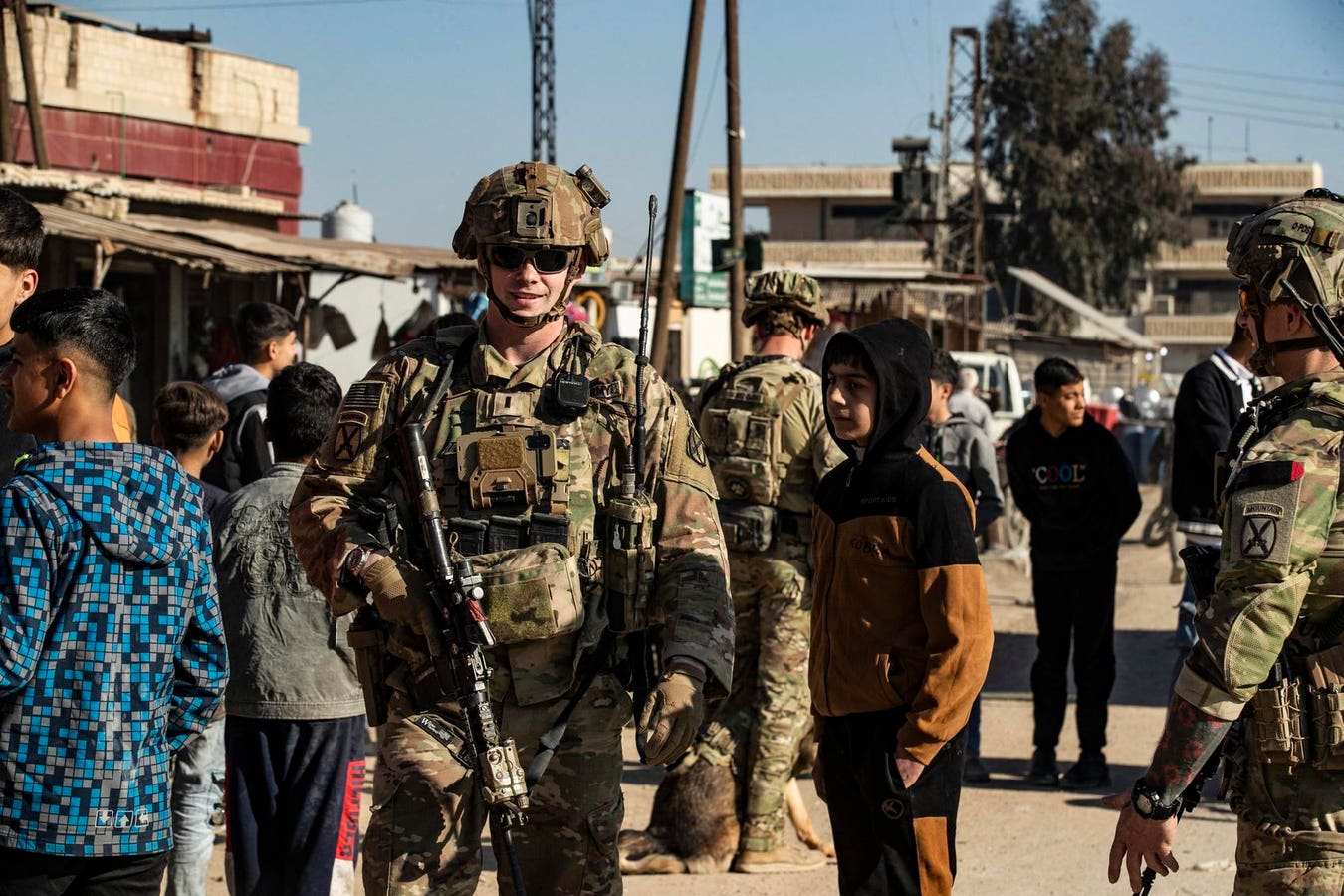
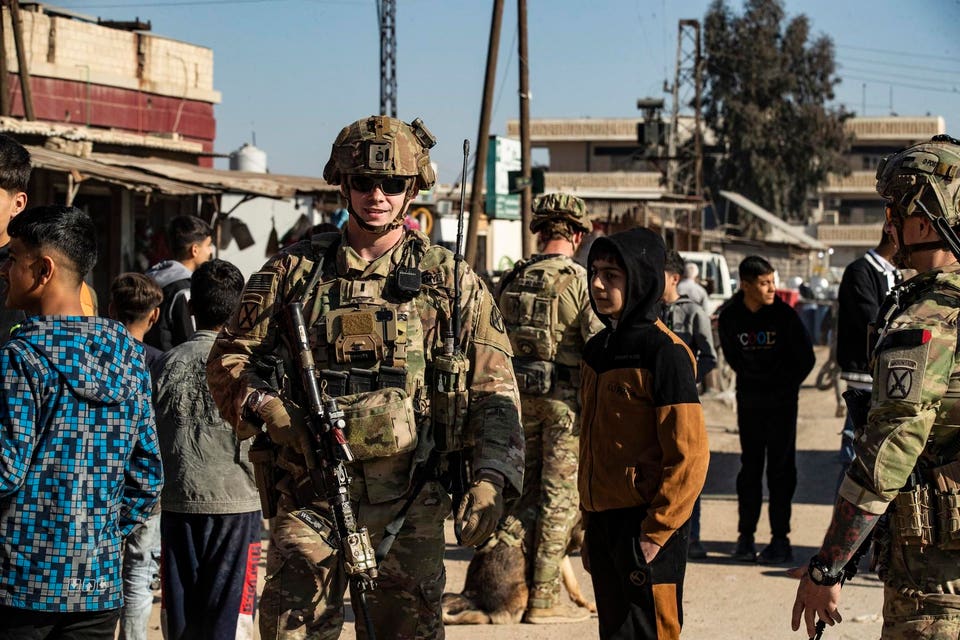
US soldiers patrol in Syria’s northeastern city Qamishli, in the Hasakeh province, mostly controlled by Kurdish-led Syrian Democratic Forces (SDF), on January 9, 2025. (Photo by DELIL SOULEIMAN/AFP via Getty Images)
AFP via Getty Images
A suspected Islamic State, ISIS, attack killed two U.S. soldiers and a civilian interpreter in central Syria on Saturday. The incident occurred a little over a month after Syria, under the new interim government led by President Ahmed al-Sharaa, officially joined the multinational U.S.-led coalition against ISIS. The killing of American troops so early in joint operations and patrols with the new Syrian military arguably underlines the danger in rushing the integration of America’s established longstanding ally against ISIS, the Kurdish-led Syrian Democratic Forces, into this new national army.
According to U.S. Central Command, an ambush executed by a lone ISIS gunman in Syria’s Palmyra killed the three Americans and injured three other U.S. troops. Syrian state media reported that two Syrian military personnel working with the Americans also suffered injuries. They killed the assailant. Videos showed U.S. Air Force F-16 fighter jets and A-10 attack planes buzzing Palmyra after in a show of force.
The UK-based Syrian Observatory for Human Rights war monitor reported that the attacker was a member of Syria’s new security forces. Concluding its brief report, the monitor called for Syria’s “Ministries of Defense and Interior to get rid of former regime members and those with ‘ISIS’ ideology.”
ISIS remnants have long operated in the desert regions of central Syria around Palmyra, which features iconic Roman-era ruins that the militants previously captured. Aside from damaging parts of the ancient site during the civil war, ISIS used its beautiful amphitheater as a stage for grisly executions they recorded for their propaganda snuff films.
The U.S.-backed SDF captured the remaining territories of the self-styled ISIS caliphate in Syria in March 2019. Since then, the group has operated underground and still poses a potential threat. The central desert became a sanctuary for them. It’s outside the reach of the SDF, which controls and governs large parts of north and east Syria, and Damascus, making it ideal terrain for ISIS to launch hit-and-run attacks and melt away.
Shortly after President Sharaa made history as the first Syrian president to visit the White House on Nov. 10, Syria became part of the anti-ISIS coalition. The coalition and the new Syrian military had cooperated before that date, albeit on a limited basis.
The U.S. began launching airstrikes against ISIS in Syria in September 2014. It did not coordinate with the former Syrian regime of Sharaa’s predecessor, President Bashar al-Assad. Early on, the Americans found the Syrian Kurds, who stoically resisted an unrelentingly brutal ISIS siege of the Syrian Kurdish border town of Kobani, were the best available on-the-ground ally against ISIS. A small number of U.S. troops deployed to northeast Syria in 2015, the same year the multiethnic SDF was established. From there, with a limited U.S. ground presence and supporting airstrikes, the SDF captured the ISIS caliphate’s de facto capital, Raqqa, in October 2017 and, as mentioned above, the last remaining swathes of the territorial caliphate by March 2019.
The SDF sacrificed an estimated 11,000 men and women in this effort. Less than a dozen U.S. troops lost their lives in the same period. Furthermore, the SDF has essentially protected American troops during patrols against ISIS remnants, enabling Washington to maintain a relatively light footprint in Syria that never exceeded 2,500 soldiers for long. It was truly a night and day difference from the vast numbers deployed and thousands lost during the 2003-11 Iraq War.
When President Donald Trump attempted to completely withdraw U.S. troops from Syria in October 2019 during his first term, U.S. troops who worked and fought together with the SDF openly expressed their shame at having to abandon such a reliable partner. Ultimately, that withdrawal became a drawdown, with U.S. troops remaining in the country to the present day. Aside from the presence in the northeast and eastern SDF-controlled regions, the U.S. has troops at the sprawling Al-Tanf base in the country’s southwest near the borders with Iraq and Jordan.
With Assad gone, the U.S. has forged relations with his successor and started working with Damascus against ISIS for the first time, upending a decade-long status quo for the SDF. In the year since Assad’s departure, Washington has insisted that the Kurdish-led forces integrate into the new Syrian military as quickly as possible. SDF commander-in-chief Mazloum Abdi signed an agreement with Sharaa in March pledging full integration by the end of this year. That process has since hit substantial stumbling blocks following the subsequent massacre of Druze in southern Syria in July. The SDF has serious reservations about Sharaa’s intentions and the substantial Islamist elements in Syria’s new security forces. Aside from the Druze, these elements earlier massacred large numbers of Syrias Alawite minority in Syria’s coastal provinces in March.
Turkey, which launched several cross-border offensives against the Kurdish-led forces, has warned the SDF against missing the year-end deadline. However, Saturday’s attack arguably shows that a rushed integration could prove destabilizing. Furthermore, Syria’s new security forces are, at the very least, inexperienced when it comes to countering a threat like ISIS. The SDF has a decade of experience on this front and superior training by the U.S. in counter-terrorism operations. Syria’s new security forces consist of former members of Sharaa’s disbanded Hayat Tahrir al-Sham and other predominantly Sunni Islamist groups. Unlike the SDF, these groups primarily focused on fighting Assad’s conventional forces and militias during the long civil war years.
Abdi has already said that the special SDF-affiliated counter-terror units can soon fight ISIS all over Syria for the first time following their integration. As recently noted in this space, that could include the site of Saturday’s ambush, the Syria Desert. The SDF has staunchly insisted that Damascus preserve their existing unit structures during the integration process. Sharaa has previously insisted that the SDF disband complete and that its former personnel join the state armed forces as individuals. A rushed integration process that demands the SDF first disband its units could create a security vacuum in the areas the group currently controls that ISIS would undoubtedly rush to exploit, as is its wont.
A more incremental integration could see the present deadline extended by a few months while the U.S. helps bridge the gap between its longstanding SDF ally and its new coalition partner in Damascus. That could see specialized SDF units redeploy to areas like central Syria for joint patrols alongside U.S. and Syrian troops to build trust and establish cooperative mechanisms with the latter ahead of integration.
A smooth integration could build a stronger and more professional Syrian military capable of providing security and stability throughout the country. That would pave the way for the kind of orderly U.S. withdrawal the present administration desires.
On the other hand, a rushed integration could lead to security deterioration and potentially end up resembling the 2011 U.S. withdrawal from Iraq, which necessitated the U.S. military’s rapid return in mid-2014 to confront a genocidal marauding ISIS.