
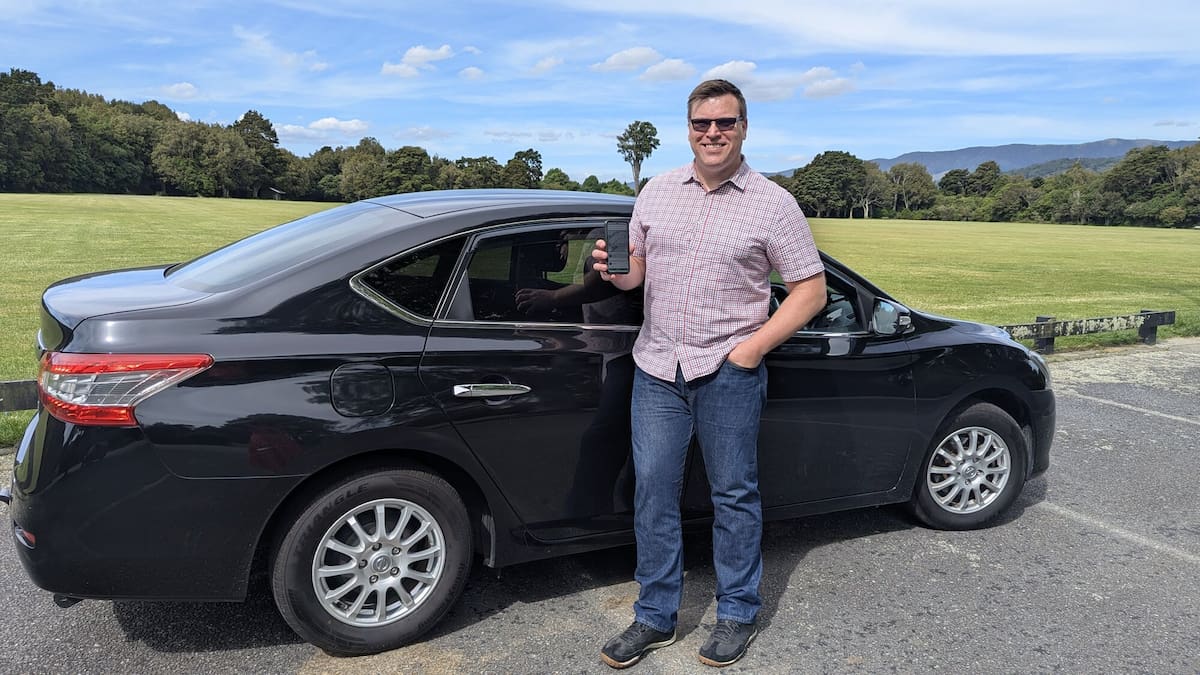
The second stage of his self-funded effort involved recruiting drivers through Facebook groups like the 10,000-member “Aride, Bolt, Uber, DiDi, (New Zealand)” – which recently added the name of Lowe’s company to its title, in something of a mark of his progress.
As of late last week, Lowe told the Herald, he had recruited 1573 drivers.
He’s now counting down to the third stage: aRide’s commercial launch, scheduled for this Wednesday, assuming some last-minute software glitches can be ironed out.
Lowe says aRide is set to launch in the following centres:
WhangāreiAucklandTaurangaTaupōRotoruaGisborneHamiltonNew PlymouthNapier/Hasting/Havelock NorthPalmerston NorthKāpitiWellingtonNelsonChristchurchQueenstownDunedinInvercargill
aRide will price match whichever service – Bolt, DiDi or Uber – in each location, Lowe says. There will be no surge pricing, bar New Year’s Eve.
In Wellington – where Lowe says DiDi is the cheapest option – aRide will match DiDi with a “distance discount” for longer rides (see the newcomer’s full pricing here).
The most drivers (702) have been signed up in Auckland, Lowe says, followed by Wellington (285) and Canterbury (199).
Lowe’s short-term target is 3000 drivers to keep wait times to a minimum. He’ll have to keep an eye on whether Uber uses short-term incentives to keep drivers loyal, or incentise those with two or three apps installed to favour its service.
Up against a $400m incumbent
The NYSE-listed Uber – through its own rideshare business and others it part-owns like DiDi and Lime – is a huge business, with a US$178 billion market cap.
It’s growing locally, too. Last year, the combined revenue of Uber Eats NZ and Uber NZ increased from $365.2 million to $403.m as Indian rideshare giant Ola folded sticks and exited New Zealand.
Can he win where Ola, Zoomy, others failed?
Lowe was an admirer of homegrown rideshare insurgent Zoomy, which was backed by the Rich List Spencer family and recruited (by its own count) 3536 drivers by taking just a 15% clip of the ticket on each ride.
Zoomy hit a wall mid-Covid (though its technology found a new life after it was acquired by TaxiCharge, and used to help power an app for the traditional industry).
Upper Hutt posse: The “aRide” branding Lowe will use for his nationwide push against Uber.
DriveHer, founded in 2018, had two angles: it was local, and had a team of women-only drivers and a policy that only female passengers could ride in the front seat. It was closed in 2021.
Like Zoomy, aRide will push that it’s made in NZ.
“We’ll pay drivers more, reinvest in the economy and pay tax here when we make a profit,” Lowe says (Uber has reported a loss and accordingly not paid tax for most years of its operation in NZ).
Luring drivers
Lowe says aRide will take a 30% cut, so drivers will keep 70% of a passenger’s fare, “compared to as low as 53.35% with Uber”.
Commerce Commission chairman John Small recently said on LinkedIn – in a post designed to spark interest in Uber rivals – “Uber takes 28% of the fare [for a GST registered driver], against 20% for Bolt and DiDi”.
Lowe says there’s a “total fare” nuance that distorts those numbers.
He says a sore point for Uber drivers is that part of the fare a customer pays is a “convenience charge” that is paid directly to Uber, then the driver keeps a cut of the remaining fare.
Lowe says aRide will price match the cheapest rideshare opertor in every centre.
Uber has not released a figure for its number of drivers in NZ, but Lowe – as a veteran of various driver groups on social media – reckons it’s about 11,000, or around 20,000 if Uber Eats drivers are included (drivers cannot work for both Uber services).
Supreme Court shifts the landscape
Unlike Zoomy or DriveHer, Lowe doesn’t have lockdowns to contend with, and he says the New Zealand-owned argument has more resonance now.
“We’ve become more conscious consumers now,” he says.
But he has – at least in the immediate future – a potentially more challenging employment landscape.
Uber’s decision not to hire drivers as employees has annoyed unions, and some drivers, but also given new market entrants a ready-made pool of contractors.
Many drivers will also install a newcomer’s app. aRide has the same vehicle requirements, so they’re instantly good to go.
But on November 17, the Supreme Court upheld a 2024 Court of Appeal ruling that found four Uber drivers were employees rather than contractors.
While the judgment only applies to the four drivers, the Workers First Union said it was a landmark decision that paved the way for thousands of union members to pursue full employment rights, including restitution for historical underpayment of wages and entitlements.
“I watched that case very closely,” Lowe said.
In his view, “Most rideshare drivers don’t want to be employees. They don’t want set shifts. They want flexibility.”
The fact that only one in 20 drivers is unionised proves his point, he says.
A union spokesman told the Herald, “Workers First has just over 1000 Uber members – about 150 Uber Eats to 850 Uber drivers.”
He added, “Our database still hasn’t processed some new joins from last week. We’ve had an influx of new memberships from drivers who want to join the backpay/entitlement claim following the Supreme Court decision.”
Lowe sees the Supreme Court decision being quickly superseded by a pending law change.
The Employment Relations Amendment Bill, introduced in July and now in the select committee stage, proposes that workers be classified as independent contractors if they are not restricted from working for others, not required to work at certain hours or for a minimum period and can subcontract work.
First Union says the law change will “enshrine worker misclassification in law on behalf of companies like Uber”.
Lowe says, “The average driver wants to be a contractor.”
Chris Keall is an Auckland-based member of the Herald’s business team. He joined the Herald in 2018 and is the technology editor and a senior business writer.