

Introduction: From Strategy to Delivery
The draft Climate Change Plan (CCP) 2026-2040[1] sets out the Scottish Government’s strategic vision for peatlands. By 2040, Scotland will be internationally recognised for its restored and resilient peatlands, where sustainable and diversified land use supports nature recovery, empowers communities, and drives a dynamic green economy. This transformation will be enabled through integrated stewardship, responsible management, public support and private investment.
The draft CCP’s peatland policies prioritise the protection, management, and restoration of Scotland’s peatlands, underpinned by robust evidence and world-class research to support effective action. Healthy peatlands are vital for Scotland’s climate and nature goals and also offer key natural benefits – they store carbon, support biodiversity and nature, reduce the risk of flooding and wildfires and improve drinking water quality. Peatland restoration offers a growing source of skilled jobs for rural communities, and seasonal opportunities for existing rural workers. It is also the primary means of reducing peatland greenhouse gas (GHG) emissions, with restoration efforts focussed on rewetting, reprofiling, stabilising and revegetating dry or damaged peatlands. Degraded peatlands require several years to recover and achieve the full potential for emissions reduction after restoration activities are complete.[2]
The Scottish Government is aiming to restore more than 400,000 hectares by 2040. This new target reflects an increase in ambition, and acknowledges the work still needed to grow this relatively young industry.
This plan addresses the period from 2025 to 2030 for Outcome 3: Restore of the wider peatlands package in the draft CCP, which aims to return degraded peat to a more natural condition and reinstate the natural ecosystem functions and benefits they can provide.
Peatland restoration in Scotland has progressed significantly since 1990, evolving from small-scale efforts to a nationally coordinated programme, Peatland ACTION, a strategic partnership established by the Scottish Government with five public sector delivery partners: NatureScot, Loch Lomond and Trossachs National Park Authority (LLTNPA), Scottish Water (SW), Cairngorms National Park Authority (CNPA) and Forestry and Land Scotland (FLS). Through this partnership, we fund public, private and voluntary sector stakeholders to carry out peatland restoration projects. Many organisations and individuals make financial and in-kind contributions to peatland restoration from their own resources or other fundraising. Peatland restoration is also supported through the Agri-Environment Climate Scheme.
Peatland restoration in Scotland is strengthened by wider community support, including the Peatland Science and Technology Advisory Group (STAG), led by SG’s RESAS team and the Chief Scientific Adviser, with expertise from the James Hutton Institute (JHI), Scotland’s Rural College (SRUC), SEPA, Forest Research, and universities across Scotland; the International Union for Conservation of Nature (IUCN) UK Peatland Programme, which promotes peatland benefits and restoration across the UK; and the Shared Island Initiative – a partnership between the Republic of Ireland, Northern Ireland, and Scotland to advance restoration and shared learning.
This plan marks the beginning of a series of rolling five-year Peatland ACTION partnership plans designed to realise Scotland’s long-term vision for peatlands by 2040. We will ensure our partnership approach is agile, dynamic and maximises the benefits for climate, nature and people, while responding to the priorities of the peatlands sector as it develops. Through this plan we aim to focus the partnership on the right priorities at the right time, as we progress toward the Scottish Government’s proposed 2040 restoration target.
Identifying actions
Within this first plan, care has been taken to document realistic and achievable activity to show what the peatland sector in Scotland has the capacity, skills and capabilities to deliver. This plan seeks to address barriers to further upscaling; build delivery capacity and stability in the sector to 2030 and beyond; ensure that restoration of our peatlands brings benefits for climate, nature and people; and strengthen delivery by focusing on actions that simplify processes, increase funding certainty, and build a long-term pipeline of investible restoration projects.
As part of this work we have utilised the Scottish Approach to Service Design[3] and worked with partners to identify key challenges facing the sector which should be the focus for the next five years. Through a series of stakeholder engagement events, discussions across the partnership, and a literature review of peatland restoration in Scotland, we have identified the following three themes as the partnership’s key priorities to tackle over the next five years:
Further: Expand peatland restoration in Scotland
Fairer: Support a just transition through restoration
Better: Improve how we work and solve technical challenges
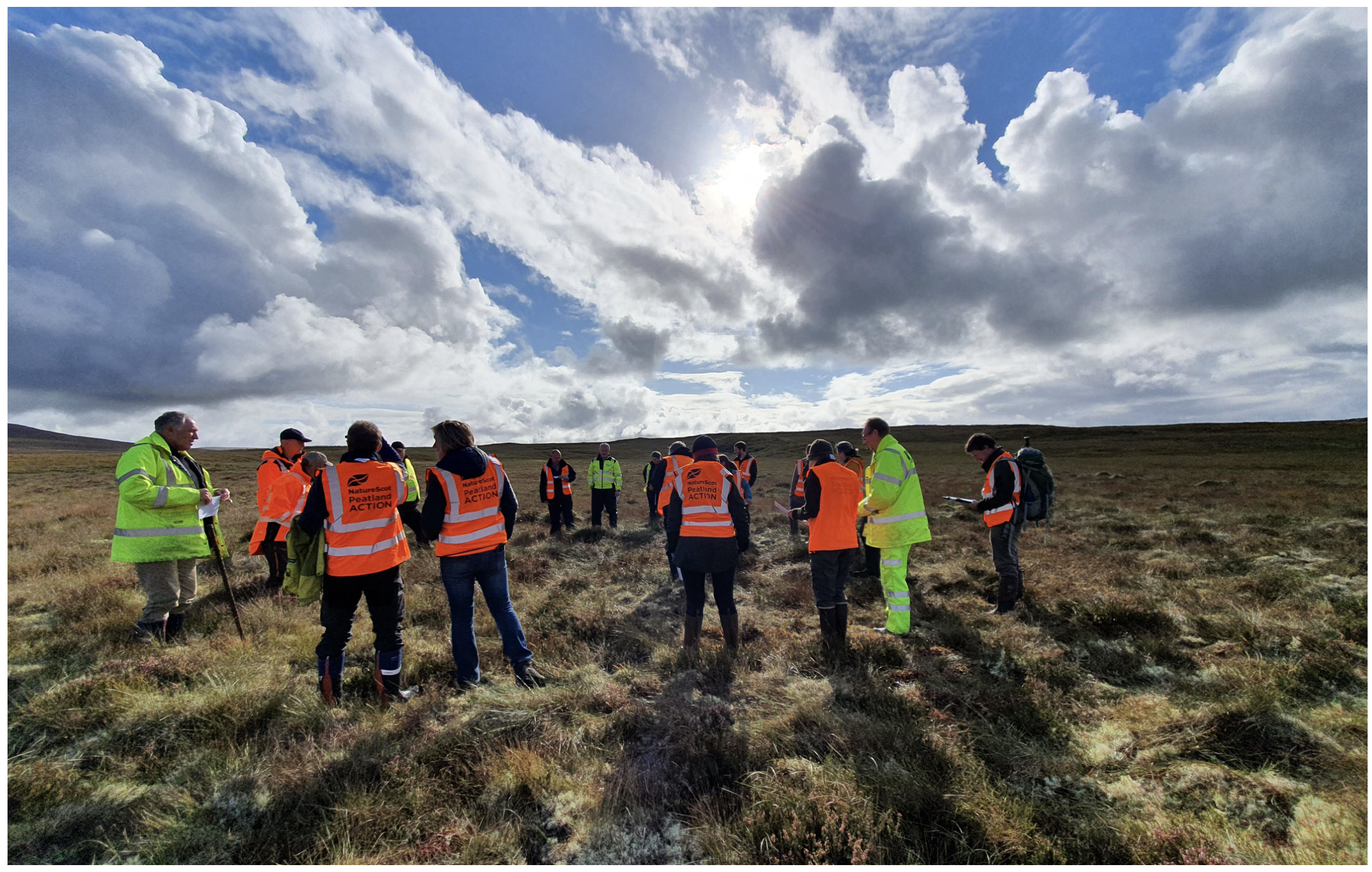
Peatland ACTION on a peatland site | Credit: Kirstin McEwan, NatureScot
Governance, monitoring and evaluation
Governance of the Peatland ACTION programme is led by Scottish Ministers, with strategic oversight provided by the Peatland ACTION Delivery Board, chaired by the Scottish Government. The Board, comprising senior representatives from the Peatland ACTION Delivery Partners, sets the programme’s direction and priorities, manages risks, and advises Ministers. Coordination of operational implementation is supported by the Peatland ACTION Delivery Partner Working Group, which guides requirements for evidence, communication, technical advice, workforce development, and blended funding to support operation alignment and delivery. Monitoring and evaluation are guided by the Peatland ACTION Monitoring Strategy,[4] with an open-access portal[5] which shows completed projects across the partnership.
Peatland ACTION progress reports[6] are published annually, providing a transparent account of restoration delivery. Each report highlights key achievements, lessons learned, and the overall impact of restoration efforts, and will also track progress against this plan to inform strategic direction and continuous improvement for the partnership, stakeholders, and communities.
To strengthen collaboration, shape long-term priorities, and ensure sector-wide alignment, we also want to continue the conversations that have developed this plan to drive collective action and inform restoration policy.