
Unlock the Editor’s Digest for free
Roula Khalaf, Editor of the FT, selects her favourite stories in this weekly newsletter.
Hong Kong’s High Court has found billionaire media mogul Jimmy Lai guilty on national security charges, in the most closely watched trial since Beijing’s crackdown on the city’s pro-democracy movement six years ago.
The trial has been viewed both within Hong Kong and abroad as a barometer for political and media freedoms in the semi-autonomous Chinese territory, and has been a source of tension between Beijing and the west.
Lai, who is 78 and has British citizenship, had faced charges of conspiring to commit sedition and foreign collusion, which he denied. He faces up to life in prison.
The court on Monday said it would announce the sentencing date as soon as possible, following a mitigation hearing next month. Lai can appeal against the ruling.
During the 156-day trial, prosecutors sought to paint Lai as a chief instigator of the 2019 pro-democracy movement in the city and accused him of working with foreign politicians, particularly in the US, to impose sanctions against China and Hong Kong.
He was charged with two counts of conspiracy to collude with foreign forces and one count of conspiracy to publish seditious materials through his newspaper, the pro-democracy tabloid Apple Daily, which was shut down in 2021. The collusion charges were levied under the national security law (NSL) that Beijing imposed on Hong Kong in 2020.
“The only reasonable inference we can draw . . . is the first defendant’s only intent — whether pre- or post-NSL — was to see the downfall of the CCP [Chinese Communist party], even though the ultimate cost was the sacrifice of the interests of the people” of China and Hong Kong, said Judge Esther Toh on Monday, reading from the more than 800 page judgment.
She likened Lai’s alleged efforts to work with US politicians to impose sanctions on China to a hypothetical US citizen working with Russia to bring down the American government.
John Lee, Hong Kong’s chief executive, said that he welcomed the verdict, adding that Lai’s actions had “harmed the fundamental interests of the nation and the wellbeing of Hong Kong residents”.
John Burns, emeritus professor of politics and public administration at the University of Hong Kong, said he expected Lai to receive a long prison sentence “given the symbolic importance of [the] trial for the central government’s narrative that the 2019 protest was an attempted ‘colour revolution’”.
Lai was first arrested in 2020, and has already spent nearly five years in detention. He has previously been sentenced to a series of jail terms over his alleged involvement in “unauthorised” anti-government protests, a banned vigil in 2020 to mark the anniversary of the Tiananmen Square massacre and alleged fraud at Next Media, his media group.
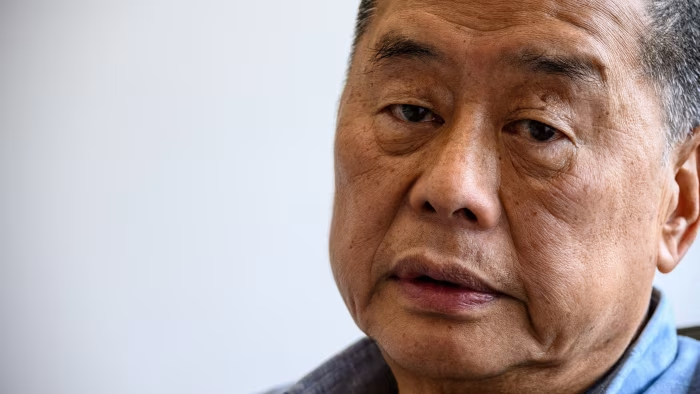
Jimmy Lai biography © AFP via Getty Images
1947 — Born in China before moving to Hong Kong in 1960
1981 — Founded fashion retailer Giordano. Forced to sell his shares in 1996 under pressure from Beijing
1995 — Launched Apple Daily, a tabloid that became one of Hong Kong’s most widely read newspapers
2019 — Met US officials to advocate for Hong Kong pro-democracy protest movement
August 2020 — Arrested under the national security law. On the same day, Apple Daily’s offices are raided by police
April—May 2021 — Convicted of unlawful assembly over 2019 protests and sentenced to a combined 20 months
December 2021 — Sentenced to 13 months over banned Tiananmen vigil
December 2022 — Sentenced to five years and nine months and fined HK$2mn (US$257,000) in Next Media fraud case
December 15 2025 — Convicted of national security charges
His family and legal team in the UK say that his health has deteriorated during his incarceration and that he has been denied access to specialist doctors to treat his diabetes. Authorities in Hong Kong have called those accusations “completely baseless”.
The verdict comes amid increasing geopolitical tensions over Hong Kong, a former British territory whose separate legal system from mainland China was among the cornerstones of its status as a global financial hub.
On Sunday, Hong Kong’s Democratic party, the city’s largest pro-democracy party and once the leading opposition force in the legislature, said it had voted to disband after 31 years.
Beijing has overhauled the city’s electoral system, permitting only pre-approved candidates and in effect barring the opposition. The new “patriots only” system has struggled to gain public support, and the territory recorded its second-lowest turnout on record in legislative elections last week.
But Hong Kong has lured back foreign investors and business in recent years, after its reputation was damaged by the 2019 unrest, the crackdown by the central and local governments and a strict Covid-19 travel regime. The city’s stock and initial public offering markets have been some of the best performing in the world this year.
Recommended

Western governments, in particular the US and the UK, have denounced the charges against Lai. US President Donald Trump said he would “100 per cent” free Lai in the run-up to his election last year.
Ahead of a summit with Chinese leader Xi Jinping in October in South Korea, Trump said he would raise the issue of Lai’s case. Neither side mentioned Lai in their readouts of the meeting, but Reuters reported that Trump had raised it with Xi.
In a statement, the UK foreign office condemned Lai’s prosecution as “politically motivated” and called for his immediate release and the repeal of the NSL.
The Inter-Parliamentary Alliance on China, a hawkish group of legislators from mostly western countries, said that the verdict “makes a mockery of the rule of law and discredits all those responsible for it”.
Additional reporting by Demetri Sevastopulo in Washington and David Sheppard in London