
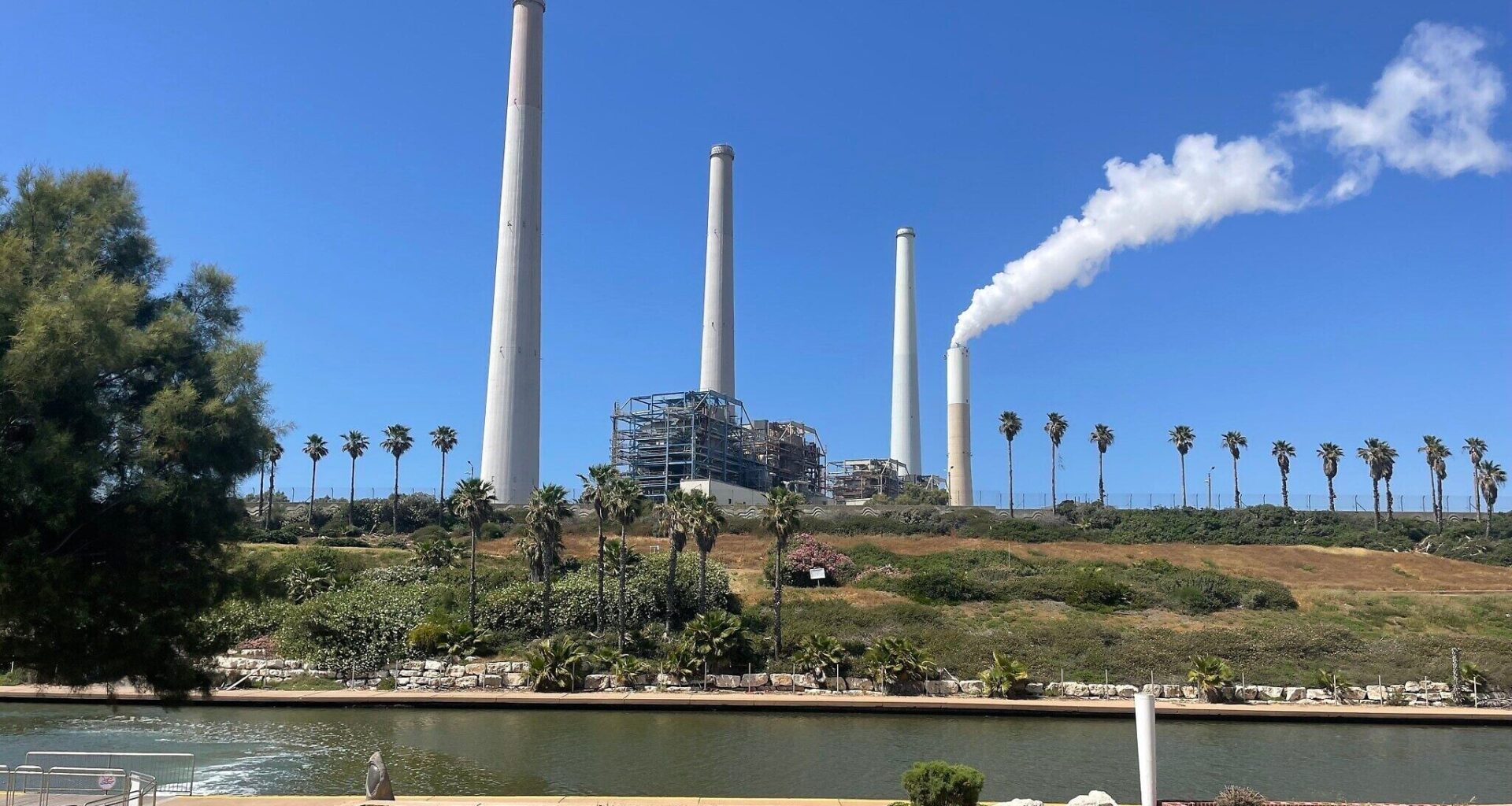
Israeli researchers are working to capture carbon dioxide from the atmosphere by speeding up the natural weathering process by which rain dissolves rock.
In nature, rain absorbs CO2 from the atmosphere and becomes carbonic acid, which reacts with rocks. In the case of limestone, the calcium carbonate — the main component of the rock — splits into calcium and bicarbonate, both of which dissolve in water. These materials return to the rivers and the sea as part of the carbon cycle. There, amongst other things, they are used by marine creatures to build shells and skeletons. When the creatures die, and their shells and skeletons sink to the bottom of the sea, they slowly fossilize and become a component of rock — and so the cycle goes on.
When humans burn fossil fuels, CO2 is released into the atmosphere, tipping nature’s delicate balance between CO2 that is emitted and reabsorbed by the planet. Excess CO2 in the atmosphere today is preventing heat from escaping from the earth (the greenhouse effect) and is sparking climate change — more drought, heavy storms, and flooding.
Despite international agreements aiming to curb human-made CO2 emissions, they are still rising.
Scientists are trying to develop methods to remove some of the CO2 from the atmosphere artificially.
Get The Times of Israel’s Daily Edition
by email and never miss our top stories
By signing up, you agree to the terms
The late Eyal Wargaft, a geochemical oceanographer from Israel’s Open University, launched a project two years ago to flush seawater and CO2 through rock to try to speed up the natural weathering process, which can take anything from thousands to millions of years. He built an open reactor.
Tragically, he died of cancer aged 43, six months into the project.

Illustrative photograph of rainwater on rocks. (FCerez, iStock by Getty Images)
Hebrew University geochemist and senior lecturer Dr. Yonaton Goldsmith and then-master’s student Noga Moran continued the work, publishing their first academic paper this month in Environmental Science & Technology, a leading journal of the American Chemical Society.
Using what is called an open reactor, with rock in transparent columns which are flushed with seawater and CO2, they have taken scientific thinking forward, discovering, for example, that dolomite absorbs CO2 better than limestone, and that smaller grains lead to more total carbon dissolved, while larger grains help speed up the chemical reaction. They have also identified the optimal CO2-to-seawater ratio for this method of enhanced weathering.
Goldstein said the project was geared towards removing highly concentrated CO2 from the chimneys of fossil fuel-driven power plants to make plenty of acidic water for a rock-filled reactor. In Israel, power stations are located close to dolomite rock.
While the reactor works, though, most of the CO2 is still escaping back into the atmosphere. Limestone absorbs ten to 15 percent of the gas, while dolomite absorbs 20 to 30%.
“We’re looking at the basic science,” he added, “and for a set of parameters to make the yield of the reaction the best possible with this particular method, so that people can build on our findings and ultimately make something that works better.”
Engineers would be needed to scale up the reactor and create something applicable in the real world, he went on.
He added, however, that until Israel operated a carbon tax to force industries to pay for their emissions, carbon removal from power plants was not yet economically attractive. “I could turn to the Israel Electric Company and say I will reduce your carbon footprint, and they would say, ‘Why? It doesn’t cost me money,’” Goldsmith said.
Give a Hanukkah gift that illuminates

This year, send your loved ones a special connection to Israel and the Jewish world.
A Times of Israel Community gift membership entitles your recipient to one full year of membership benefits, at a special discounted price.
Already a member? Sign in to stop seeing this
You appreciate our journalism

You clearly find our careful reporting valuable, in a time when facts are often distorted and news coverage often lacks context.
Your support is essential to continue our work. We want to continue delivering the professional journalism you value, even as the demands on our newsroom have grown dramatically since October 7.
So today, please consider joining our reader support group, The Times of Israel Community. For as little as $6 a month you’ll become our partners while enjoying The Times of Israel AD-FREE, as well as accessing exclusive content available only to Times of Israel Community members.
Thank you,
David Horovitz, Founding Editor of The Times of Israel