
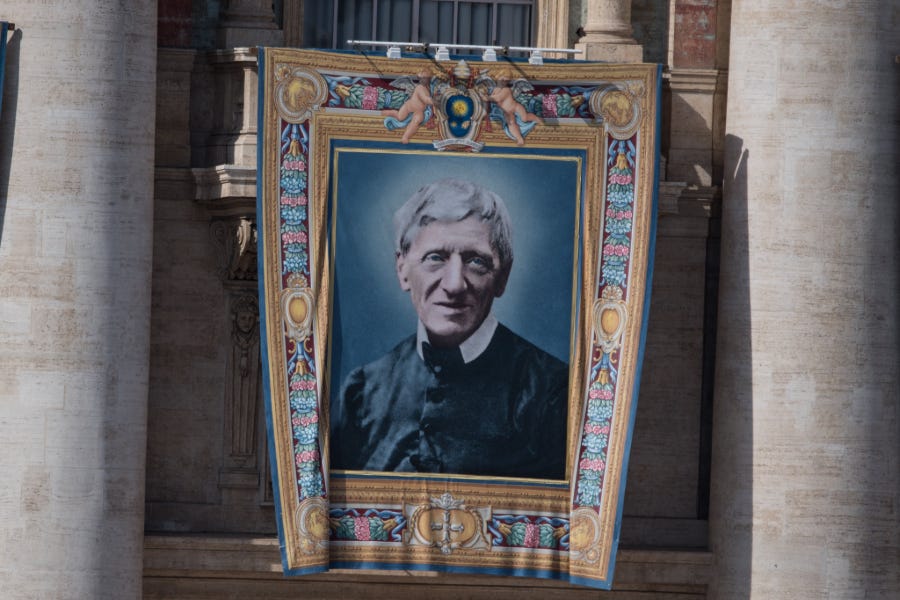
The Vatican announced Thursday that St. John Henry Newman will soon be declared a Doctor of the Church.
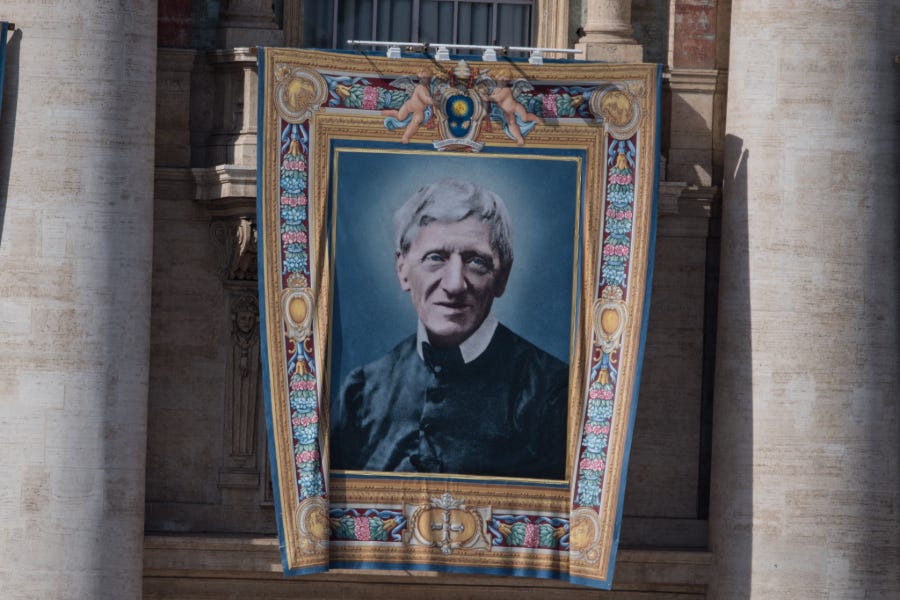 A tapestry depicting St. John Henry Newman hangs from St. Peter’s Basilica on Oct. 13, 2019, the day of his canonization. © Mazur/cbcew.org.uk.
The Holy See press office said July 31 that Pope Leo XIV had confirmed the opinion of members of the Vatican’s Dicastery for the Causes of Saints that the title should be conferred on the 19th-century English theologian.
The last saint to be declared a Doctor of the Church was Irenaeus of Lyons in 2022. Pope Francis proclaimed the 2nd-century bishop “Doctor unitatis,” or “Doctor of Unity,” on Jan. 21, 2022, after first announcing that he would take the step in October 2021.
The Vatican did not say when Pope Leo will formally proclaim Newman as a Doctor of the Church or which Latin title he will be given.
Newman will be the 38th saint to be recognized as a Doctor of the Church. He will be the second Englishman to receive the title after St. Bede the Venerable, who died in the 8th century and was granted the title in 1899.
The pope’s decision is a vindication of the work of Newman scholar Fr. Ian Ker, who died in 2022. Ker strongly advocated that the English saint should be declared a Doctor of the Church, arguing that “reading Newman is like reading the great Church Fathers.”
Newman’s elevation will be significant not only for English Catholics but also for members of the Anglican Church of England. Newman was baptized as an Anglican after his birth in 1801 and served as an Anglican clergyman before becoming a Catholic in 1845.
He became a member of the Oratory of St. Philip Neri. His influential writings include the “Apologia Pro Vita Sua,” the “Grammar of Assent,” and the poem “The Dream of Gerontius.” Pope Leo XIII named him a cardinal in 1879.
Newman died in 1890 in Edgbaston, Birmingham, England. He was beatified by Pope Benedict XVI in 2010 and canonized by Pope Francis in 2019.
In his beatification homily, delivered at Birmingham’s Cofton Park, Benedict XVI highlighted not only Newman’s intellectual legacy but also his qualities as a pastor, describing him as “much-loved father of souls.”
The German pope noted that, after founding an Oratory in Birmingham, Newman dedicated himself to serving the local population, “visiting the sick and the poor, comforting the bereaved, caring for those in prison.”
“No wonder that on his death so many thousands of people lined the local streets as his body was taken to its place of burial not half a mile from here,” he said.