
Over NIS 220 million will be cut from a program meant to boost Arab economic development and instead allocated to the police to combat “severe nationalistic crime” in the Arab community, Prime Minister Benjamin Netanyahu’s office said Sunday.
The planned move, which drew condemnation from Arab leaders, falls short of the NIS 3.1 billion ($960 million) that Social Equality Minister May Golan had initially sought to divert from the program to the National Security Ministry, the police, Shin Bet, and her own ministry.
The decision represents “a critical and significant step in Prime Minister Netanyahu’s national plan to combat crime and illegal weapons in the Arab sector,” and was made during a cabinet meeting held Sunday in Dimona, according to the joint statement from Netanyahu, May, and National Security Minister Itamar Ben Gvir.
Ben Gvir, who heads the far-right Otzma Yehudit party, has been accused of imposing collective punishment against Arab towns and ordering military-style police campaigns to crack down on rampant crime in the community.
“The decision approved [Sunday] is an important step toward a clear policy: zero tolerance for criminals, significant strengthening of the police and the Shin Bet, and the restoration of security to law‑abiding citizens, Jews and Arabs alike,” said Ben-Gvir. “This is only the first stage, and this struggle will continue with determination and full force.”
Get The Times of Israel’s Daily Edition
by email and never miss our top stories
By signing up, you agree to the terms
Golan said that the NIS 220.7 million ($68.7 million) included in the decision will establish a “groundbreaking” program to address “the root of the problem,” which will both supplement and strengthen the existing program to combat crime in the Arab community.

MK May Golan at the Knesset, July 14, 2025. (Yonatan Sindel/Flash90)
Funds will be diverted from a five-year NIS 30 billion ($8.3 billion) program created in 2021 under the short-lived Naftali Bennett-Yair Lapid-led government, designed to bring Arab communities on par with Jewish counterparts in areas such as housing, policing, and economic development, after decades of neglect.
Netanyahu said the funds would not come from projects already approved under the program.
The vast majority of the redirected funds will go to the police and Shin Bet, to be allocated in the 2026 budget, including for technological upgrades and digital integration.
Other funds will go to the police to strengthen Unit 33, an undercover counterterror unit that, despite its ostensible focus on nationalist violence, is often used to fight crime in the Arab sector, as well as to establish a unit to combat weapons smuggling into Israel.
Golan alleged without evidence that it was the Bennett-Lapid government and their development program that both created and “enabled criminal organizations… to take control of local authorities.”
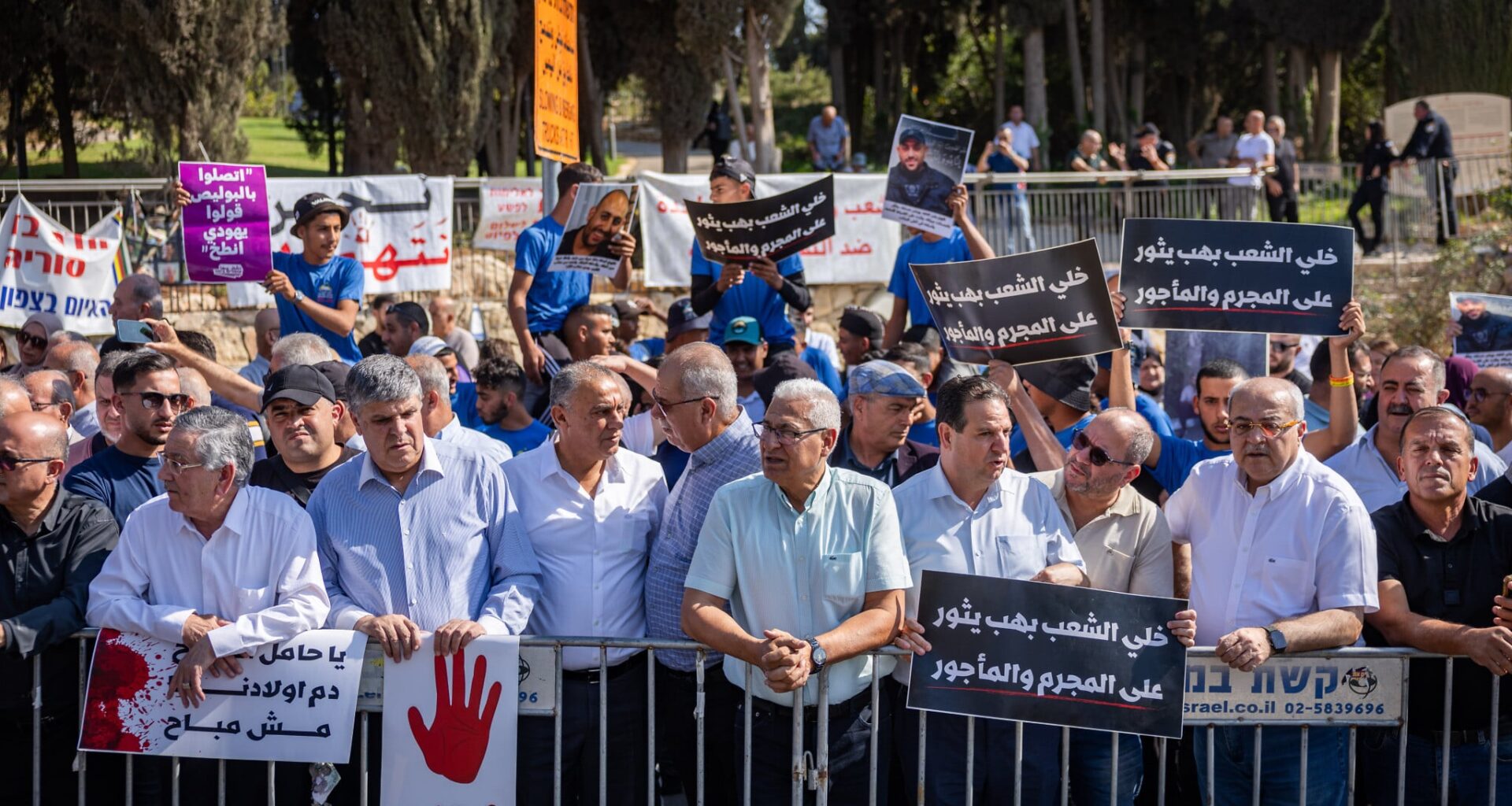
Violent crime in Arab society has claimed an unprecedented number of lives over the past three years. Community leaders and local politicians have long demanded police action to quell the crisis, but are critical of law enforcement’s handling of the issue.
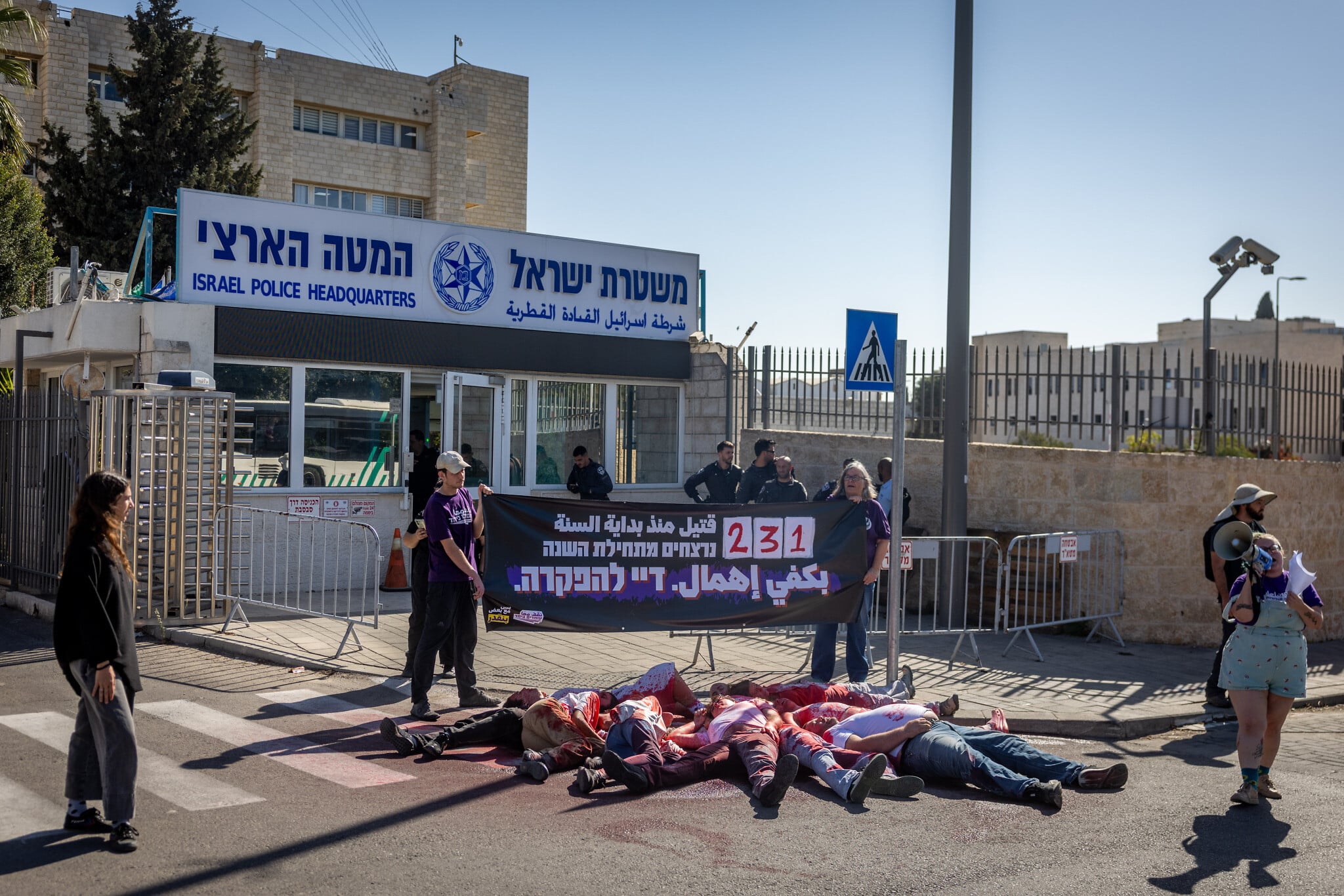
Members of the ‘Standing Together’ movement protest outside Israel’s national police headquarters in Jerusalem against rising violence in Arab communities in Israel, November 23, 2025. (Chaim Goldberg/Flash90)
Arab mayors have called for a consistent presence of police officers in their locales, as opposed to large-scale, army-style raids typically conducted in Arab cities and towns without prior coordination with local leadership.
In the statement, Netanyahu noted that violent crime was the top issue he heard about from “from every Arab citizen in Israel.”
The proposal will now advance to the Knesset Finance Committee to be deliberated upon, and could face hurdles before reaching a Knesset vote.
Yesh Atid MK Vladimir Beliak, who sits on the Finance Committee, told The Times of Israel that Haredi parties could link up with Arab politicians and other opposition members to gum up the legislation’s passage to the Knesset.
“The Arab MKs will certainly oppose it, and they have an unofficial alliance with the Haredi parties, so it will be difficult to pass,” he said.
‘Racism as policy’
But Arab leaders questioned why funds to fight crime needed to come at the expense of a program designed with them to address systemic issues like poverty, limited education, and lack of economic opportunities seen as helping fuel the rise of organized crime in Arab society.
“The cuts are expected to severely harm efforts to address the root causes of the growing crime in Arab society,” said coexistence organization Abraham Initiatives in a statement. “They are likely to reduce services and infrastructure and roll back the progress that has been made so far, step by step.”
The organization added that it is considering petitioning the High Court over the decision.
The National Committee of Heads of Arab Local Authorities also condemned the decision, noting that it was made despite “sweeping opposition from professional staff across the ministries.”
“Cutting funds will significantly harm the activities of the government ministries implementing the five-year plan,” said the committee in a statement.
During an emergency session of the Knesset Committee on the Status of Women convened to discuss the proposal earlier this month, representatives from the Finance, Education, Science, Justice, Health, Labor and Welfare ministries all spoke out against the diversion of funds.
“This is what racism looks like as policy,” Labor MK Naama Lazimi told The Times of Israel in response to the announcement. “People are being murdered — women, children, teenagers. And what the minister is doing is crushing the ministry, destroying programs that were working.”

MK Naama Lazimi attends a Women and Gender Equality committee meeting at the Knesset, in Jerusalem, on January 27, 2025. (Yonatan Sindel/Flash90)
“Where in the world has anyone decided to stop investing in the social and economic development of a marginalized group, and that is what helped eradicate crime?” she added.
The planned transfer comes as Golan is being investigated by police for fraud and misusing public funds, leading some critics to claim that the move represents a conflict of interest and describe it as a kickback. There is no evidence of any link between the probe and the transfer, which supporters say is necessary to address the ongoing crime wave rocking Arab communities.
“Someone who herself is suspected of criminal offenses, who is under investigation for improper use of public funds, is now the one seeking to distribute money to the very units that are supposed to investigate her,” said Lazimi, a member of the Knesset Finance Committee. “This corruption raises serious questions about the administrative and public judgment at its core.”