
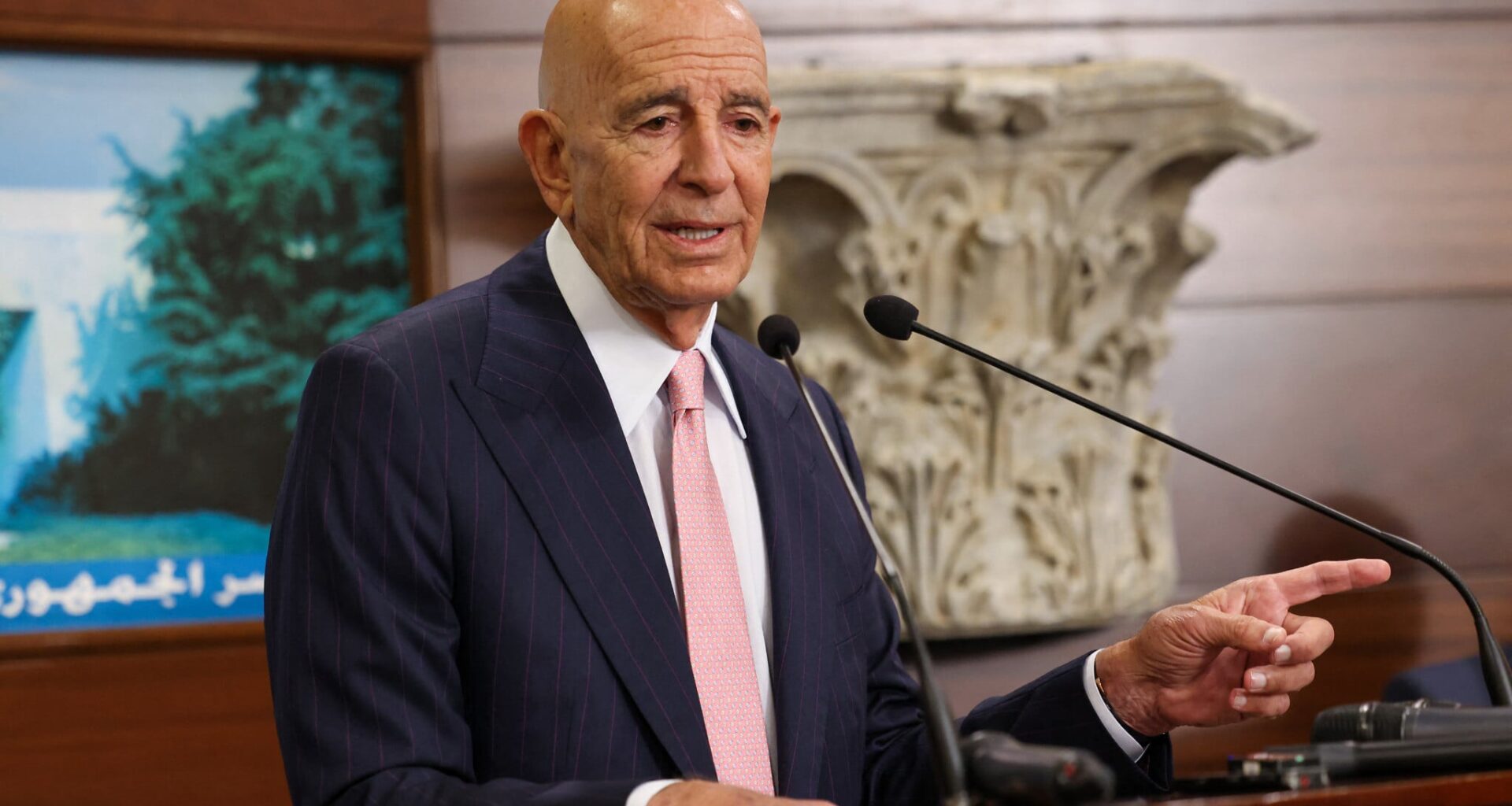
Prime Minister Benjamin Netanyahu on Monday met with the US Ambassador to Turkey and Special Envoy to Syria and Lebanon Tom Barrack, amid concerns that Israel could launch a major military offensive against Hezbollah if Beirut does not step up its campaign to disarm the terror group.
Lebanon’s foreign minister said Friday the country has received warnings from Arab and international parties that Israel was preparing for a wide-scale military operation against Hezbollah, as the country intensified diplomatic efforts to avert an escalation and maintain the November 2024 ceasefire that ended over a year of fighting.
Netanyahu met Barrack in his Jerusalem office alongside Foreign Minister Gideon Sa’ar, acting National Security Adviser Gil Reich, Military Secretary Maj. Gen. Roman Gofman, and Ambassador to Washington Yechiel Leiter. The US side included Ambassador to Israel Mike Huckabee and Middle East adviser Aryeh Lightstone.
The Lebanese army told The Washington Post on Monday in a statement that “weapons control” efforts in the country — involving disarming Hezbollah south of the Litani River — were almost complete, ahead of a three-week deadline set by Beirut for its military to put arms under the sole control of the state.
Israel “has not provided any tangible evidence proving the reactivation of military activity south of the Litani River, nor any systematic reconstruction of combat capabilities,” the Lebanese army added.
Get The Times of Israel’s Daily Edition
by email and never miss our top stories
By signing up, you agree to the terms
Israeli officials told the Post the deadline for possible military action against Hezbollah at the end of the year could be extended, due to US President Donald Trump’s aversion to an escalation torpedoing his declarations that he has brought peace to the Middle East with the ceasefire in Gaza.
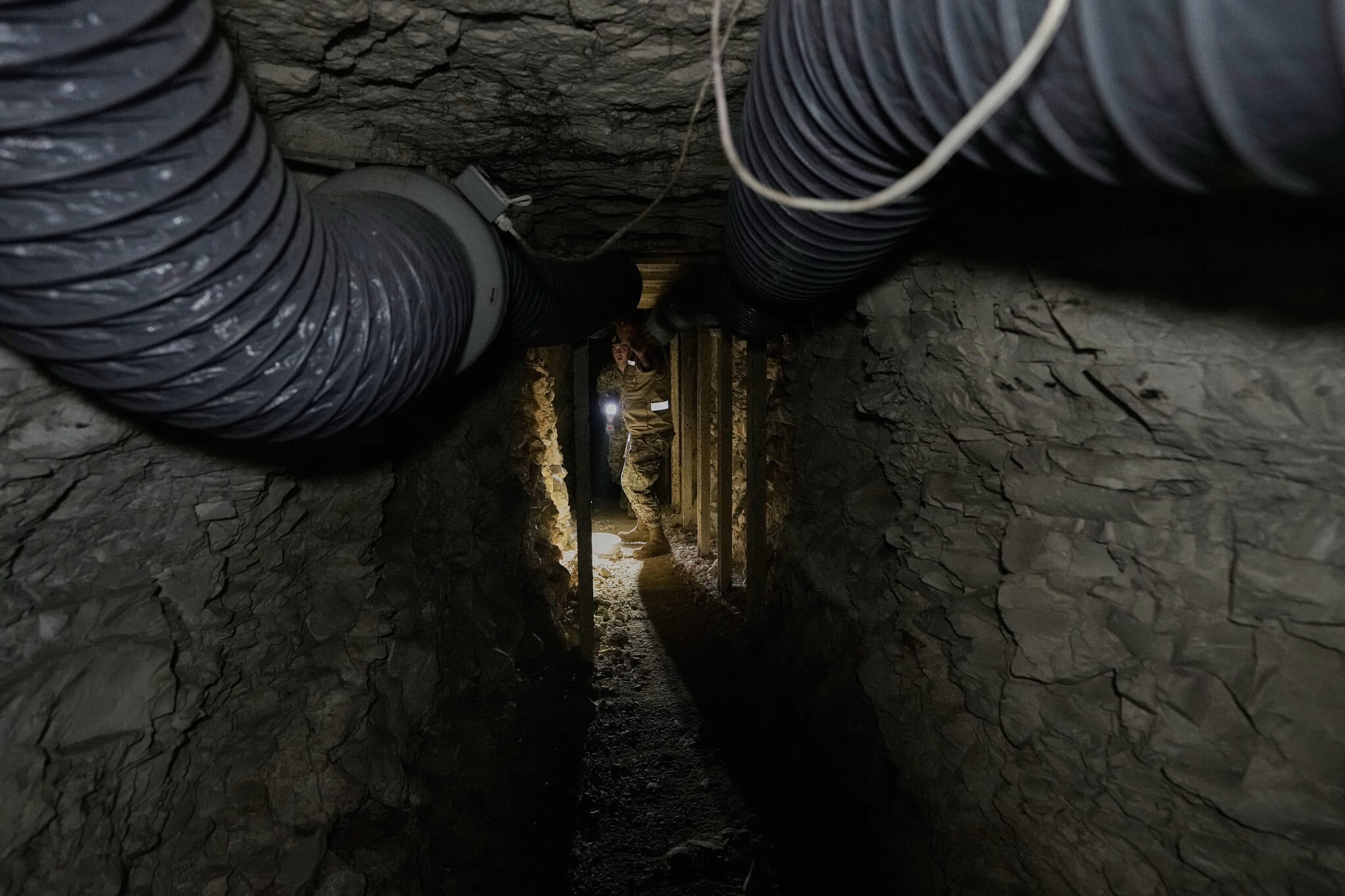
Lebanese army soldiers walk through a tunnel dug into a mountain that was used by Hezbollah as a clinic and storage facility near the Lebanese-Israeli border in the Zibqin Valley, southern Lebanon, November 28, 2025. (AP Photo/Bilal Hussein)
“The US won’t like this part of the world blowing up,” one of the Israeli officials said, speaking anonymously.
Meanwhile, Western and Arab diplomats on Monday toured an area along Lebanon’s border with Israel where Lebanese troops and UN peacekeepers have been carrying out efforts to disarm Hezbollah.
The delegation that included the ambassadors of the United States and Saudi Arabia was accompanied by Gen. Rodolph Haikal, commander of the Lebanese Armed Forces, as well as top officers in the border region.
Parts of the zone south of the Litani River and north of the border with Israel were formerly a Hezbollah stronghold, off-limits to the Lebanese national army and UN peacekeepers deployed in the area.
During the tour, the diplomats and military attaches were taken to an army post that overlooks one of five hills inside Lebanon that were captured by Israeli troops last year.
“The main goal of the military is to guarantee stability,” an army statement quoted Haikal as telling the diplomats. Haikal added that the tour aims to show that the Lebanese army is committed to the ceasefire agreement that ended the Israel-Hezbollah war last year.
There were no comments from the diplomats.
Demands for Hezbollah’s disarmament have mounted since the onset of a ceasefire between Israel and the terror group just over a year ago.
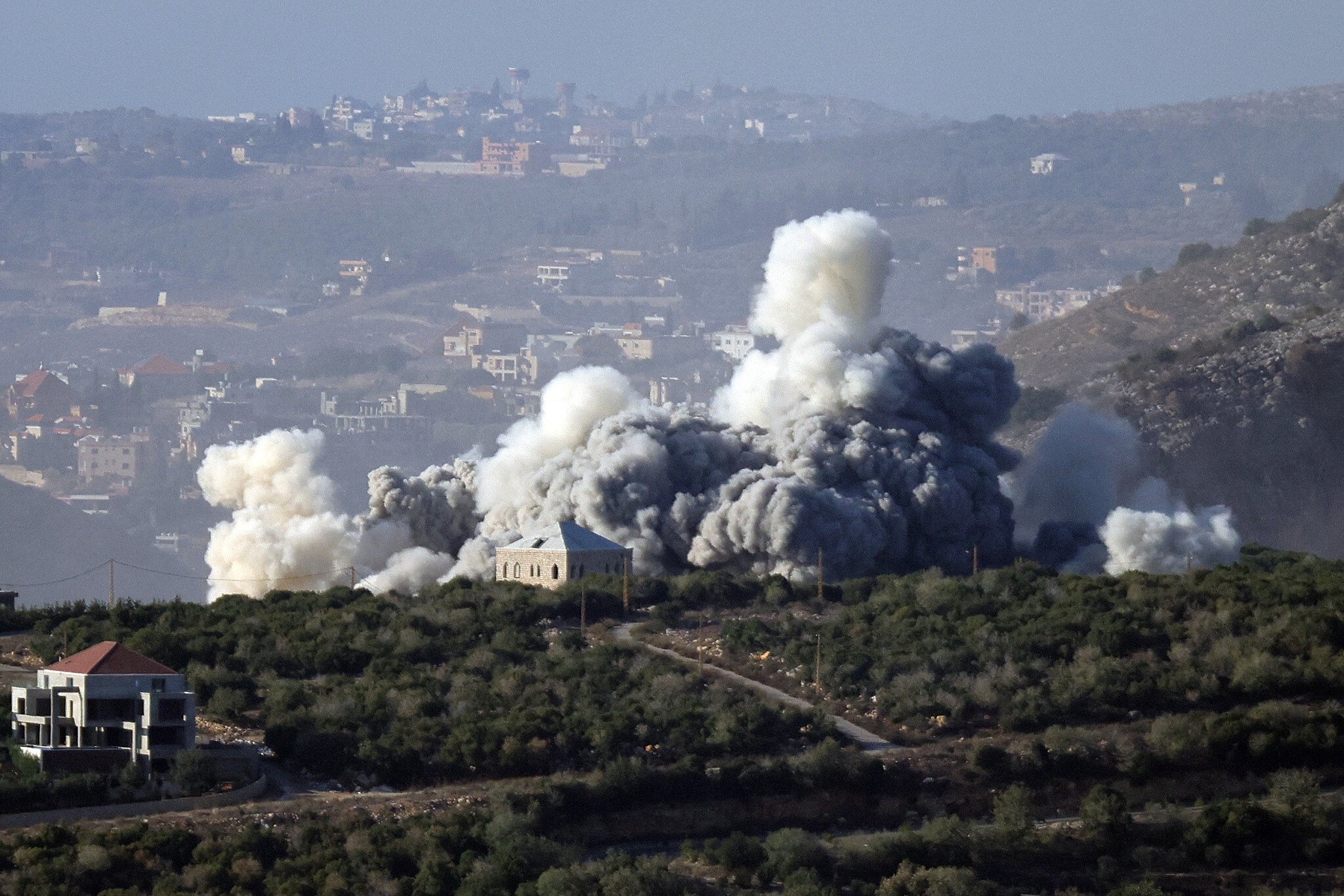
Smoke rises from the site of an Israeli airstrike in the southern Lebanese village of El Mahmoudiyeh on November 27, 2025. (Rabih DAHER / AFP)
Under the terms of the ceasefire, which ended the October 2023-November 2024 conflict between Israel and a badly weakened Hezbollah, the terror group was to be disarmed and allow the Lebanese Armed Forces to deploy fully across the country as the Israel Defense Forces withdrew. That disarmament has not yet happened, however, despite Lebanon having drawn up a plan to do so.
Israel has retained troops in the country, and regularly conducts strikes that it says are against Hezbollah attempts to rebuild its strength. In an unusual occurrence on Saturday, the IDF issued a warning to residents of the southern Lebanon town of Yanouh ahead of planned airstrikes against Hezbollah infrastructure, but postponed the strike after Lebanese troops went to search the site.
Over the past weeks, the US has increased pressure on Lebanon to work harder on disarming Hezbollah and canceled a planned trip to Washington last month by Haikal.
US officials were angered in November by a Lebanese army statement that blamed Israel for destabilizing Lebanon and blocking the Lebanese military deployment in the country’s south.
A senior Lebanese army official told The Associated Press on Monday that Haikal will fly to France this week, where he will attend a meeting with US, French, and Saudi officials to discuss ways of assisting the army in its mission. The officer spoke on condition of anonymity because he was not authorized to speak publicly.
Emanuel Fabian contributed to this report.
Give a Hanukkah gift that illuminates

This year, send your loved ones a special connection to Israel and the Jewish world.
A Times of Israel Community gift membership entitles your recipient to one full year of membership benefits, at a special discounted price.
Already a member? Sign in to stop seeing this
You appreciate our journalism

You clearly find our careful reporting valuable, in a time when facts are often distorted and news coverage often lacks context.
Your support is essential to continue our work. We want to continue delivering the professional journalism you value, even as the demands on our newsroom have grown dramatically since October 7.
So today, please consider joining our reader support group, The Times of Israel Community. For as little as $6 a month you’ll become our partners while enjoying The Times of Israel AD-FREE, as well as accessing exclusive content available only to Times of Israel Community members.
Thank you,
David Horovitz, Founding Editor of The Times of Israel