
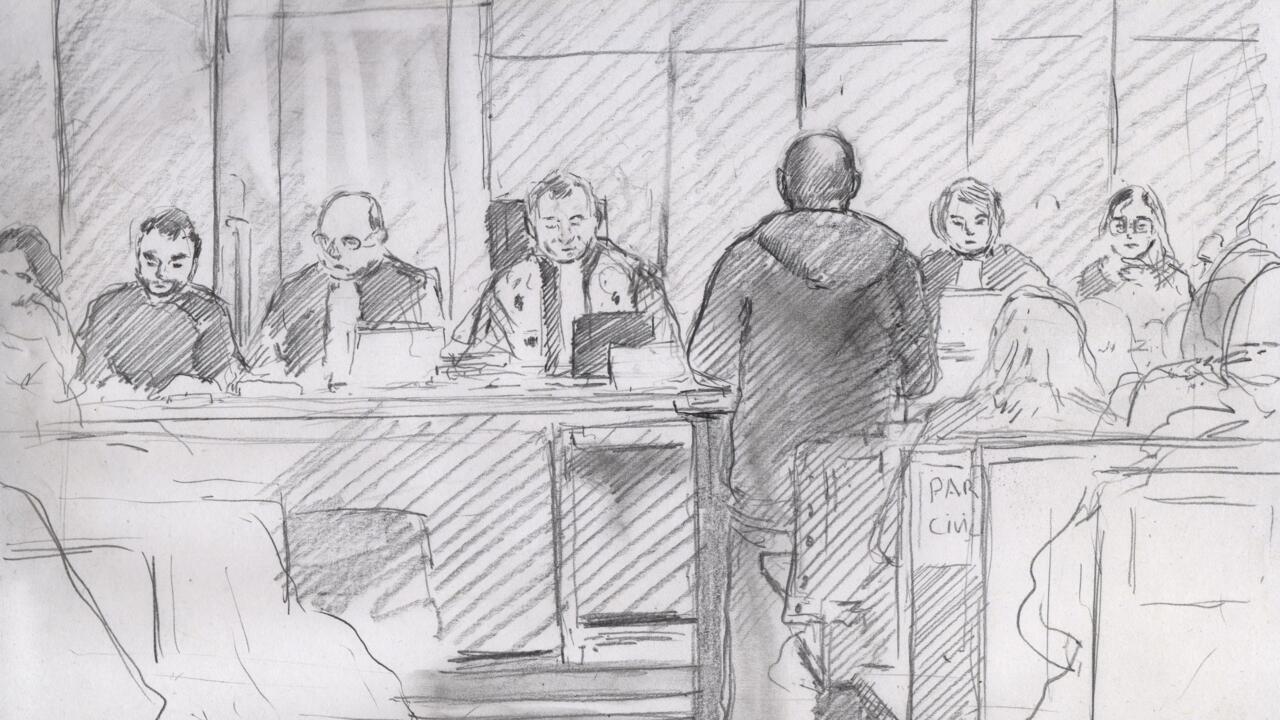
Former Congolese rebel leader Roger Lumbala was given a 30-year prison sentence for complicity in crimes against humanity in the Democratic Republic of Congo in 2002-2003.
Lumbala, accused of being one of the masterminds of atrocities in the Second Congo War, had been on trial since last month after he was arrested in France in 2020.
Read moreDR Congo ex-rebel leader Lumbala’s trial opens in France
For human rights organisations, the trial was a historic opportunity to challenge the impunity enjoyed by warring parties in eastern DR Congo, where fighting continues despite a “peace” agreement ratified in Washington in early December.
Prosecutors had sought a life sentence for Lumbala, 67.
Announcing the verdict, court President Marc Sommerer said Lumbala was found guilty of ordering or aiding and abetting torture and inhumane crimes, summary executions, rape constituting torture, sexual slavery, forced labour, theft and pillage.
Lumbala, who briefly served as trade minister then ran for president in 2006, insisted he was merely a politician with no soldiers or volunteers under his control.
For more than a month, the court heard about rape used as a weapon of war, sexual slavery, forced labour, torture, mutilation, summary executions, systematic looting, extortion, and the plundering of resources, including diamonds.
Operation ‘Erase the Slate’
The alleged atrocities were committed in 2002-2003 during Operation “Erase the Slate”, conducted in the northeast of the country by the Rally of Congolese Democrats and Nationalists (RCD-N) – Lumbala’s rebel group.
The RCD-N was supported by neighbouring Uganda and allied with the MLC group of the current Congolese Minister of Transport, Jean-Pierre Bemba.
During the trial, one man told how his brother had his forearm amputated and was then executed after being unable to eat his severed ear.
Women recounted rapes by soldiers, often gang rapes committed in front of parents, husbands, and children.
The victims were mostly Nande or Bambuti Pygmies, ethnic groups accused by the attackers of siding with a rival faction.
The principle of universal jurisdiction
The Second Congo War ran from 1998 to 2003. It involved nine countries and killed more than 5 million people, including many who died of hunger and disease.
While some individuals have been tried at the International Criminal Court (ICC) for crimes committed during the war, Lumbala’s trial marked the first time a Congolese national has been tried before a national court in connection with the conflict.
Lumbala was arrested in January 2021 under France’s “universal jurisdiction” law, which allows French courts to seek justice related to crimes against humanity committed abroad.
Lumbala refused to testify in the trial, questioning the legitimacy of the French court. He attended the verdict.
Yasmine Chubin, legal director of the Clooney Foundation for Justice, which was involved in the trial as a civil party, said using national courts for such cases would allow for arrests of suspects beyond the handful sought by the ICC.
With universal jurisdiction “you sort of tighten the net and make it so that there are lots of different options for people (victims) and nowhere for perpetrators of these crimes to go,” she said.
Pisco Paluku Sirikivuya, a 50-year-old nurse from Mambasa in eastern Congo, travelled to Paris to tell the court how RCD-N rebels robbed and injured him, killed his uncle and raped his friend’s wife in Congo’s Ituri province.
“I am moved and very satisfied with this verdict. We have waited so long,” he said on Monday.
“We hope that this will serve as a lesson to those who continue to bring grief to the people of Congo, and particularly to Ituri.”
(FRANCE 24 with AFP and Reuters)