
This article is an on-site version of our FirstFT newsletter. Subscribers can sign up to our Asia, Europe/Africa or Americas edition to get the newsletter delivered every weekday morning. Explore all of our newsletters here
Good morning and welcome back to FirstFT Asia. In today’s newsletter:
Australia agrees on gun law reform
The elite British private school that lost its way in Singapore
Xi attacks ‘reckless’ government spending
Is there a right way for CEOs to quit?
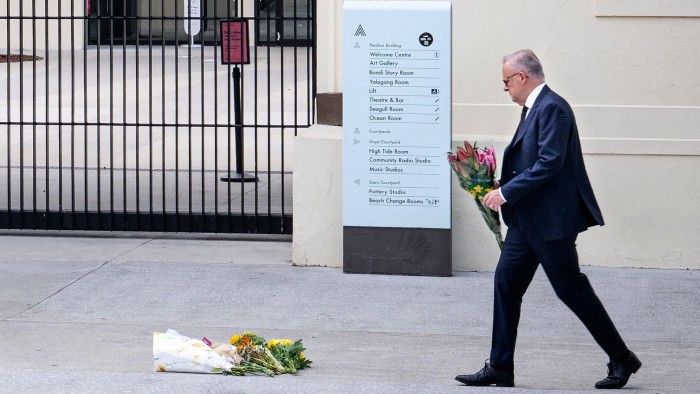
We start in Australia, which has agreed a string of measures to toughen national firearms laws, a day after gunmen killed 15 people in an attack on a Jewish festival in Sydney.
What to know: Prime Minister Anthony Albanese said his cabinet and state leaders had agreed to accelerate the creation of a national firearms registry and would provide A$100mn ($66mn) to the states and territories. Other measures include limits on how many firearms a single person can own and making it a requirement that gun buyers are Australian citizens. “Leaders agreed that strong, decisive and focused action was needed on gun law reform as an immediate action,” a joint cabinet statement said.
Speaking earlier in the day after visiting the scene of Sunday’s attack at Bondi Beach, Albanese said authorities would do “whatever is necessary” to protect Australia’s Jewish community, saying antisemitism was “a scourge and we will eradicate it together”.
Previous reforms: Australia adopted some of the world’s most stringent gun laws after 35 people were killed by a lone gunman in Port Arthur, Tasmania, in 1996. The measures included a gun amnesty and buyback scheme as the country moved to ban the type of semi-automatic weapon used. However, there are now thought to be more weapons in circulation than in 1996, with powerful long-arm rifles and shotguns popular with hunters. Read the full story.
‘A culmination of hate’: Bondi Beach has become a place of heartache for the nation’s Jews — and the focus of fury over its government’s handling of rising antisemitism.
‘Hero’ who tackled Bondi gunman: Ahmed al Ahmed drew international praise for disarming one of the shooters in the deadly attack. His parents, who moved to Australia from Syria two months ago, spoke to local media about their son.
Here’s what else we’re keeping tabs on today:
Economic data: The US and Hong Kong report November employment data.
Volkswagen: The carmaker will stop manufacturing vehicles at its site in Dresden after today, marking the first time in the company’s 88-year history that it will close production at a site in Germany.
Five more top stories
1. A Hong Kong court found media billionaire Jimmy Lai guilty on national security charges, in the most closely watched trial since Beijing’s crackdown on the city’s pro-democracy movement six years ago. The trial has been viewed as a barometer for political and media freedoms in the semi-autonomous Chinese territory. Lai faces up to life in prison.
2. Donald Trump said talks with Russian President Vladimir Putin had brought a peace deal in Ukraine “closer now than we have ever been”, even as European officials said sensitive territorial issues had yet to be resolved. Trump was speaking just hours after officials from Ukraine, Germany and the US claimed progress in drafting a deal to end Russia’s invasion.
3. The US has backed a $7.4bn investment in a critical minerals processing plant to be built by Korea Zinc as Washington tries to counter China’s dominance over the supply chain for strategic metals. The project comes after South Korea agreed to invest $350bn in the US in return for lower tariffs as part of a trade deal signed in late October. Read the full story.
4. Brussels plans to scrap the EU’s 2035 combustion engine ban, allowing carmakers to continue making a limited number of petrol and diesel-fuelled vehicles after the prohibition was meant to come into effect. The European Commission is set to propose a revision of the law today.
5. Federal Reserve governor Stephen Miran has said that “phantom inflation” is distorting the US central bank’s decision-making and causing it to keep interest rates too high. Miran, a staunch ally of Trump and a vocal proponent of lower rates, said that when “noise” was stripped out, underlying inflation was close to the Fed’s target.
FT Investigation  © FT montage/Huiying Ore/FT
Former staff allege bullying, misogyny and safeguarding lapses at the Singapore branch of an elite British school, saying profit was prioritised over education and welfare. Experts warn the situation shows the risks of franchising prestigious school brands without sufficient oversight.
We’re also reading . . . Chart of the day
Chinese investment declined further last month while retail sales weakened sharply, as President Xi Jinping launched an unusually blunt attack on “reckless” government spending that Beijing believes is constraining growth.
 Take a break from the news . . .
The importance of choreographing an orderly leadership succession has been highlighted by recent turmoil at companies such as Diageo and HSBC. FT management editor Anjli Raval asks: is there a right way for CEOs to quit?
