
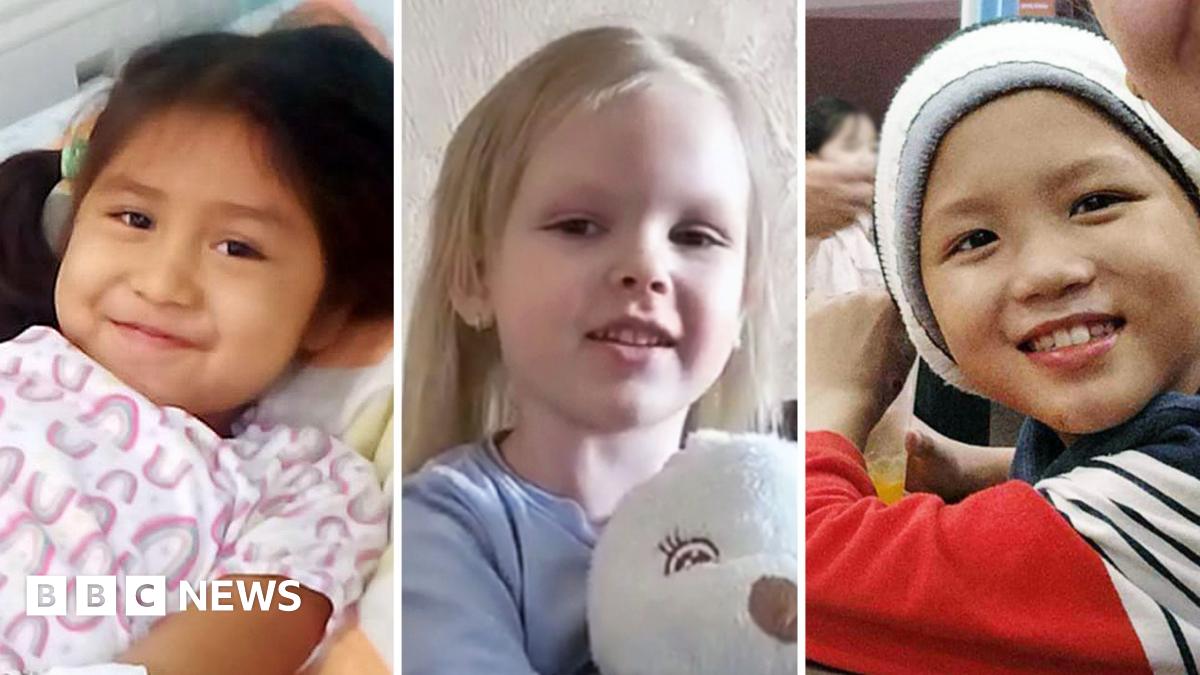
Olena showed us the contract she had been asked to sign.
In addition to the family’s $1,500 (£1,122) filming fee on the day, it states they would get $8,000 (£5,986) once the fundraising goal was met. The amount for the goal, however, has been left blank.
The contract showed an address in New York for Chance Letikva. On the organisation’s website, there is another – in Beit Shemesh, about an hour from Jerusalem. We travelled to both, but found no sign of it.
And we discovered Chance Letikva seems to be one of many such organisations.
The man who filmed Viktoriia’s campaign told our producer – who was posing as a friend of a sick child – that he works for other similar organisations.
“Each time, it’s a different one,” the man – who had introduced himself as “Oleh” – told her. “I hate to put it this way, but they work kind of like a conveyor belt.”
“About a dozen similar companies” requested “material”, he said, naming two of them – Saint Teresa and Little Angels, both registered in the US.
When we checked their registration documents, we once again found Erez Hadari’s name.
What is not clear is where the money raised for the children has gone.
More than a year after Viktoriia’s filming, her mother Olena rang Oleh, who seems to go by Alex Kohen online, to find out. Shortly afterwards, someone from Chance Letikva called to say the donations had paid for advertising, she says.
This is also what Mr Hadari told Aljin, Khalil’s mother, when she confronted him over the phone.
“There is cost of advertising. So the company lost money,” Mr Hadari told her, without giving any evidence to support this.
Charity experts told us advertising should not amount to more than 20% of the total raised by campaigns.
Someone previously employed to recruit children for Chance Letikva campaigns told us how those featured had been chosen.
They had been asked to visit oncology clinics, they said – speaking on condition of anonymity.
“They were always looking for beautiful children with white skin. The child had to be three to nine years old. They had to know how to speak well. They had to be without hair,” they told us.
“They asked me for photos, to see if the child is right, and I would send it to Erez.”
The whistleblower told us Mr Hadari would then send the photo on to someone else, in Israel, whose name they were never told.
As for Mr Hadari himself, we tried to reach him at two addresses in Canada but could not find him. He replied to one voice note we had sent him – asking about the money he had been apparently crowdfunding – by saying the organisation “has never been active”, without specifying which one. He did not respond to a further voice note and letter laying out all our questions and allegations.