
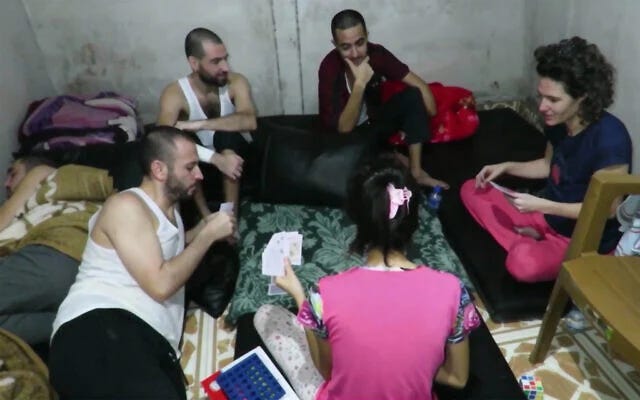
It’s horrifying that Israelis know precisely what it’s like to be in Sydney today: The anguish. The rage. The heartbreak. The grief. The fervent, desperate praying.
The vulnerability that will never, ever completely dissipate.
The recognition that there are patterns to Jewish history that do not end.
No matter where you live. No matter how good things once were.
Because if you’re an identified Jew, you’re part of this story.
Uvdah, Israel’s rough equivalent to 60 Minutes, is one of the platforms on which Ilana Dayan, one of Israel’s most highly regarded and extraordinarily talented journalists, presents her work. Always superb, she outdid herself last week.
Much of the English-language Israel-related press has shared the video of the “beautiful six” hostages, later murdered in cold blood in a Hamas tunnel, lighting Hanukkah candles in December 2023. It’s moving and heartbreaking, but that brief clip is nothing compared to the entire hour-long episode which covers much more than Hanukkah.
There’s no way, yet, to link to that one episode. But click on the thumbnail and you’ll get there. Even if you don’t speak Hebrew, watch some … the words are incredibly important, but some of it is in English, and all the visuals speak in ways that words cannot.
This episode of Uvdah is a beautiful, harrowing depiction of six extraordinary souls, from six very different places in life and in Israel, who found themselves together in the depths of hell—and who were then murdered together.
For hours, for days, for weeks, Hamas filmed them. And in this one very short clip (on Instagram, here), as they sing Maoz Tzur, someone asks how many verses there are. Hersh Goldberg-Polin responds that there’s one for each time our enemies tried to destroy us and failed.
To which Eden Yerushalmi quips: “We should add another verse.”
What makes that comment so chilling is that Eden Yerushalmi had no way of knowing that that is precisely what had already happened in Israel. Many versions of the additional verse made their way around, and last year, we shared the one written by Professor Vered Noam.
Our family sang it, with voices cracking, for the last two years that we celebrated Hanukkah, praying that they would all come home. Some did; far too many did not.
Yet, if we dared imagine that this year, perhaps we might not light candles with hearts quite as broken, then we got a reminder, today, that the hatred of the Jew may morph, but it never goes away.
Which is why we force the light to grow brighter. It’s the only meaningful Jewish response.
When does a cri de cœur become liturgy? 
Almost since the very first days of the war, most congregations in Israel have made additions to the liturgy, both on weekdays and on Shabbat/holidays. What those additions are is for a different time.
For Hanukkah this year, we’re planning to share four podcast conversations, each related to one dimension of what the holiday is about. Here is the tentative schedule:
Monday: Kalanit Turgeman is the sister of Dalia Emanuelof. Dalia’s son, Dvir, was the first Israeli solder killed in Operation Cast Lead, in January 2009. Kalanit tells the story of her nephew Dvir, the tragedy of his falling, and a miracle of sorts that followed.
Wednesday: Israel is a land of modern day Maccabees. Our younger generation showed that they are made of the very best that the Jewish people has ever produced. My colleague at Shalem College, Dr. Ido Hevroni, shares how teaching war-saturated classics like the Iliad and the Odyssey to young people who have just returned from battle is different from teaching it to anyone else. Only in Israel can these conversations unfold.
Friday: We are used to thinking about Hanukkah as being about a battle for the religious freedoms that foreign powers had sought to steal from us. But what about when we have to battle our own leaders for religious freedom? Rabbi Shaul Farber, founder and CEO of Itim, speaks about the surge of interest in Jewish expression in post-October-7 Israel, and the irony that it risks being snuffed out by our own religious authorities.
Sunday: Jews have fought bravely not only in Israel’s wars, but in armies across the world. Far too often, Jewish soldiers were buried with nothing to indicate that they were Jews. Shalom Lamm, who heads Operation Benjamin, speaks about the sacred search for those graves and the delicate work with local governments to honor these men as Jews. Contrary to what we might expect, there are such graves in Israel, too. Lamm explains how that could possibly be.
