
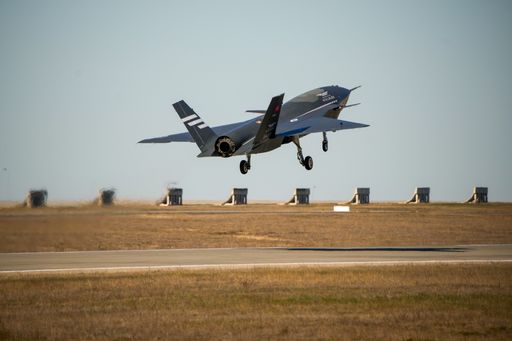
Last month, Türkiye’s defence sector achieved a spectacular feat. During a live test over the Black Sea, Baykar’s unmanned jet Kizilelma detected a fast aerial target using Aselsan’s Murad radar and launched a Tubitak Sage Gokdogan missile from beyond visual range. The missile hit.
Beyond the engagement itself, the significance lay in the chain behind it: an unmanned platform, a national radar and a national air-to-air missile operating within a single domestic architecture.
It marked a step toward an indigenous, autonomy-enabled air combat stack rather than isolated technological achievements.
And security experts are unanimous that the war in Ukraine changed the character of war.
It pushed defence companies to rethink how they work, what they build and how fast they can deliver it. The centre of gravity is shifting from slow, hardware-centric programmes to systems driven by software, autonomy and data.
Defence analyst Arda Mevlutoglu describes the direction of travel in simple terms.
“There are strong indications that military advantage is shifting from traditional platforms to software, autonomy and adaptable systems,” he tells TRT World.
“Superiority is increasingly determined by how fast a force can sense, decide, adapt and strike rather than by possessing the most exquisite platform.”
Uncrewed systems are not new. What is new is the maturity of enabling technologies and the scale of demand. Advances in artificial intelligence, sensors, communications, advanced materials and power management have turned autonomy from a niche add-on into a core design principle.
Associate professor Merve Seren of the Ankara-based Yildirim Beyazit University argues that Ukraine accelerated the shift by changing how militaries even define the category.
In the 1990s, she notes, unmanned systems entered service mainly as air platforms.
Today, she tells TRT World, “unmanned platforms should be seen as a family – spanning land, air and sea, including both surface and underwater systems that are being integrated rapidly and at scale.”
That matters because the change is no longer just about using drones on the battlefield. It is about doctrine. Seren says that earlier use of unmanned platforms did not necessarily create doctrinal transformation.
“Now the fast, intense and widespread use of unmanned systems has caused a doctrinal change in countries’ defence approaches,” she says, pointing to concepts that became central in Ukraine, including saturation attacks designed to exhaust air and missile defence, swarm tactics and the mass employment of FPV drones.
Mevlutoglu makes a similar point from an innovation and procurement angle. The real break, he argues, is the compression of innovation cycles and the diffusion of dual-use technology.
“Start-ups, commercial technologies and autonomy-enabled systems can now deliver meaningful combat impact at a fraction of the cost and time associated with traditional defence procurement,” he says.
The Ukraine shift
Ukraine highlighted this dynamic by turning frontline feedback into rapid adaptation, sometimes in weeks, as explosive-equipped FPV drones, AI-supported target identification and improved loitering munitions altered battlefield conditions faster than many legacy modernisation plans could match.
In policy circles, this broader shift is often grouped under the label deep tech. The term covers AI and data, robotics and autonomous systems, advanced materials and manufacturing, space, new energy systems, microelectronics and quantum technologies, among others.
These fields demand serious engineering and carry uncertain timelines, but once they mature, they scale quickly and can overturn established markets. In defence, that means the edge is no longer only about upgrading legacy systems.
It is about creating new capabilities altogether, then integrating them into networks that link land, sea, air, space and cyber into a single data-rich battlespace.
Governments have internalised the logic. The US created the Defense Innovation Unit in 2015 to pull commercial technology into defence programmes at commercial speeds.
Related
NATO launched DIANA to draw startups toward defence problems. What used to be an exception is becoming a baseline expectation.
Mevlutoglu describes the strategic implication as a competition between systems, not just platforms.
“The Ukraine war has made visible that conflicts are now contests between innovation systems,” he says. “Those who can iterate fastest, integrate autonomy and deploy software-defined capabilities gain disproportionate advantage.”
The most visible face of this shift is the rise of companies that were built around autonomy and software from day one.
This shift is also reflected in a growing number of cross-company partnerships and joint initiatives.
Ukraine sits at the centre of this story as both laboratory and warning sign. It is a proof of concept for how cheap drones, autonomy and battlefield networking can change operational tempo.
It is also a warning about how quickly a battlefield can become saturated with low-cost attritable systems that force constant adaptation.
Seren points to the maritime dimension as a clear illustration of why the family concept matters.
She says the damage inflicted on the Russian navy shows “the destruction that unmanned maritime vehicles can cause,” while underwater unmanned platforms are becoming even more challenging because the subsurface domain is “a much more grey area” than the surface or the air.
Seren also argues that the other major trend is not only unmanned systems but the autonomisation of war through AI and data-driven processes.
“It is necessary not to think of AI algorithms only as elements integrated into unmanned aerial vehicles,” she says.