
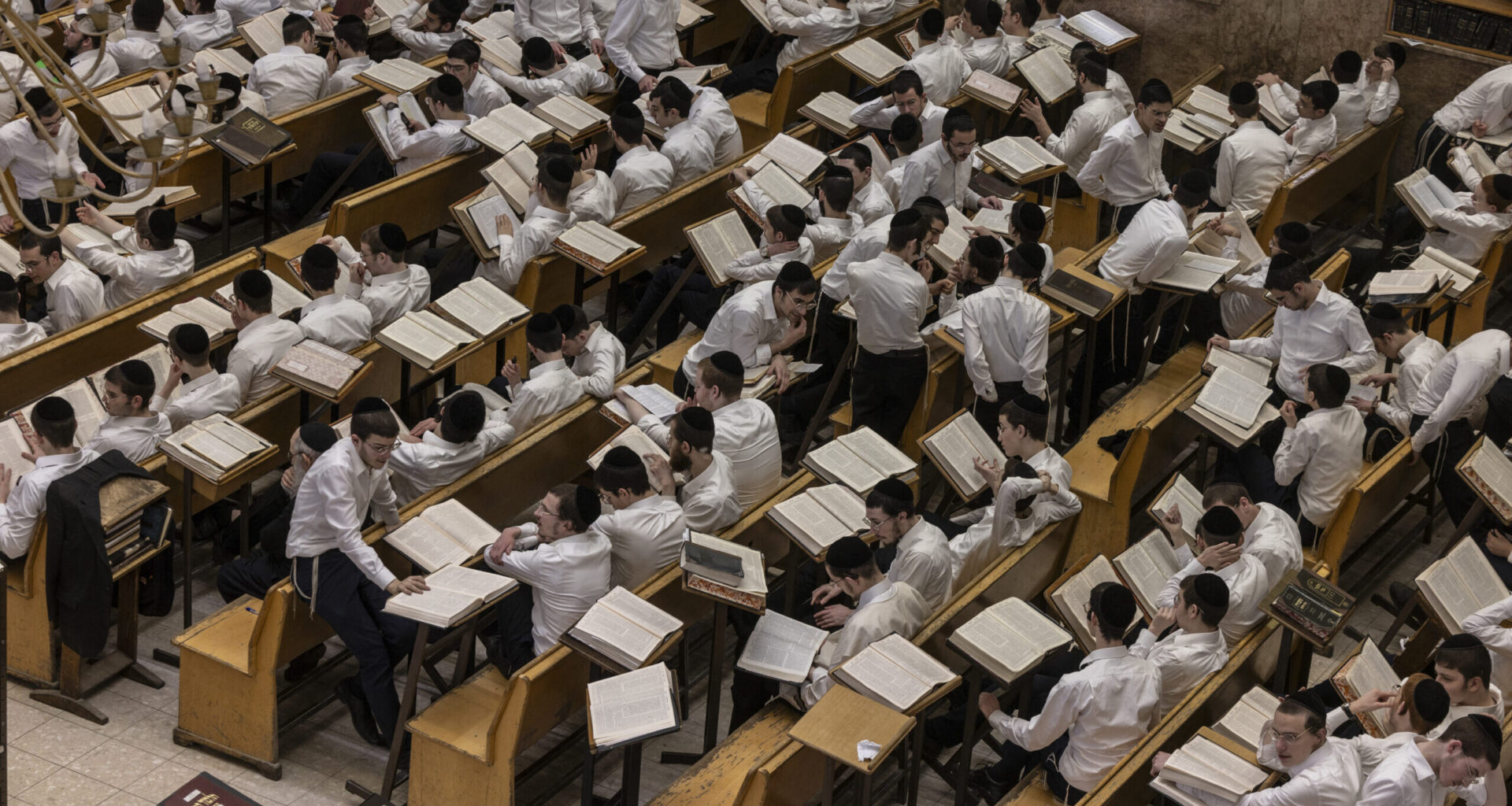
The Israel Democracy Institute (IDI) released its 10th annual Statistical Report on Ultra-Orthodox Society on Sunday, detailing what editors described as a decade-long stall in the integration of Haredi men into Israel’s workforce and military service even as the community’s size and the number of yeshiva and kollel students continued to climb.
The report, edited by Dr. Gilad Malach and Dr. Lee Cahaner of IDI’s Ultra-Orthodox Society in Israel Program, estimates the ultra-Orthodox population at about 1,452,350 people, roughly 14.3% of Israel’s population. It also describes ultra-Orthodox society as exceptionally young, with 57% aged 19 and under and a fertility rate of about 6.5 children per woman, trends the institute said have remained largely unchanged over the past decade.
Malach and Cahaner said in a joint statement, “The data reflects a decade of stagnation and even a decline in the integration of ultra-Orthodox men, compared to the decade prior, which was one of momentum in Haredi integration.” They added that the slide shows up in employment, income, the range of sectors in which men work, and enlistment. “Similarly, no significant change has occurred in matriculation eligibility over the last decade, all while there has been rapid growth in the number of yeshiva and kollel students.”
By contrast, the report says ultra-Orthodox women have continued moving into education, employment and training at rates approaching those of non-Haredi Jewish women, though their pay remains lower. The authors also pointed to technology training and rising levels of higher education as a possible driver of future integration, alongside increased internet use.
Employment data in the report put Haredi male employment in 2025 at 53% and women’s employment at 81%, with both groups working fewer weekly hours than their non-Haredi Jewish counterparts. The wage gap remained wide: the average monthly wage for ultra-Orthodox men was listed as 9,929 shekels, about 49% of non-Haredi Jewish men’s income, while ultra-Orthodox women averaged 8,617 shekels, about 67% of non-Haredi Jewish women’s wages.
On service, the report says 2,560 graduates of ultra-Orthodox education enlisted in the Israel in 2024 and 500 entered national service. It found that 55% of those who joined the army were placed in general tracks rather than Haredi-adapted frameworks, a pattern the report says suggests many counted as ultra-Orthodox in the IDF are not ultra-Orthodox or later leave the community.
The report also highlights what it describes as a tension between poverty rates and asset ownership. It says 33% of ultra-Orthodox families live below the poverty line, yet 75% own an apartment, slightly higher than the share among the rest of Jewish society.