

EUR/USD has pulled back from session highs at 1.1764, and is trading practically flat on the daily chart, at 1.1755 at the time of writing. Weaker-than-expected preliminary Manufacturing and Services Purchasing Managers Indexes (PMIs) data put some pressure on the pair earlier on the day, although downside attempts remain limited so far.
Services activity in the Eurozone slowed down to a 52.6 level, as measured by the PMI, a whole point below November’s 53.6 reading and against market expectations of an improvement to 53.9. Likewise, manufacturing activity has accelerated its contraction to 49.2 from 49.6 in November. The market consensus had anticipated a slight improvement to 49.2.
German PMIs have shown a similar trend, with the Manufacturing PMI falling to 47.7 from 48.2 in the previous month and Services activity easing, slowing down to 52.6 from 53.1 in November. In France, Services PMI fell to 50.2 from 51.4 in the previous month, while manufacturing activity expanded against expectations, to 50.6 in December. from 47.8 in November
During the US market session, the focus will be on the release of the Nonfarm Payrolls reports for October and November. These figures are expected to provide further insight into the momentum of the US labour market, although the lack of key data, which was not collected during the government shutdown, will deprive traders of the full picture.
Euro Price Today
The table below shows the percentage change of Euro (EUR) against listed major currencies today. Euro was the strongest against the Canadian Dollar.
USDEURGBPJPYCADAUDNZDCHFUSD-0.04%-0.23%-0.26%0.02%0.02%-0.04%-0.03%EUR0.04%-0.20%-0.22%0.08%0.06%0.02%0.01%GBP0.23%0.20%-0.04%0.26%0.26%0.20%0.20%JPY0.26%0.22%0.04%0.29%0.29%0.22%0.23%CAD-0.02%-0.08%-0.26%-0.29%-0.01%-0.06%-0.05%AUD-0.02%-0.06%-0.26%-0.29%0.00%-0.06%-0.05%NZD0.04%-0.02%-0.20%-0.22%0.06%0.06%0.00%CHF0.03%-0.01%-0.20%-0.23%0.05%0.05%-0.00%
The heat map shows percentage changes of major currencies against each other. The base currency is picked from the left column, while the quote currency is picked from the top row. For example, if you pick the Euro from the left column and move along the horizontal line to the US Dollar, the percentage change displayed in the box will represent EUR (base)/USD (quote).
Daily Digest Market Movers: The US Dollar remains depressed ahead of US employment dataThe Euro (EUR) remains supported near recent highs as investors continue to bet on further interest rate cuts by the Federal Reserve (Fed). The European Central Bank (ECB) is widely expected to keep rates on hold at Thursday’s meeting, and might even hint at a rate hike in the second half of 2026.Data from the US released on Monday failed to support the US Dollar. The New York Empire State Manufacturing Index fell to -3.9 in December, below the 10.6 reading forecasted by the market and also below November’s 18.7 reading.In the Eurozone, on the other hand, Industrial Production data beat expectations with a 0.8% growth in October, from 0.2% in September, and market forecasts of a mere 0.1% advance. Year-on-year, industrial production increased 2%, from the 1.2% growth seen in September.Beyond that, negotiations for a peace deal in Ukraine continue. US offered NATO-style security guarantees to Kiev after US President Donald Trump and Ukrainian President Volodymyr Zelenskyy’s meeting in Berlin, which has provided some support to the Euro.In the US, Nonfarm Payrolls data are expected to show a 50K net increase in payrolls in November, with the Unemployment Rate steady at 4.4%. October’s payroll figures will also be out, although the jobless rate will not be released due to a lack of data.At the same time, the US Commerce Department will release October’s Retail Sales, which are expected to have grown 0.2%, the same pace as in September. Excluding automobiles, US retail consumption is expected to have risen 0.2%, slightly below September’s 0.3% growth.Technical Analysis: EUR/USD rally starts to give signs of exhaustion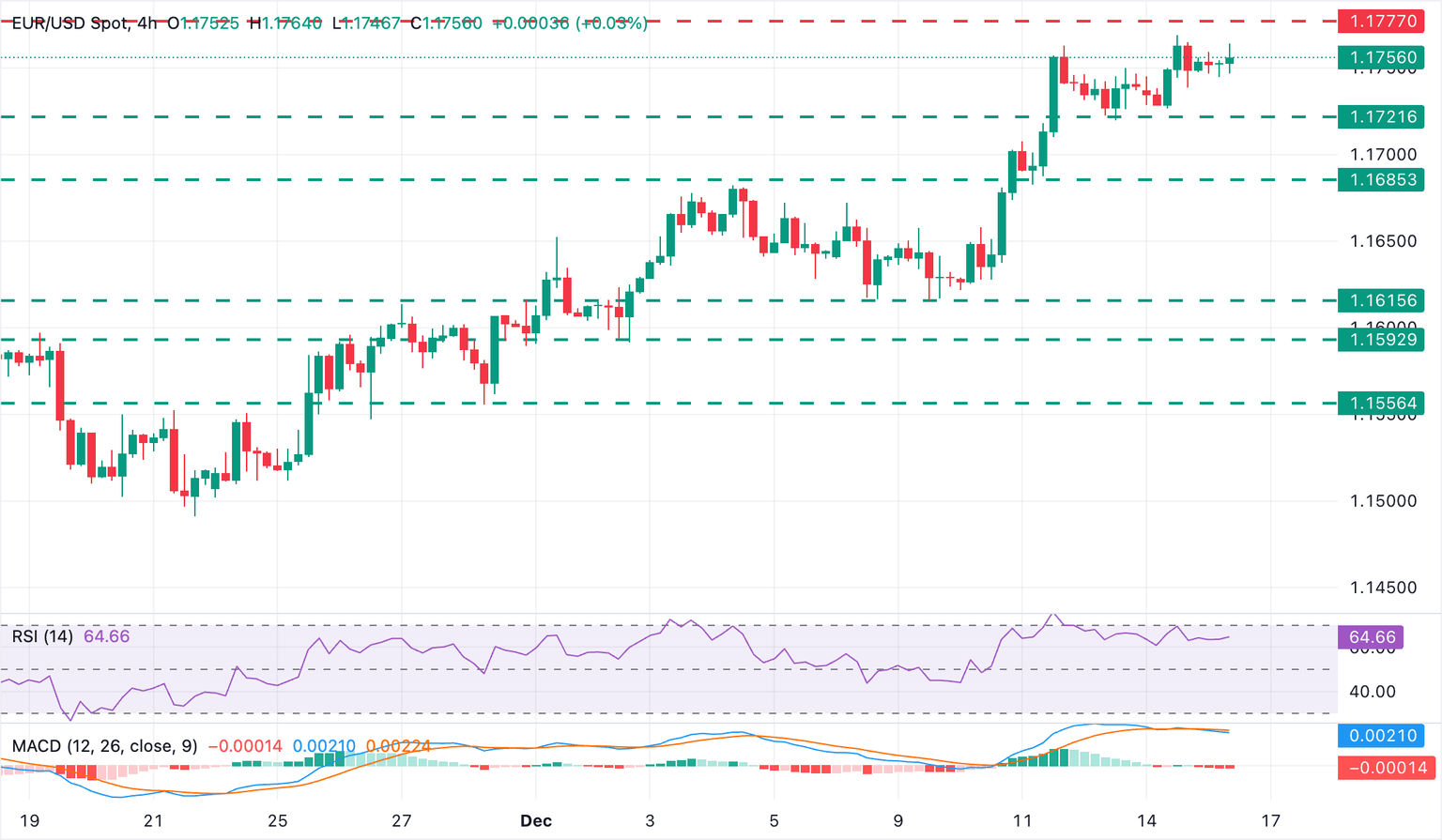 EUR/USD 4-Hour Chart
The EUR/USD maintains its bullish trend intact, but Monday’s upside attempts failed to confirm above last week’s high at 1.1763, and technical indicators are pointing to a weakening momentum. The. 4-hour Relative Strength Index (RSI) is showing a bearish divergence, although still at levels within bullish territory. Meanwhile, the Moving Average Convergence Divergence (MACD) indicator has recently crossed below the signal line, hinting at a deeper correction.
Immediate support is at the December 12 low, near 1.1720. Below that, the December 11 low at the 1.1685 area, and the December 9 low at 1.1615 will emerge as the next bearish targets. To the upside, the 1.1760-1.1770 area has capped bulls on December 11 and 15, ahead of the October 1 peak at around 1.1780. The pair has a significant resistance area here, which should be cleared to shift the focus towards the September 23 and 24 highs near 1.1820.
(This story was updated on December 16 at 11:10 GMT to reflect a last-minute consensus change in Nonfarm Payrolls for November to 50K.)
Employment FAQs
Labor market conditions are a key element to assess the health of an economy and thus a key driver for currency valuation. High employment, or low unemployment, has positive implications for consumer spending and thus economic growth, boosting the value of the local currency. Moreover, a very tight labor market – a situation in which there is a shortage of workers to fill open positions – can also have implications on inflation levels and thus monetary policy as low labor supply and high demand leads to higher wages.
The pace at which salaries are growing in an economy is key for policymakers. High wage growth means that households have more money to spend, usually leading to price increases in consumer goods. In contrast to more volatile sources of inflation such as energy prices, wage growth is seen as a key component of underlying and persisting inflation as salary increases are unlikely to be undone. Central banks around the world pay close attention to wage growth data when deciding on monetary policy.
The weight that each central bank assigns to labor market conditions depends on its objectives. Some central banks explicitly have mandates related to the labor market beyond controlling inflation levels. The US Federal Reserve (Fed), for example, has the dual mandate of promoting maximum employment and stable prices. Meanwhile, the European Central Bank’s (ECB) sole mandate is to keep inflation under control. Still, and despite whatever mandates they have, labor market conditions are an important factor for policymakers given its significance as a gauge of the health of the economy and their direct relationship to inflation.