
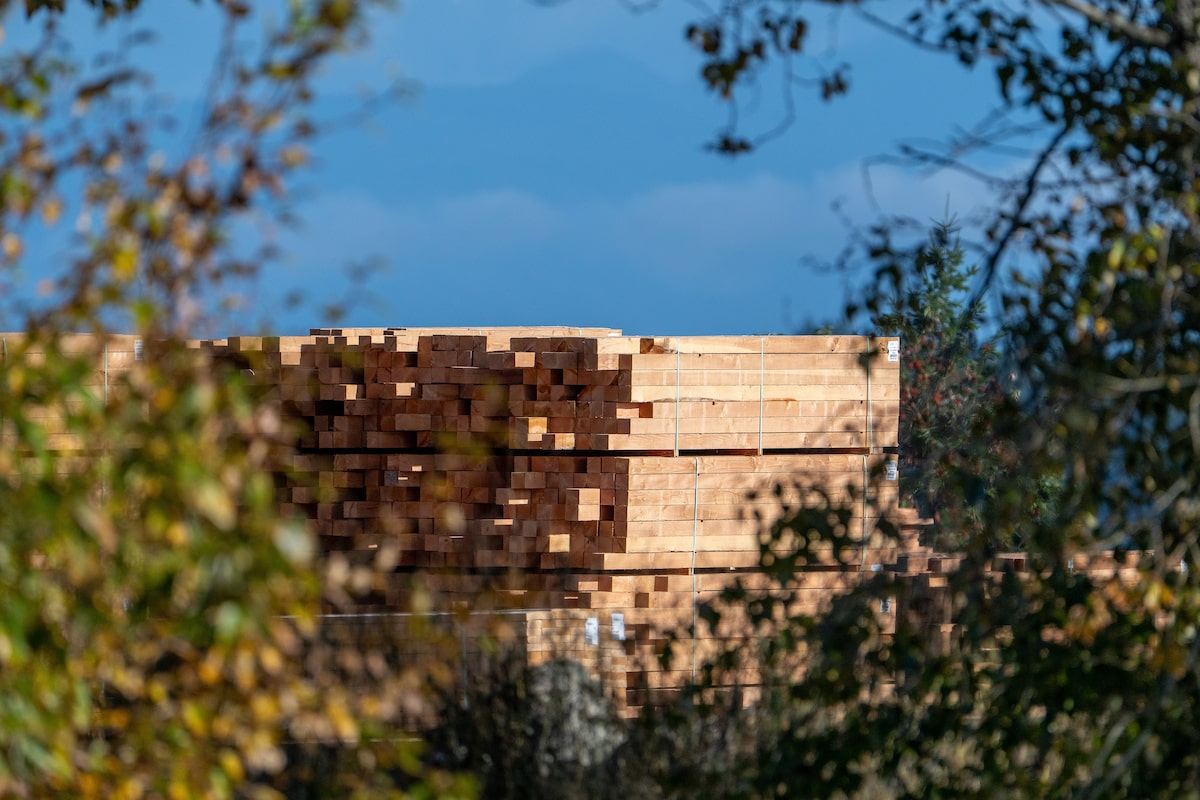
Stacks of lumber sit in the storage and sorting yard at the WFP Duke Point Sawmill in Nanaimo, B.C., in October.James MacDonald/The Globe and Mail
The National Association of Home Builders in the United States is warning about rising costs that it says are squeezing the construction industry after a recent spike in U.S. import taxes on Canadian softwood lumber.
Higher U.S. duties and new tariffs are having serious repercussions as American builders contend with escalating material and labour expenses, NAHB chairman Buddy Hughes cautioned on Monday.
Builders have also been struggling during a period of sluggish sales.
“Market conditions remain challenging with two-thirds of builders reporting they are offering incentives to move buyers off the fence,” Mr. Hughes said in a statement.
The latest NAHB/Wells Fargo Housing Market Index has edged up slightly, but negative sentiment lingers in perceptions of sales conditions, with the gauge remaining well below levels that would indicate confidence among home builders.
Ottawa to launch softwood lumber task force aimed at sector’s competitiveness
The index’s latest survey also showed that 40 per cent of builders reported reducing prices in December, with an average price drop of 5 per cent.
Warnings from the NAHB about inflationary pressures places it at odds with the powerful U.S. Lumber Coalition, whose members include Seattle-based Weyerhaeuser Co. WY-N
The coalition has said that the impact of U.S. import taxes on consumers has been vastly exaggerated, arguing that softwood lumber accounts for a tiny portion of the total costs of a new house, including land value.
For decades, the U.S. government has criticized the Canadian system in which forests are mostly on Crown land and buyers pay “stumpage fees” to provincial governments for the right to log.
The U.S. Department of Commerce argues those fees can give companies in Canada an unfair competitive advantage over their American counterparts, which harvest timber largely from private land and bid against each other for the privilege.
But the Canadian government has rejected the Commerce Department’s arguments that producers in Canada benefit from subsidies while allegedly dumping the product below market value.
Ottawa rejects softwood lumber industry request for duties payouts for fear of irritating U.S.
Tim Hodgson, the federal Energy and Natural Resources Minister, announced the launch on Monday of the Canadian Forest Sector Transformation Task Force.
The task force will be headed by Ken Kalesnikoff of Kalesnikoff Mass Timber in British Columbia and Frédéric Verreault of Chantiers Chibougamau in Quebec.
“Along with Ken and Frédéric, a seasoned group of industrial leaders will spend the next 90 days working urgently across the country to examine the opportunities and challenges shaping the sector’s global competitiveness and domestic needs,” Mr. Hodgson said during a news conference in Toronto.
The goal is to promote the use of Canadian wood products domestically, including mass timber and modular systems.
Mr. Hodgson reiterated that Ottawa has unveiled $2.35-billion in financial supports for Canada’s forestry industry since August. That includes $1.2-billion in loan guarantees to help Canadian lumber producers with operations and $500-million in grants and contributions in a bid to find new buyers overseas and reduce their dependence on the U.S.
Various forestry groups in Canada have expressed disappointment over the rollout of the financial supports, which they say has been too slow.
Banks tell Natural Resources Minister loans for softwood industry are imminent, sources say
Softwood markets are volatile, with U.S.-headquartered lumber producers asserting that by historical standards, current prices are relatively affordable.
Benchmark lumber prices are down roughly 75 per cent from the record highs attained in the spring of 2021, when there was huge demand from a do-it-yourself construction boom during the COVID-19 pandemic, with consumers snapping up materials for decks, fences and home renovations.
Softwood production from U.S. sawmills recently accounted for about 70 per cent of American domestic consumption. Canada accounted for 24 per cent of U.S. lumber consumption, while other countries had a market share of about 6 per cent.
The Canada-U.S. softwood dispute dates back to the early 1980s.
“For years, the sector has experienced the effects of repeated, unjust trade action by the United States,” Mr. Hodgson said. “Now, the United States is transforming its commercial relationships with every partner, including Canada, creating uncertainty, volatility and real pressure for Canadian workers and businesses.”
Analysis: Can Canada finally sell more of its lumber overseas?
The 2006 Canada-U.S. softwood agreement expired in 2015. In the latest round of the trade dispute, softwood companies based in Canada have paid more than $10-billion in U.S. duties since 2017 for production originating from Canadian sawmills. Production from U.S. sawmills, including those owned by Canadian-based companies, is exempt from the lumber duties.
U.S. import taxes on softwood now total 45.16 per cent on most Canadian producers.
The Commerce Department levies anti-dumping and countervailing duties totalling 35.16 per cent against most Canadian producers. It raised the duty rates in the summer, up sharply from the previous 14.4 per cent.
U.S. President Donald Trump announced new 10-per-cent tariffs on softwood in September against Canada and other countries, citing Section 232 of the U.S. Trade Expansion Act, which allows him to invoke national-security concerns to impose such levies. The new tariffs took effect on Oct. 14.
Imports into the U.S. of upholstered furniture, kitchen cabinets and vanities face new tariffs of 25 per cent, which also took effect on Oct. 14. On Jan. 1, 2026, those tariff rates are slated to rise, dealing a further blow to Canada’s forest products industry.