
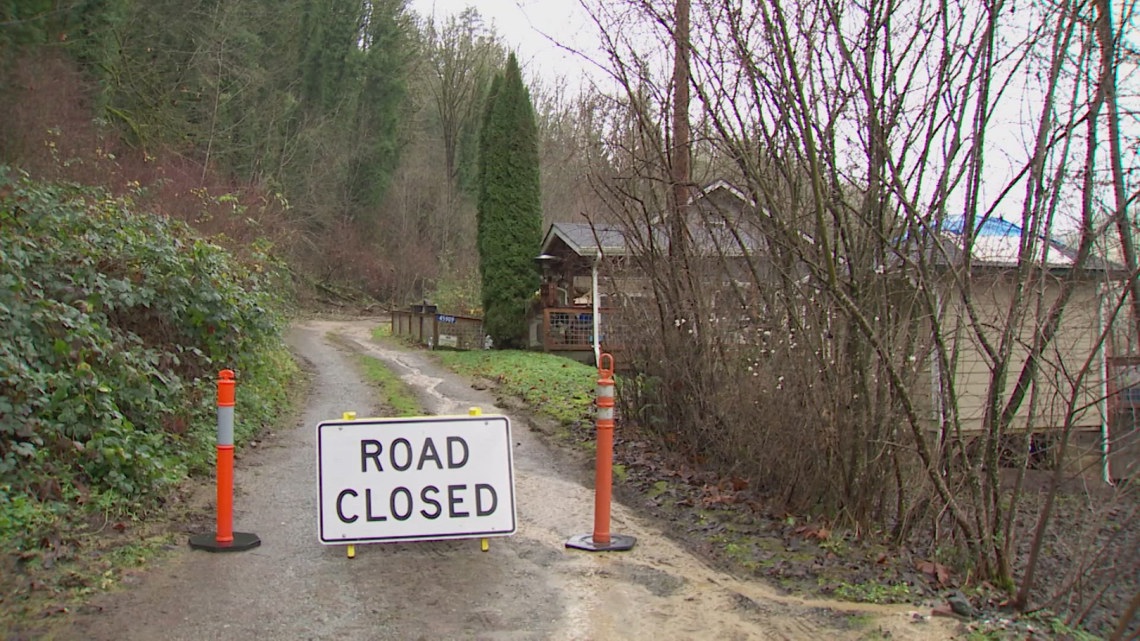
Two landslides have triggered evacuation warnings for some neighborhoods. Now with more rain in the forecast, the situation could get worse.
CONCRETE, Wash. — As a second atmospheric river hits Washington state, residents of the small town of Concrete are bracing for another weather crisis.
Two landslides have already threatened homes. Two earthquakes shook the region this morning. And now, more rain is coming, testing a community still recovering from last week’s historic flooding.
Town officials issued Level 3 (Go now!) evacuation orders on Monday night for those living in the Eriksen Road neighborhood due to risk of landslides. The first landslide was discovered in Dec. 10, as a result of increased rainfall, and a second landslide was found on Dec. 14.
Monett Bauer, who has lived in Concrete for 30 years, packed her car with Christmas presents and important paperwork. Just behind her home, trees and mud had come crashing down the hillside days earlier, stopping just before reaching her property.
“When we heard it, I thought, when is it going to hit my house?” Bauer said, recalling the rumbling and snapping sounds of the landslide.
The National Weather Service has issued a Flood Watch for Skagit County through Thursday afternoon, with a Flood Warning already in place for the Skagit River in both Concrete and Mount Vernon. Strong winds are expected through Wednesday morning.
Saturated soils from recent flooding, combined with high winds and additional rainfall, create ideal conditions for landslides, falling trees and power outages. The Army Corps of Engineers is working to manage water flow from Ross Dam and Upper Baker Dam, but officials acknowledge there are limits to what can be controlled.
“We are using available storage space in these reservoirs to reduce the peak flow level downstream as much as possible,” said Kyle Comanor, senior water manager for the Seattle District’s Western Washington division. “However, residents should be prepared for high river levels to return as the next atmospheric river hits our region.”
River forecasts are dire. The Skagit River in Concrete is predicted to crest at 32.8 feet early Tuesday morning, then peak again Wednesday afternoon at 33.32 feet, both well above the major flooding threshold of 32.5 feet. In Mount Vernon, the river is expected to crest at 32.81 feet Tuesday evening and again at 32.89 feet Thursday morning.
Just days ago, Mount Vernon experienced a record flood stage of over 37.7 feet. After that surge, engineers began releasing water from the reservoirs to create space for the heavy rain expected in the coming days.
Uncontrolled rivers and streams, such as the Sauk River, contributed to the severity of recent flooding and remain a wild card.
“This is not a typical weather event,” said Mark Stoelinga, a meteorologist with the Army Corps of Engineers. “We are managing unprecedented rainfall and runoff to minimize risks to local communities.”
For residents in Concrete, preparation has become routine. Generators are being tested. Go-bags are packed in cars parked on high ground. Some families have already evacuated.
Yet what troubles Bauer most is the uncertainty. She works for the Concrete school district, and this morning she was already at work when the second earthquake hit, strong enough that officials canceled school, partly out of concern that saturated roads could wash out, leaving students stranded and unable to get home. Before the earthquakes came flooding. Now come landslides.
“We just keep thinking of what’s next,” Bauer said.
Officials are urging residents throughout Skagit County to monitor forecasts closely. The Army Corps of Engineers will continue regulating flows throughout the week, attempting to spread the volume of water over time. For Concrete, every foot of river rise can mean the difference between a flooded basement and a destroyed home.
For Bauer, the stakes are even higher. She has lived in her home for 30 years, paid off the mortgage, and considered it the culmination of a lifetime of work. She says her homeowner’s insurance does not cover landslides or flooding.
“This is what I worked hard to pay off,” Bauer said. “I’ve paid my house off. We own it.”
For now, the town waits with generators humming, bags packed, eyes fixed on the rising river.