
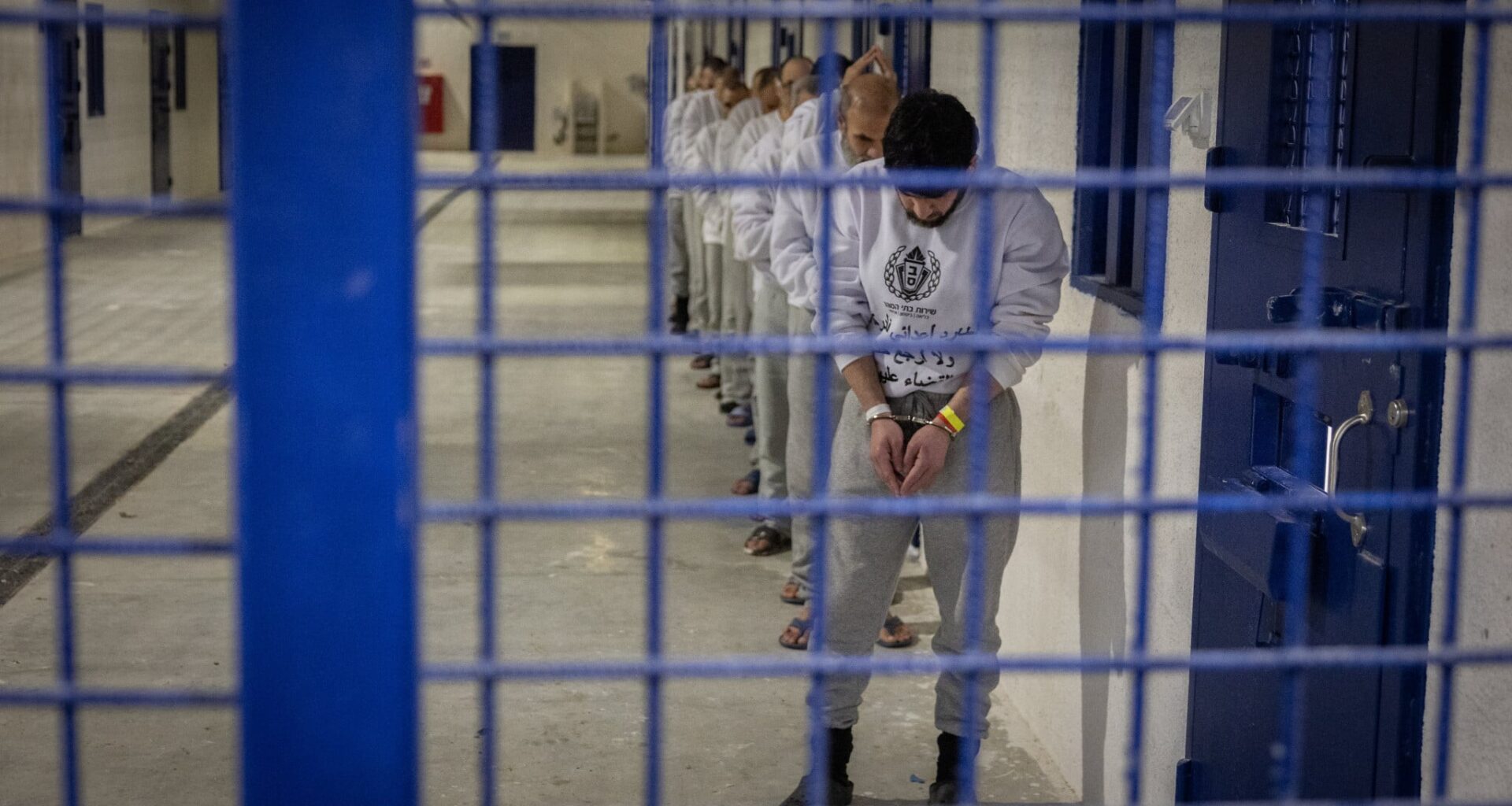
Israel Prison Service Chief Commissioner Kobi Yaakobi warned Tuesday that detention facilities are “on the brink” as Palestinian security prisoners have largely lost hope of being freed in a hostage-prisoner exchange, raising the specter of an outbreak of violence.
Speaking to the Knesset National Security Committee, the prisons chief said “the hope they had has turned into despair” due to not being included among the thousands of detainees released during the Gaza war in exchange for hostages held by Gaza terror groups.
With no more exchanges on the horizon, and barring abductions of more Israelis who could be released in swaps, inmates imprisoned on security charges could seek to take matters into their own hands, Yaakobi warned.
“Those who are with us [in prisons] today are terrorists who have demonstrated operational capabilities,” he said. “If there is a feeling that the ‘war of resistance’ is at low intensity — I don’t know what will develop in the north or south, but inside the prisons, I can say with certainty that we are on the brink of something happening.”
The Prison Service’s head of security and operations, Avichai Ben Hamo, told the committee that more prison diagrams were being found in the cells of security inmates.
Get The Times of Israel’s Daily Edition
by email and never miss our top stories
By signing up, you agree to the terms
Some of the blueprints found include locations of locks, numbers of prison guards in each wing and other details relevant to a jailbreak, he reported.
Such findings were rare, he said, when prisoners still had hope of being let go as part of a hostage deal.
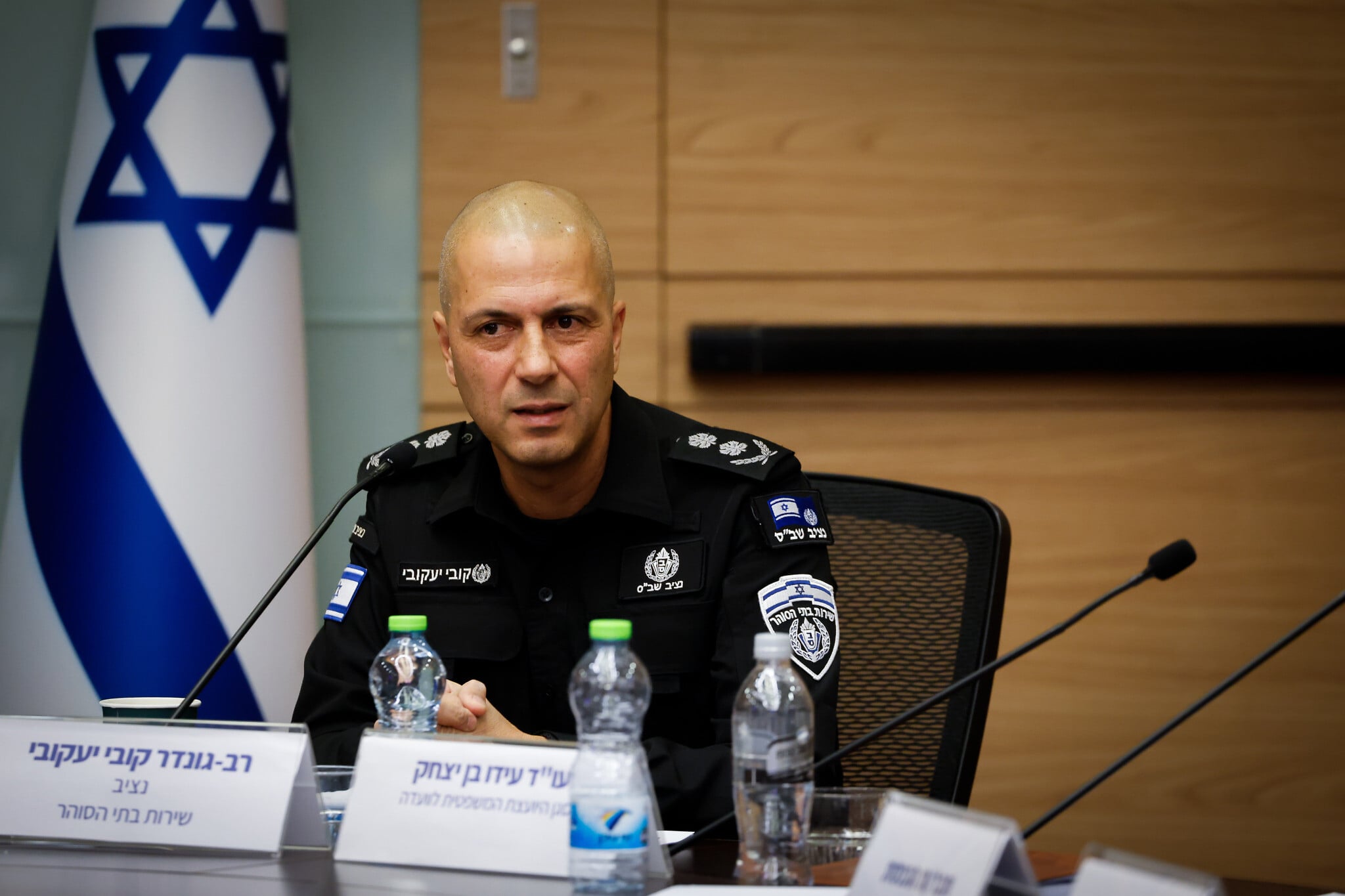
Israel Prisons Chief Commissioner Kobi Yaakobi speaks to the Knesset National Security Committee on December 16, 2025. (Noam Moskovitz/Knesset Spokesperson)
“We see a direct connection between the atrocities committed by the terrorists on October 7 and [inmates’] behavior in the prisons. Our eye knows how to discern the type of attention given to the locks, the fences and the courtyards,” Ben Hamo told the committee.
Now the prisoners “understand that the doors have shut and that they remain in prison, and they are determined to challenge our security policy every day, every hour,” he added, warning they could attempt a mass escape.
A total of 3,755 security prisoners were released in deals over the course of the war, in exchange for many of the 251 hostages kidnapped during the October 7, 2023, attack, and three others held since 2014 and 2015.
Only a single slain hostage remains in Gaza, Ran Gvili. Israel has agreed to return only the bodies of Palestinians killed amid the fighting, as opposed to living prisoners, in exchange for hostages’ remains.
Israel has a long history of releasing slews of prisoners in lopsided exchanges, such as the 2011 deal that saw over 1,000 Palestinian inmates released for a single kidnapped soldier, Gilad Shalit.
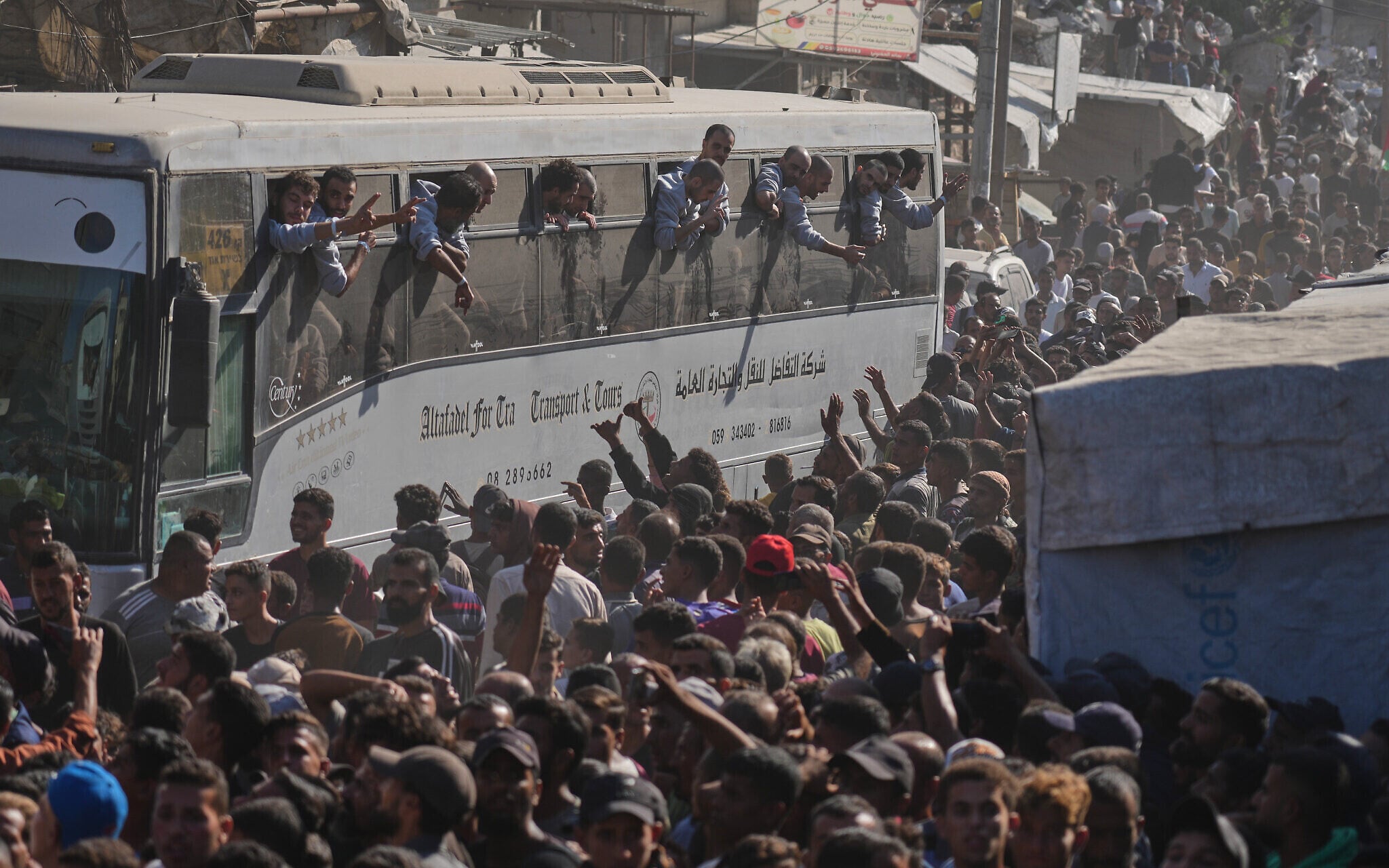
People gather to greet freed Palestinian prisoners arriving on buses in the Gaza Strip after their release from Israeli jails under a ceasefire agreement between Hamas and Israel, outside Nasser Hospital in Khan Younis, southern Gaza Strip, Oct. 13, 2025. (AP Photo/Jehad Alshrafi)
Ex-Hamas leader Yahya Sinwar, who was among those released in that deal and later masterminded the October 7 attack, is thought to have been partially motivated to carry out the onslaught by the prospect of freeing more prisoners via hostage deals.
According to data from the Prison Service, the current prison population stands at 22,573 — 9,230 security prisoners and 13,343 criminal prisoners.
Unlike standard criminal prisoners, security prisoners are in custody for committing “security offenses,” which can range from deadly terror attacks to publishing what Israel deems incendiary content online. Almost all are Palestinian or Israeli Arab.
Yaakobi told the committee that dire conditions such prisoners are subject to help prevent terrorism through deterrence. He stressed that they are the “minimum living conditions required by law,” though the High Court found earlier this year that security detainees were not being fed enough.
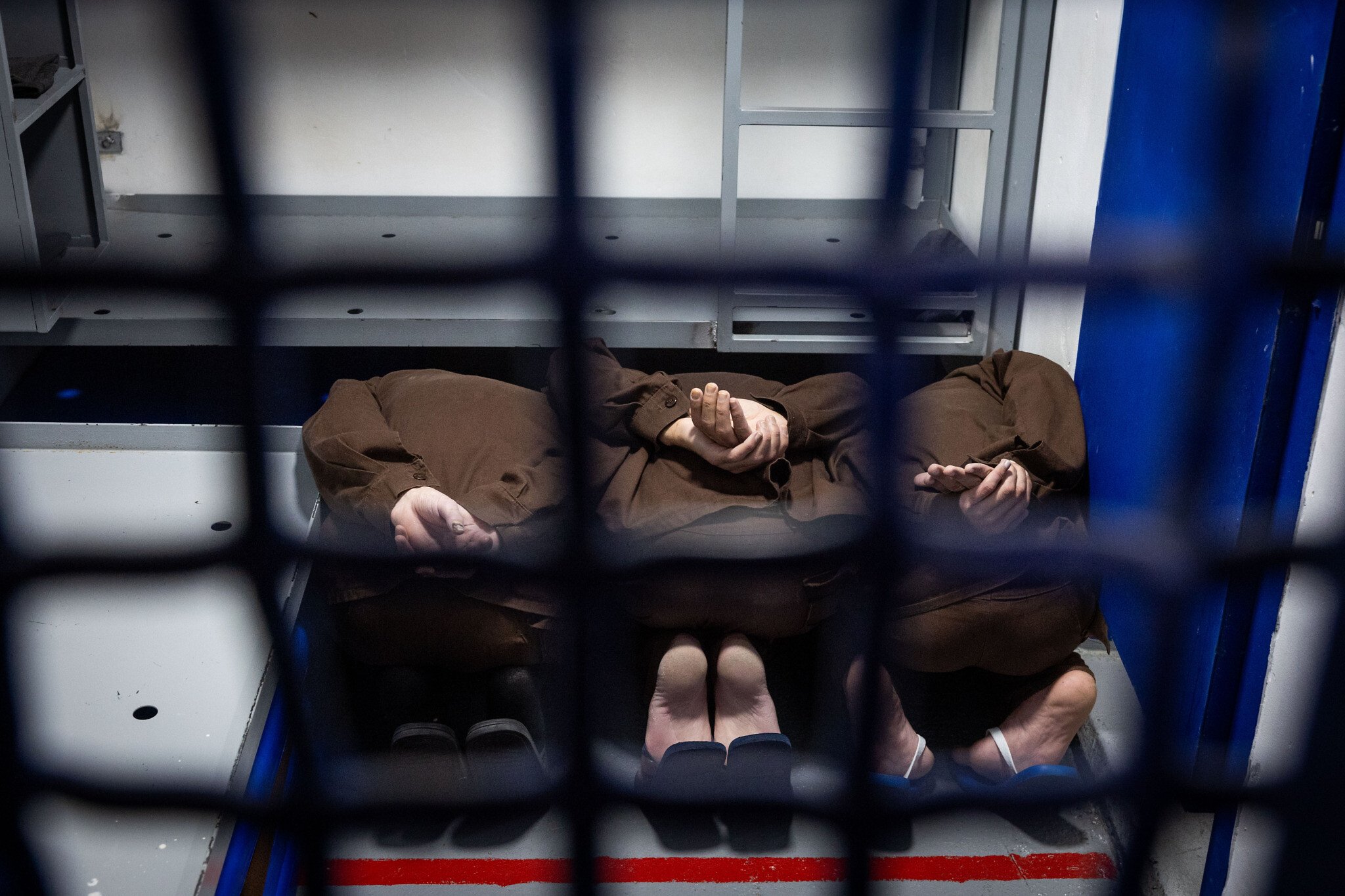
Elite Hamas Nukhba terrorists who were detained after participating in the October 7, 2023, massacre appear to pose with their hands behind their backs in a jail cell in a prison in central Israel, March 4, 2025. (Chaim Goldberg/Flash90)
Prison conditions for security inmates have deteriorated drastically under National Security Minister Itamar Ben Gvir, who oversees the Prison Service and has boasted about the harsh measures implemented on his watch.
An audit by the Public Defender’s Office published this month found that Palestinian security prisoners are being given meager food rations, beaten regularly by guards and held in unsanitary conditions that have allowed diseases to spread quickly in crowded, tiny cells.
Yaakobi said the Prison Service is trying to increase its capacity as the system grapples with a major overcrowding crisis, which reached unprecedented heights in the wake of October 7, 2023.
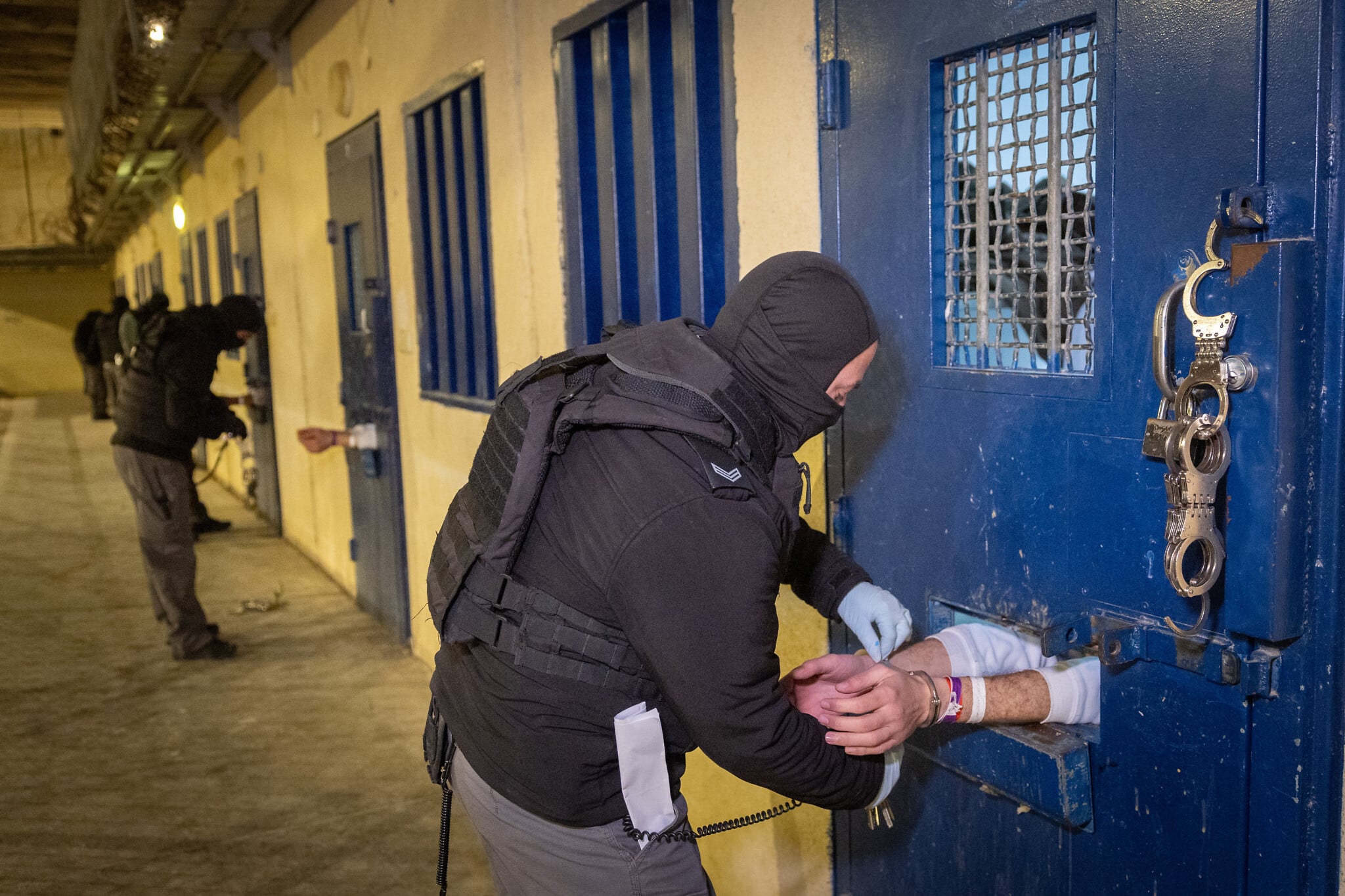
Israel Prisons Service officers prepare inmates for release as part of a hostage deal at Ketzi’ot Prison in southern Israel, on February 26, 2025. (Chaim Goldberg/Flash90)
Soon after the war’s outset, the Knesset approved emergency provisions that have allowed the Prison Service, normally provisioned for 14,500 prisoners, to hold inmates of all kinds in cramped, overcrowded cells, sometimes without a bed to sleep on.
Yaakobi told the committee that 2,392 new incarceration spaces had been added to detention facilities, and set a goal of over 5,000 new spaces by spring 2026. But even if the IPS does meet their goal, prisons will still be over their official capacity of 14,500 detainees.
According to the Public Defender’s audit, a large number of prisoners lack adequate living space.
While 35 percent of criminal detainees are held in a living space less than 3 square meters (32 square feet), over 90% of security detainees are held in such conditions, the agency found, despite a 2018 High Court ruling stipulating that no less than 4.5 square meters (48 square feet) should be allocated to an individual prisoner.
You appreciate our journalism

You clearly find our careful reporting valuable, in a time when facts are often distorted and news coverage often lacks context.
Your support is essential to continue our work. We want to continue delivering the professional journalism you value, even as the demands on our newsroom have grown dramatically since October 7.
So today, please consider joining our reader support group, The Times of Israel Community. For as little as $6 a month you’ll become our partners while enjoying The Times of Israel AD-FREE, as well as accessing exclusive content available only to Times of Israel Community members.
Thank you,
David Horovitz, Founding Editor of The Times of Israel