
Eight of this year’s top documentary filmmakers — and Oscar contenders — talk about their movies, their inspirations and taking on subject matter ranging from highly dangerous to deeply personal.
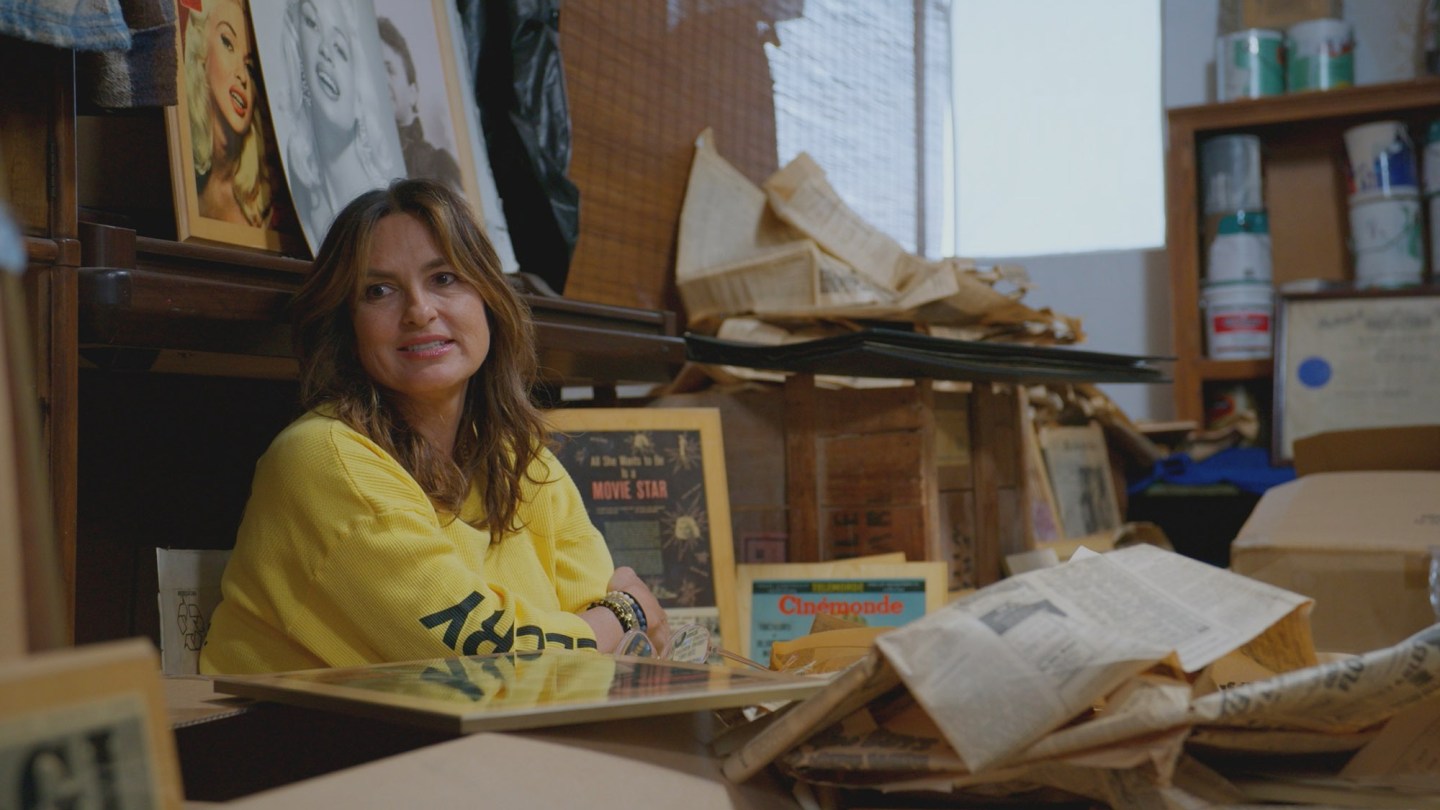
Mariska Hargitay (My Mom Jayne)
On finally being ready to make a film about her mom, Jayne Mansfield: “I’d had a lot of PTSD from the car accident when I was 3 [that claimed her mother’s life], so I wanted to be really careful. But I did a lot of trauma work, therapy, something called parts work and internal excavation, and realized that, after I did this work, I got so much internal space back. When somebody has PTSD and is traumatized, especially as a child, you don’t have the words. I would get these feelings, not knowing what it was because I didn’t understand what to compare it to. Sometimes I’d be driving and I’d have to pull over — I couldn’t be trapped. There were a lot of things that I didn’t fully understand. But I went deep and excavated that; it was an archaeological dig, both on my family and on myself. I wanted to untrap myself, and I wanted to be free. After I had done so much work that I felt like a different human, I went, ‘Oh my God, I can tell the story.’” Read more. — Scott Feinberg
Laura Poitras (Cover-Up)
On wanting to tell the story of investigative journalist Seymour “Sy” Hersh for 20 years and why it took so long: “I documented the war in Iraq. As I was preparing to go there, his story on Abu Ghraib, and the photographs, were published. It was heart-stopping that this torture was happening, and at a time when most of the mainstream press was cheerleading for the war and not asking adversarial questions of the government. Then, within weeks, I was in Iraq — I actually filmed at Abu Ghraib — and then came back and was editing. I knew that the so-called War on Terror wasn’t ending anytime soon and that my next film was going to continue on this, and that there was a crisis in investigative journalism, with Sy being an example of the opposite, so I called him up. I went to his office in D.C., and there’s Sy, with his tennis rackets, leaning back and asking, ‘What do you want?’ We talked for 40 minutes. I was desperate to make this film, just based on his body of work. He could’ve been not such an interesting guy, and I still would’ve been interested, but once I met him, I became obsessed. But he left me a message, saying, ‘I love your work, but unfortunately even with the sources that live down the street from me, I have to go to other cities or countries to meet them, and there can be no cameras following.’ Every now and then, I’d be like, ‘Hey, Sy, checking in. Maybe now’s the time?’ Then I ended up making [the 2014 Oscar-winning Edward Snowden doc] Citizenfour, which was, in a way, also about journalism, and [the 2022 Oscar-nominated doc] All the Beauty and the Bloodshed, which taught me about working with archival material and doing a large scale of history, with Nan [Goldin, the latter film’s subject]. It was also half a century, and her archive was very personal, but it was a great experience. So I reached out again. Sy had a longtime collaborator, Mark Obenhaus, and we decided to do it together.” Read more. — Scott Feinberg
Gabe Polsky (The Man Who Saves the World?)
On when he first heard about Patrick McCollum, an American convinced he’s destined to fulfill an ancient prophecy: “I got a call out of the blue from a producer who works with Jimmy Kimmel. We’d been wanting to work together, and he said, ‘Would you get on the phone with this guy Patrick?’ Patrick told me this story about Indigenous elders of the Amazon coming to him and saying, ‘We think you’re this guy in the prophecy that’s going to help to unite the tribes of the Amazon.’ I thought he was crazy, but something inside me wanted to know more. I met Patrick and started getting to know him, and it was like a machine gun of one insane story after another. I’d never met anyone that strange and fascinating. He seemed to have done everything from being a carny to a jewelry designer to a peacemaker. He was a kung fu master, a welder and a race car driver. He was best friends with Jane Goodall. It was almost overwhelming. But I knew at the end of the day, whether this prophecy was real or not, that he had something really deep to say, and I could learn a lot from him.” Read more. — Scott Feinberg
Petra Costa (Apocalypse in the Tropics)
On convincing Brazil President Lula, right-wing leader Jair Bolsonaro and Malafaia, a powerful televangelist, to cooperate in the doc , examining the rise of Christian nationalism in Brazil: “As soon as Lula came out of prison [where he served time for corruption charges] in November 2019, I was contacting him and his team asking for an interview, and it took until four days before the 2022 election for them to finally accept. It was 10 hours waiting in a hotel, then he canceled, and then the next day he had pity and said, “OK, come have breakfast with me.” That was the best thing because it was a completely unguarded interview in his house, where he said things that he would never have said in a hotel setting. With Bolsonaro, I had the luck of filming him when he was the easiest congressman to have access to. For two years, he was desperate to have attention and was perceived by the entire media as a joke — and then he was elected president. With Malafaia, we decided to work with a journalist that had been covering the evangelical movement in Brazil since 2010, so the first interview with him she conducted alone and then she told him about us. We told him that we wanted to follow him for years, and he was willing.” Read more. — Scott Feinberg
Mstyslav Chernov (2000 Meters to Andriivka)
On embedding with Ukranian troops for the doc, which follows a Ukrainian platoon as it fights to reclaim a Russian-held village: “After [20 Days in Mariupol], I had an editor call me and say, ‘Mstyslav, you don’t have to do any of this anymore. Just get out of the country.’ I said, ‘I can’t.’ I kept looking for a story — not a story of Ukraine being a victim, but a story of being small and unable to really win the fight for your house, but still not giving up. Then, Mariupol started coming out here in L.A., and I kept traveling between Ukraine and screenings. It was so weird: Barbie, Oppenheimer and 20 Days in Mariupol — I remember taking pictures of those posters all together, not knowing how to feel about it, and then going to the BAFTA Tea Party and someone asking me, ‘Are you someone’s security guard?’ I had this military coat on because I didn’t have time to change. So that was weird. Meanwhile, everything in Ukraine was on fire. I realized I could not tell that story from a distance. You just don’t have the moral right of being outside when you’re telling [a story] about someone literally dying in front of their friends. I never exposed myself to as much danger as any soldier would, and a lot of scenes in my film were filmed by soldiers themselves, but I couldn’t allow myself to be far away and observing.” Read more. — Scott Feinberg
Raoul Peck (Orwell: 2+2=5)
On exploring George Orwell’s enduring relevance by juxtaposing the author’s words with images of the present: “It’s about our reality. Orwell gives us the tools to understand what’s going on. He connects the dots. I believed that he was a science fiction writer, but no, he was talking about what he went through. He went through war as well. He understood the mechanism of power and politics, and he saw through it. He wrote about what he was seeing and living through in Europe at the time. His books weren’t just about Stalinism or fascism, they were about democracy and how democracies can become authoritarian as well. We are in the middle of that right now.” Read more. — Scott Feinberg
Geeta Gandbhir (The Perfect Neighbor)
On relying more on footage than re-enactments and confessionals: “The decision to live in the body camera footage came from a couple places. One, when I thought about going back to and re-interviewing the community and asking them about what had happened, I didn’t want to re-traumatize them through that process. What you hear in the film are the detective interviews. So they’d already had to relive it, and I couldn’t see doing it again. Then there was the piece of how immersive and undeniable the body camera footage is. We were not on the ground as filmmakers directing anything. This footage shows things exactly as they unfolded — without a reporter, without a filmmaker, without a journalist on the ground. So it feels undeniable. It also feels immersive and cinematic to us as filmmakers. The cops functioned, unintentionally, as multicam. Something that we found so extraordinary was they unintentionally captured this beautiful community as they were before. And you never get to see that. You never see a community, particularly one like this, living their lives with this strong social network, raising children together kind of, all the love you see. And we really wanted to subvert the traditional use of body camera footage — which is used for people of color to surveil us, to criminalize us, to protect the police — by showing these children as they were and humanizing them.” Read more. — Brande Victorian
Ryan White (Come See Me in the Good Light)
On filming poet-activist Andrea Gibson and the last months of their life following a terminal cancer diagnosis — while also finding the funny in a tragic situation: “When I introduce this film, because I think people are afraid to watch it or they’re bracing themselves for the saddest film ever, I like to tell the audience that it was the most fun I’ve ever had making a film and it’s the hardest I’ve ever laughed making a film because I find that gives people permission to sort of relax a little bit and laugh. Even in that final week of Andrea’s life in July, we were still having fun, but we didn’t know when it was going to end. It was definitely my understanding as a filmmaker, and I think Andrea’s and Megan’s [Falley, Andrea’s wife], that we were going to document through the death, through the final breath. And that really changed in the edit room. I think Andrea knew this all along and was just kind of waiting for me to understand that this wasn’t going to be a death film, it was going to be a film about living. So it was a decision in the edit room: Why does Andrea have to die at the end of this film? It’s not what it’s about.” Read more. — Brande Victorian