
This is an on-site version of the White House Watch newsletter. You can read the previous edition here. Sign up for free here to get it on Tuesdays and Thursdays. Email us at whitehousewatch@ft.com
Good morning and welcome to White House Watch. In this edition, we’ll be digging into the Trump administration’s personality-driven approach to diplomacy. Also in today’s newsletter:
US suspends technology deal with UK
Fed governor Stephen Miran on “phantom inflation”
How Jensen Huang won over Donald Trump
The US president’s diplomatic efforts are being shaped by a “shockingly small” circle of people, one former defence official told my colleagues Abigail Hauslohner and Alec Russell for their fascinating Big Read on the president’s reliance on a coterie of envoys, many of whom have little to no foreign policy experience.
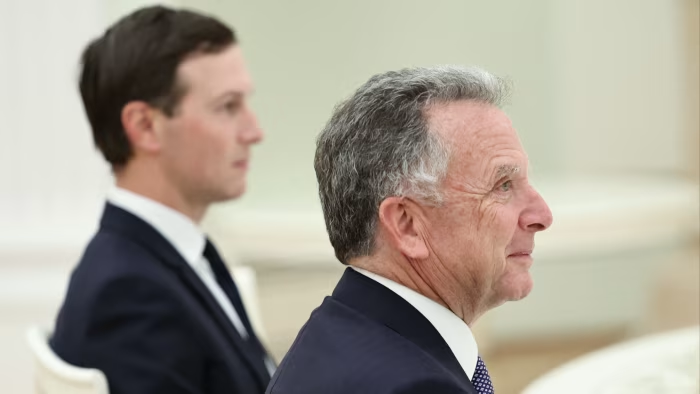
The official described it as “policy by personality” — replacing decades of processes and institutions with a handful of boldfaced names, namely real estate developer Steve Witkoff, the president’s longtime friend and business partner-turned-special envoy for “peace negotiations”, and Jared Kushner, Trump’s venture capitalist son-in-law who has no formal government role but has been central to peace talks in both the Middle East and Ukraine.
A White House spokesperson described the strategy as part of an intentional shift from a long-standing “bottom-up” approach to “a top-down process driven by the president,” adding: “The president has an untraditional background and a lot of his team have untraditional backgrounds. Jared and Steve are business deal guys. But they are trusted.”
The new reporting is undeniably timely: Kushner and Witkoff have been front and centre this week as Ukrainian, European and US officials gathered in Berlin to draft a deal to end Russia’s invasion. Trump struck an optimistic note late on Monday, telling reporters in the Oval Office that a peace deal was within reach.
“I think we’re closer now, and they will tell you that they’re closer now,” he said hours after the latest talks wrapped up in Germany. “We had numerous conversations with President Putin of Russia, and I think we’re closer now than we have been ever.”
The latest headlinesWhat we’re hearing
How did Jensen Huang, the soft-spoken electrical engineer and co-founder of semiconductor giant Nvidia, charm his way into Trump’s good books? In the words of one person familiar with the company’s strategy: “I think game recognises game.”
My colleagues Joe Miller, Demetri Sevastopulo and Michael Acton lift the curtain on Trump’s decision to allow Nvidia to export its H200 chip to China, with the US government taking a 25 per cent cut.
They detail how Huang, a Washington outsider, was initially sceptical of the “value proposition” of making personal appeals to the US president, according to a person familiar with Nvidia’s strategy.
But after an initial overture from commerce secretary Howard Lutnick, Huang was soon in direct contact with Trump, flying to Mar-a-Lago in April for the first of several one-on-one conversations. My colleagues note that Huang has met Trump privately at least six times this year, as well as spoken to the president on the phone and accompanied him on several foreign trips.
At the same time, people with knowledge of the company’s strategy say Nvidia, which sells the advanced chips that power sophisticated artificial intelligence models, beefed up its lobbying operation and began courting lawmakers on Capitol Hill.
Yet insiders insist it was ultimately the one-on-one relationship between Trump and Huang that sealed the H200 decision.
“At the end of the day, it was a meeting between [Huang] and the president,” said one person with knowledge of the move. “That’s how this came about”.
Viewpoints
Trump’s trade war climbdown in South Korea in late October was the hinge moment of the year, writes Edward Luce, and marks a new epoch.
Convoluted messages and conflicting policies have been hallmarks of Trump’s first year back in the White House, and the US president seems determined to make matters worse, argues American Compass chief economist Oren Cass.
Marjorie Taylor Greene, the Republican congresswoman from Georgia, has become a “newly sprouted and very bothersome” thorn in Trump’s side, observes Jemima Kelly.
Are fonts really political as well as personal choices? Academic Shahidha Bari examines secretary of state Marco Rubio’s decision to instruct US diplomats to use the typeface Times New Roman instead of Calibri.
For all the gloom that took hold at the start of Trump’s second term, the global economy, trade and markets have outperformed economists’ consensus expectations in 2025, notes Tej Parikh. Sign up for the Free Lunch newsletter here.
A sharp rise in the number of university students claiming a disability in the US, UK and Europe lays bare how educational systems are benefiting a privileged few and failing those most in need, argues John Burn-Murdoch.
Recommended newsletters for you
FT Exclusive — Be the first to see exclusive FT scoops, features, analysis and investigations. Sign up here
US Top Stories — The latest US top stories, from markets to geopolitics. Sign up here