
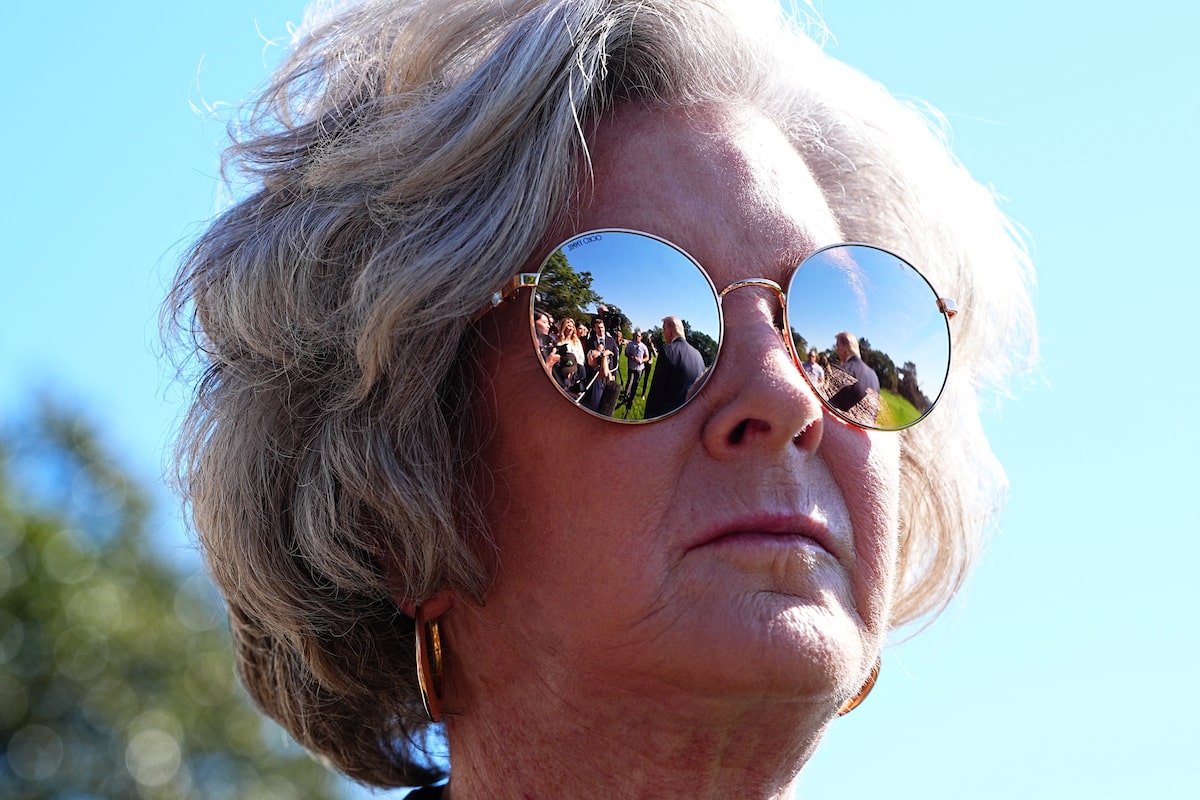
U.S. President Donald Trump is reflected on the glasses of White House Chief of Staff Susie Wiles as he speaks to the media, at the White House on Oct. 5.Aaron Schwartz/Reuters
Donald Trump and his family are defending the White House chief of staff after a series of interviews in which she described the U.S. President as a man with “an alcoholic’s personality” whose leadership has been inflected by retribution against perceived foes.
Susie Wiles, a long-time aide to Mr. Trump who managed his 2024 campaign and now occupies a privileged place inside the country’s executive branch, said in the startlingly unvarnished interviews with Vanity Fair that Mr. Trump had pursued his campaign of global tariffs against internal advice.
She called Vice-President JD Vance a conspiracy theorist, said billionaire Elon Musk had taken a wrecking ball to important programs, and raised questions about the conduct of immigration agents as they carry out deportations ordered by the administration.
She also described Mr. Trump as a law-abiding leader who has no genuine intention of seeking a third term, who did nothing untoward with sex offender Jeffrey Epstein and who will, when necessary, obtain proper congressional authorization if he orders a land war on Venezuela.
Nonetheless, the extensive comments from Ms. Wiles offer one of the most frank accounts to date of Mr. Trump’s second term, from a person whose influence and access may have no parallel in the current administration.
The White House chief of staff has pushed back on the article, calling the story a ‘hit piece’ that lacks context, though she hasn’t denied the quotes that were attributed to her.
The Associated Press
Ms. Wiles is known as a quiet but potent force in the White House, determined to carry out Mr. Trump’s vision rather than seeking to change him or file away his rough edges. She has shown little desire to occupy the spotlight that shines so brightly on her boss, and on Tuesday criticized the two-part magazine article that carried her observations alongside quotes from senior members of Mr. Trump’s cabinet and glossy photographs of the most powerful personalities in his inner circle.
Writing on X, Ms. Wiles called the article “a disingenuously framed hit piece on me and the finest President, White House staff, and Cabinet in history.”
”The truth is the Trump White House has already accomplished more in eleven months than any other President has accomplished in eight years and that is due to the unmatched leadership and vision of President Trump.”
During Mr. Trump’s turbulent first administration, he had four separate chiefs of staff; the shortest tenure, that of Reince Priebus, lasted just 192 days. On Tuesday, in a sign of how seriously the President takes Ms. Wiles’s views, he spoke to the New York Post to defend her. He said she was right in her unflattering description of him, acknowledging he has a “possessive and addictive type personality.”
Ms. Wiles had likened Mr. Trump to heavy boozers whose “personalities are exaggerated when they drink.” He “operates [with] a view that there’s nothing he can’t do. Nothing, zero, nothing,” she said.
Trump administration adds five more countries to travel ban, imposes new limits on 15 others
Mr. Trump agreed. ”I don’t drink alcohol. So everybody knows that – but I’ve often said that if I did, I’d have a very good chance of being an alcoholic. I have said that many times about myself, I do,” Mr. Trump told the Post. Ms. Wiles, he added, has “done a fantastic job.”
On X, meanwhile, Donald Trump Jr. called Ms. Wiles ”by far the most effective and trustworthy Chief of Staff that my father has ever had,” saying she was ”a loyal fighter” who had stood fast when “other supposed friends left my dad like a bunch of rats.”
The role Ms. Wiles plays in steering a President who frequently acts on his own impulses remains unclear. Before Mr. Trump announced global “Liberation Day” tariffs in April, Ms. Wiles said, she had asked Mr. Vance to step in. She wanted him to persuade the President to wait until middle ground could be found between people in the administration with deeply divergent views on the wisdom of imposing dramatic new import levies.
Mr. Trump went ahead anyway. The result was a tariff policy that Ms. Wiles said has “been more painful than I expected.”
Opinion: For the U.S. Supreme Court, Trump’s tariffs case is existential
(She described Mr. Vance as “a conspiracy theorist for a decade” whose allegiance to Mr. Trump was a conversion for “political” purposes.)
Ms. Wiles expressed reservations, too, about other centrepieces of Mr. Trump’s second term so far. She was “initially aghast” at the gutting of the United States Agency for International Development, or USAID, by Mr. Musk under the Department of Government Efficiency earlier this year. Mr. Musk, who subsequently left that position after a falling out with Mr. Trump, is “an avowed ketamine [user]” who slept in a sleeping bag during daylight hours inside a government office building, Ms. Wiles said. He was not helpful, she added.
“He’s an odd, odd duck, as I think geniuses are.”
Oversight of USAID has since been handed to Secretary of State Marco Rubio, who told Vanity Fair that critics of U.S. foreign-aid cutbacks should look in the mirror: “Is it the United States’ fault?” he said. “Why isn’t China paying for more immunizations? Why isn’t the U.K. or Canada or any of the G7 countries?”
New Ebola outbreak in Congo will be test for weakened global health system after Trump cuts
Ms. Wiles, nonetheless, said more work is needed to safeguard American citizens and cancer-stricken children who have been among those deported by U.S. Immigration and Customs Enforcement amidst a sweeping campaign ordered by Mr. Trump.
“If somebody is a known gang member who has a criminal past, and you’re sure, and you can demonstrate it, it’s probably fine to send them to El Salvador or whatever,” Ms. Wiles said. “But if there is a question, I think our process has to lean toward a double-check.”
Ms. Wiles, a Florida political operative, argued that Mr. Trump had nothing to fear from the release of investigatory records on Mr. Epstein, saying the two men were “young, single playboys together” but that the files contain no evidence of Mr. Trump “doing anything awful.” The President, however, “was wrong” to say that Bill Clinton had repeatedly visited Mr. Epstein’s island: “There is no evidence” for that, Ms. Wiles said.
She also shed new light on some of the most critical issues facing the U.S. today. She suggested, for example, that Mr. Trump no longer believes that Vladimir Putin will settle for some portion of Ukraine, as the war continues to rage.
“Donald Trump thinks he wants the whole country,” Ms. Wiles said.