
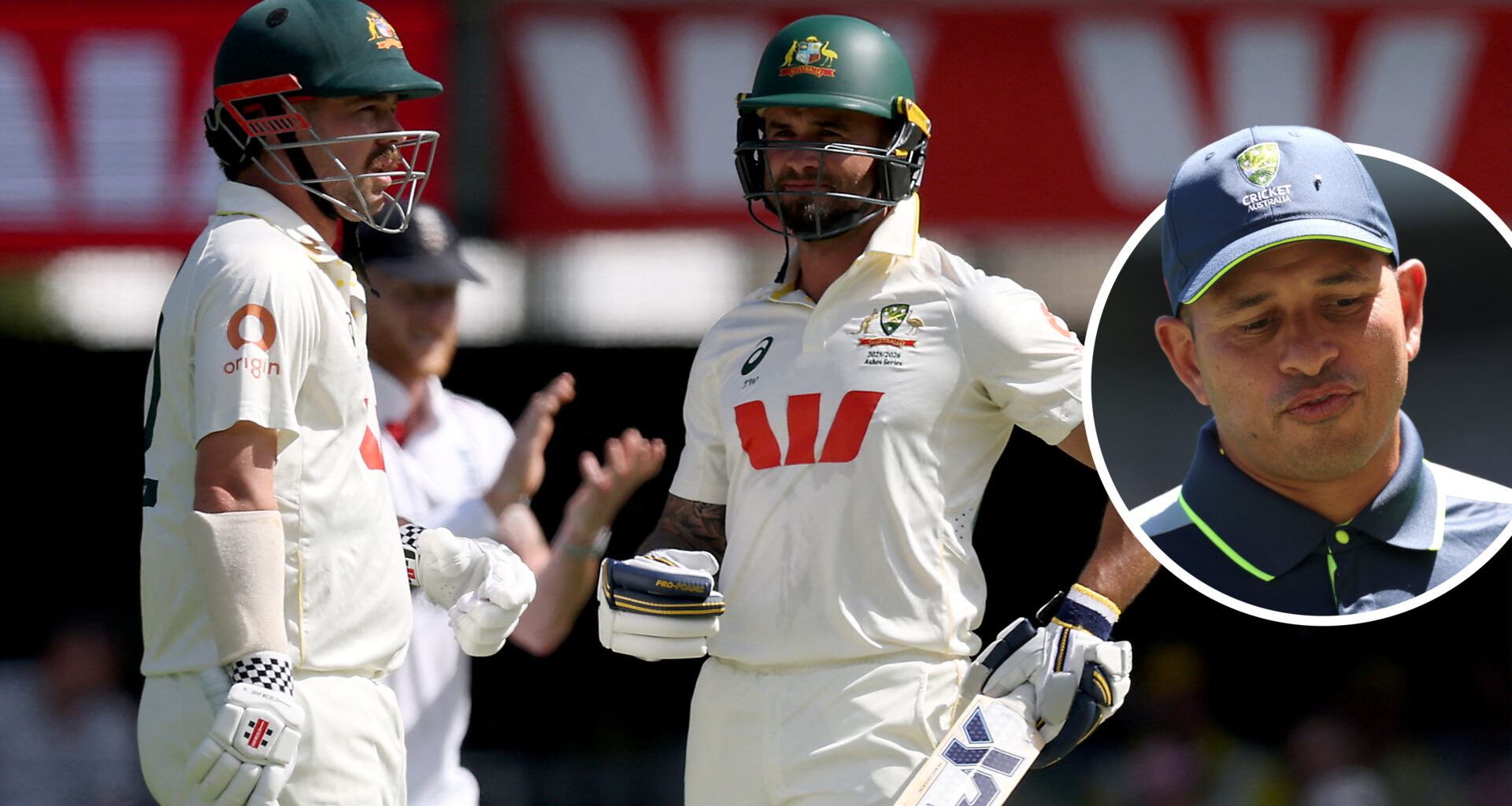
When Usman Khawaja walked off Edgbaston in the final session of the 2023 Ashes Test’s fifth day, the exhausted left-hander had batted for more than 13 hours across Australia’s two innings. Pat Cummins not long after hit the winning runs and Khawaja was deservedly named player of the match. His epic feat of endurance had ground down the home side and clinched Australia a famous victory.
Two-and-a-half years on and Khawaja looks to have played his final Test less than halfway through the return bout against England. For all the hype around the so-called Bazball method, it is Australia who might have made the most aggressive move of this series.
Khawaja’s exit might not just spell the end of one of Australian cricket’s great stories of persistence, but could also signal the shift into a new era of thinking on what constitutes an ‘opening batter’.
As selection boss George Bailey asked during the Brisbane Test, “What’s the threshold now to be a ‘specialist’ opener? Do you have to have done it for a certain amount of time or innings? Does it count if you’ve done it in white-ball cricket?”
All those questions will now be asked about Travis Head, whose enthusiasm to take on the new ball has ultimately cost Khawaja his spot. The renegade South Australian has been this helter-skelter series’ standout player. In four innings, he has spent 285 minutes at the crease, longer than any of his teammates. That’s roughly a third of the 796 minutes Khawaja batted for across two innings in his marathon Birmingham effort in 2023.
If there is no room for Khawaja’s steady-as-she-goes approach in this ongoing Ashes campaign being played at warp speed, where does that leave cricket’s traditional Test match opener?
Australia have of course not closed the door on Khawaja returning later in this series. But an SCG farewell for the Islamabad-born, Sydney-raised Queenslander now looks increasingly unlikely despite his declaration this week he is fully fit again after the back spasms that dogged him through the first part of the series.
His exclusion has partially come about by chance too.
Head eagerly grabbed the chance to partner Jake Weatherald in Australia’s fourth-innings chase in Perth, having offered to open on several occasions since David Warner’s retirement in January last year.
“I think what you say publicly is always a little bit different to what you say privately,” Australia’s returning captain Cummins said on Tuesday. “If you nominate yourself in a spot, it means someone’s missing out.
“Trav’s a great team man and vice-captain, so he never really wants to tread on any toes. He’s always very adamant he will do whatever the team needs. For the last few years, we think it’s (been batting at) number five and he’s happily done that.
“He’s always thrown it up there. We’ve gone through a few openers over the last couple of years, he’s always said, ‘If you need me, I’m happy to do it’.
“But when he was running off at Perth Stadium and he was demanding (to open) saying, ‘I think it’s my time. I think it’s me’, we were kind of like, ‘Go for it’. That was probably the first time it was like, ‘He really wants it and thinks it’s his opportunity’.”
Head’s ensuing masterclass, combined with Weatherald showing strong early signs his Sheffield Shield dominance translates well to international cricket, has essentially forced the hand of Bailey’s panel.
But as Khawaja’s returns with the bat have diminished over recent years, so too have selectors hinted at their preference for top-order players who can move the game on: Head has opened in Asia; Sam Konstas was brought in with a licence to attack India after Nathan McSweeney’s tried and failed valiantly for three Tests; and Weatherald not only averaged more than 50 during the last Sheffield Shield season, but had a strike-rate close to 70.
Not worried about outside noise: Khawaja
Khawaja, with 3,168 runs at 46.58 since his recall during the 2021-22 Ashes, remains Australia’s leading run scorer in Test cricket over the past four years. In fact only Joe Root (4,173 runs at 54.90) has more runs in that period among all batters.
But more recently, his output has dropped and he has struggled against high-pace bowlers like Jasprit Bumrah, Shamar Joseph and Kagiso Rabada, particularly from around the wicket.
There was of course the brilliant 232 against Sri Lanka in Galle where he showed all the nous accumulated from a 17-year professional career to navigate a turning pitch. If Australia were touring India this January, not January 2027, it seems likely they would want to keep Khawaja close by.
But his career-best knock earlier this year marks the only time he has reached triple figures from his last 44 innings, from which he is averaging 32.70, well down from the 67.66 he averaged in 32 innings following his recall. He hit seven tons and eight half-centuries in that honeymoon period.
Clinical Khawaja smashes records in career-best 232
Tellingly, the rate at which his runs have come has also dropped. In his 25 knocks after his recall in 2022, he held a strike-rate of 52.23. That has slowed considerably through his past 51 innings to 43.47.
It is unfair to compare that to the rollicking pace Head and Weatherald have kept in a very small sample size – their three opening stands have been 75 off 69 balls, 37 from 35 and 77 off 79 – but the fact remains their electric starts have had positive flow-on effects.
“So far it’s looked like they’ve been able to keep the scoreboard ticking over. Whatever’s been thrown at them, they’ve had an answer to,” Cummins said of the Head-Weatherald partnership.
“It’s really set up the platform for our innings. The few times they’ve batted I think you’ve seen people like Marnus (Labuschagne) and Steve (Smith) walk in after that as well and really get on the back of that and start their innings well.
“I don’t know if it’s scrambled the opposition, but it’s certainly got that momentum and kept that scoreboard ticking over and started our innings brilliantly.”
‘Cashed-up bogan’: Weatherald’s tight bond with Head
What could also have smoothed over Australia’s tough selection call is Head’s ability to batten down the hatches when required. The 31-year-old effectively shielded Weatherald from England’s best bowler, Jofra Archer, who has gotten the rookie opener out twice in three innings, when he faced all but four of the first 30 balls of the speedster’s first-innings opening spell in Brisbane.
“It just shows how adaptable he is,” Weatherald told cricket.com.au’s Unplayable Podcast this week. “I don’t think we actively talked about it. That’s the thing when you open the batting, you get stuck down some ends.
“He did an amazing job getting through probably Jofra’s hardest spell when he’s probably bowling his fastest … To be able to get through that little period sets up the rest of the game for everyone else.”
Head and Weatherald now boast two of the four 75-plus run opening partnerships Australia have managed in 34 innings since Warner retired. One of the others also involved Head when he and Khawaja put on 92 in Galle, which set up the latter’s double-ton. The fourth was Konstas’ 89-run stand with Khawaja at the MCG last summer that rattled the otherwise relentless force that was Bumrah through that India series.
All four of those partnerships registered a run-rate above four-and-a-half per over, and two of them came at quicker than a run-a-ball. With fast bowlers arguably more dangerous than ever when wielding a new ball on seaming pitches in Australia (and elsewhere), fast starts might well be the way of the future.
2025-26 NRMA Insurance Men’s Ashes
First Test: Australia won by eight wickets
Second Test: Australia won by eight wickets
Third Test: December 17-21: Adelaide Oval, 10:30am AEDT
Fourth Test: December 26-30: MCG, Melbourne, 10:30am AEDT
Fifth Test: January 4-8: SCG, Sydney, 10:30am AEDT
Australia squad (third Test only): Pat Cummins (c), Scott Boland, Alex Carey, Brendan Doggett, Cameron Green, Travis Head, Josh Inglis, Usman Khawaja, Marnus Labuschagne, Nathan Lyon, Michael Neser, Steve Smith, Mitchell Starc, Jake Weatherald, Beau Webster
England squad: Ben Stokes (c), Harry Brook (vc), Jofra Archer, Gus Atkinson, Shoaib Bashir, Jacob Bethell, Brydon Carse, Zak Crawley, Ben Duckett, Matthew Fisher, Will Jacks, Ollie Pope, Matthew Potts, Joe Root, Jamie Smith (wk), Josh Tongue