
Unlock the Editor’s Digest for free
Roula Khalaf, Editor of the FT, selects her favourite stories in this weekly newsletter.
Japan risks being without a giant panda on its shores for the first time in more than half a century, as a diplomatic row with China looms over the most famous enclosure of Tokyo’s Ueno Zoo.
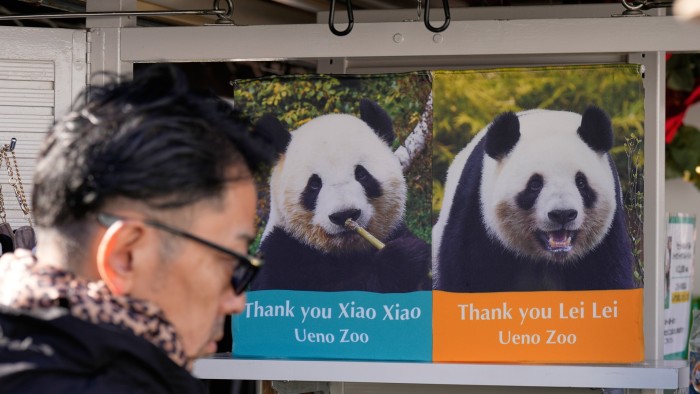
Ueno residents Xiao Xiao and Lei Lei, part of Beijing’s programme of “panda diplomacy” to lend the animals abroad as a symbol of friendship and normal bilateral relations, are to be sent to China in January. While their departure in early 2026 is long scheduled, deteriorating ties between Japan and China mean there are no plans to replace them.
Any move by China to leave Japan without pandas would extend and deepen a diplomatic row that erupted in November when Japan’s new Prime Minister Sanae Takaichi speculated on potential Japanese military involvement in any war in the Taiwan Strait. Relations between Beijing and Tokyo are now at their most strained in years.
Visitors queued for hours at Ueno this week for a brief glimpse of the pandas, which were born in Tokyo in 2021. Remaining tickets are being sold via lottery.
“It is a very sad thing to say goodbye to these two, because I have been coming to see them from when they were babies. But the really sad thing would be if China never gives us any more from now on,” said Emi Iemura, who was buying a “Thank you Xiao Xiao” T-shirt in the gift shop. “We all hope that things calm down.”
Rolling loans of pandas to Japan have been a pattern since panda diplomacy was established in 1972 and the practice has weathered a number of intense diplomatic storms.
 Visitors have queued for hours at Ueno Zoo in Tokyo this week to bid farewell to the pandas © Eugene Hoshiko/AP
China’s ministry of foreign affairs on Monday, in response to a question on whether the lease of the pandas would be renewed, referred reporters to “the competent authorities”.
In April, before the current dispute, the ministry had said in response to similar questions that “we welcome Japan’s continuous interest in international co-operation on giant panda conservation” and that “the two countries maintain close communication on relevant co-operation”.
“The potential first ‘panda-less’ situation in Japan in 50 years could be linked to . . . Japanese side’s erroneous words and deeds,” the Communist party’s nationalist mouthpiece Global Times said on Monday, quoting a Chinese scholar.
Since the row between the two countries erupted, Beijing has warned its citizens against travelling to Japan, while Tokyo has accused China’s military of conducting dangerous activities in international waters.
While Takaichi told a press conference at the end of the parliamentary session on Wednesday that the “door remains open” for dialogue with China, officials and foreign diplomats in Tokyo expect the dispute to stretch well into 2026.

In recent weeks, the spat has been further inflamed by joint Chinese-Russian military exercises near Japan and a move by Chinese fighter jets to lock their radars on Japanese planes.
China this week also said it would impose sanctions on Shigeru Iwasaki, the former chief of the Joint Staff of the Japan Self-Defense Forces and one of Tokyo’s most prominent military figures, because of a role he took this year as a consultant to Taiwan’s government.
Iwasaki, a former F-15 fighter pilot with the call sign “Rocky”, has travelled frequently to Taiwan. He has also been closely involved in Japan’s efforts to enhance its defences against cyber attacks since his retirement from the military.
China has also reinstated curbs on seafood imports from Japan and cancelled flights. Chinese tourism arrivals to Japan were down 21 per cent in November from a month earlier, official data showed on Wednesday, but the figures remained above last year’s level.
But there are few signs that Beijing is taking more concerted economic action.

Trade between the countries has remained steady this year. In the first 11 months of 2025, China’s imports from Japan rose 5.8 per cent against a year earlier, while its exports to its neighbour grew 3.4 per cent.
In November, China’s imports from Japan increased 6.8 per cent year on year, while exports to Japan rose 4.3 per cent — showing little impact from the dispute.
Recommended

One Japanese MP, who asked for anonymity given the sensitivity of relations with China, said judicious use of panda diplomacy might still represent the best chance of an “off-ramp” in a row from which neither side can be seen to climb down.
“If, in a few months’ time, China says it will lend Japan another panda, that would be an easy way for everything to calm back down,” the person said.