
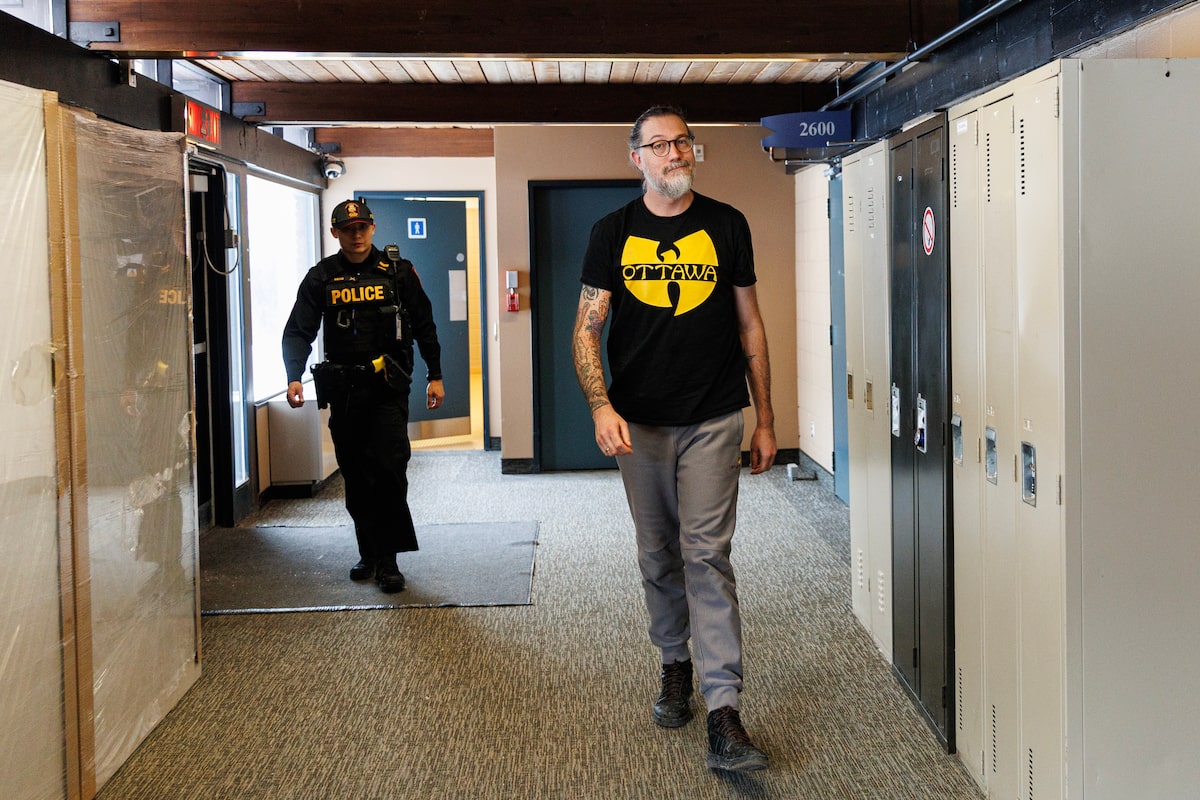
Master Warrant Officer Matthew Robar arrives at court in Gatineau on Monday.Keito Newman/The Globe and Mail
A Canadian Armed Forces intelligence operator charged with espionage exposed a fellow military member’s identity during unauthorized dealings with a foreign intelligence agency, according to documents filed in military court.
Master Warrant Officer Matthew Shawn Robar was arrested last week and charged with passing highly sensitive government secrets to what court documents refer to as a “foreign entity.”
The government has not identified the foreign entity. But a source told The Globe and Mail earlier this week that the country MWO Robar is accused of providing information to is Ukraine.
The Globe is not naming the source because they were not authorized to speak about a confidential matter.
In a military court hearing Monday, MWO Robar was released from jail under strict conditions, including that he surrender his regular and government passports and avoid any contact with any embassy or foreign intelligence service or foreign military.
Canadian military intelligence officer allegedly shared classified information with Ukraine
In exhibits presented in military court Monday and released to media Tuesday, prosecutors allege that MWO Robar shared with the foreign entity the full name and identity of a Canadian Armed Forces member who was engaged in covert intelligence and information-collection activities. He did not have approval of senior commanders to share the operative’s identity, documents presented in court say.
Information allegedly passed to the foreign entity also gave it leverage over Canada, which was used to make threats, the documents say.
Military prosecutors also allege that MWO Robar talked to the foreign entity about possibly working for their country’s foreign intelligence agency after he came under investigation in the fall of 2024.
“Through his continued work with the foreign intelligence service, they discussed future employment opportunities as a reward for facilitating the foreign entity’s interests,” the documents allege.
The relationship between MWO Robar and the foreign entity began between November, 2023, and April, 2024, when the two discussed a project described as “unconventional activity that involved sensitive techniques.”
It happened after MWO Robar was tasked by his superiors with interviewing “several individuals who wanted to report concerns related to the Canadian Armed Forces.” During these interviews, one of the individuals told the Forces member that he should speak with the foreign entity.
This project was “thematically aligned to the reported concerns” that had been brought to the Forces, according to the documents, which also said MWO Robar would have required the approval of senior commanders for this – which was never granted.
Nonetheless, MWO Robar continued to work on the project, including in a meeting in September, 2024, with the foreign entity at an undisclosed location abroad. During the meeting, the prosecution alleges MWO Robar also identified “several specialized units with the CAF who could possibly work with the foreign entity.”
At the same time, the foreign entity shared “sensitive information” with MWO Robar, asking him to pass that on to a Canadian Armed Forces partner “in an unconventional manner,” the documents said.
At one point, prosecutors allege the foreign entity “threatened to go to the media with the safeguarded and special operational information in an attempt to leverage Canada into supporting the foreign intelligence service interests.”
Although “Canada did not give in to the foreign entity’s threat,” the document says, MWO Robar’s conduct still gave them “leverage over Canada and therefore advanced theirs and the foreign intelligence service interests.”
The involvement of Ukraine in an espionage case is likely to raise questions about the relationship between Ottawa and Kyiv, and the $22-billion Canada has committed to the war-torn country.
The Ukrainian embassy and Ukrainian ambassador Andrii Plakhotniuk have not responded to repeated requests for comment.
On Tuesday, Foreign Affairs Minister Anita Anand was asked by The Globe about the role of Ukraine in this espionage case. She replied: “I don’t actually have all of the facts relating to this case. I am pleased to see that a member of the Canadian Armed Forces who has allegedly violated the rules is is being investigated. I think that’s what you have to do in terms of maintaining the rule of law in our country. I don’t have the facts relating to the precise information, the recipient of the information and the broader sharing of information at that level, so it would not be prudent for me to comment.”
Canada provides $50-million to buy drones and drone parts for Ukraine
The military prosecutor and defence counsel told the court Monday that the actions of the accused do not amount to the same serious national-security threat posed by former naval intelligence officer Jeffrey Delisle. Mr. Delisle was charged in 2012 with passing secrets to Russia and sentenced to 20 years in prison.
MWO Robar’s arrest remains a rare instance of an active member of the military facing legal repercussions for an alleged security breach.
Military prosecutor Major Max Reede said in court Monday that Mr. Robar is not a flight risk and was “not motivated by personal or financial gain or to cause harm.”
On Monday, the court heard that the foreign entity sent a series of e-mails in October, 2024, to third parties where they “openly disclosed” that they were working on a project with MWO Robar for over six months. The foreign entity said they provided direction and guidance to MWO Robar, the court heard.
Major Reede said those e-mails revealed that the foreign entity was privy to information that the government of Canada was taking measures to safeguard, including an “intelligence assessment of that foreign entity, the planned movements of a foreign military partner and the identity” of a Canadian military officer who is responsible for intelligence work.
Among the charges MWO Robar faces are “communicating special operational information” and “breach of trust in respect of safeguarded information” under the Foreign Interference and Security of Information Act, the military and RCMP said in a joint statement.
The first charge is under Section 17 (1) of the act, which deals with communicating “special operational information to a foreign entity or to a terrorist group.” The act says everyone who commits an offence under this subsection is “guilty of an indictable offence and is liable to imprisonment for life.”
The documents suggest that MWO Robar suffers from post-traumatic stress disorder. But they also allege he has not always been truthful about his mental-health struggles. Among the charges he faces is “feigning disease” under the National Defence Act.
None of the accusations have been proven in court.
The court heard that several members of the Canadian Armed Forces’ counter-intelligence unit became concerned with MWO Robar’s engagement with the foreign entity and informed their chain of command.
In October, 2024, MWO Robar was removed from duty at the counter-intelligence unit, and ordered to write reports of each of his interactions with the foreign entity. Major Reede alleged that “he lied in these reports.”
That same month, investigators obtained search warrants for MWO Robar’s home where they found classified information. Search warrants were also issued for National Defence headquarters in Ottawa where they found classified information in MWO Robar’s desk, the court heard.
His personal phone was also seized and text messages found on the Signal app allegedly showed MWO Robar “acknowledged that it was his intent to continue working on the Project even after being removed from” the counter-intelligence unit where he had been employed.