
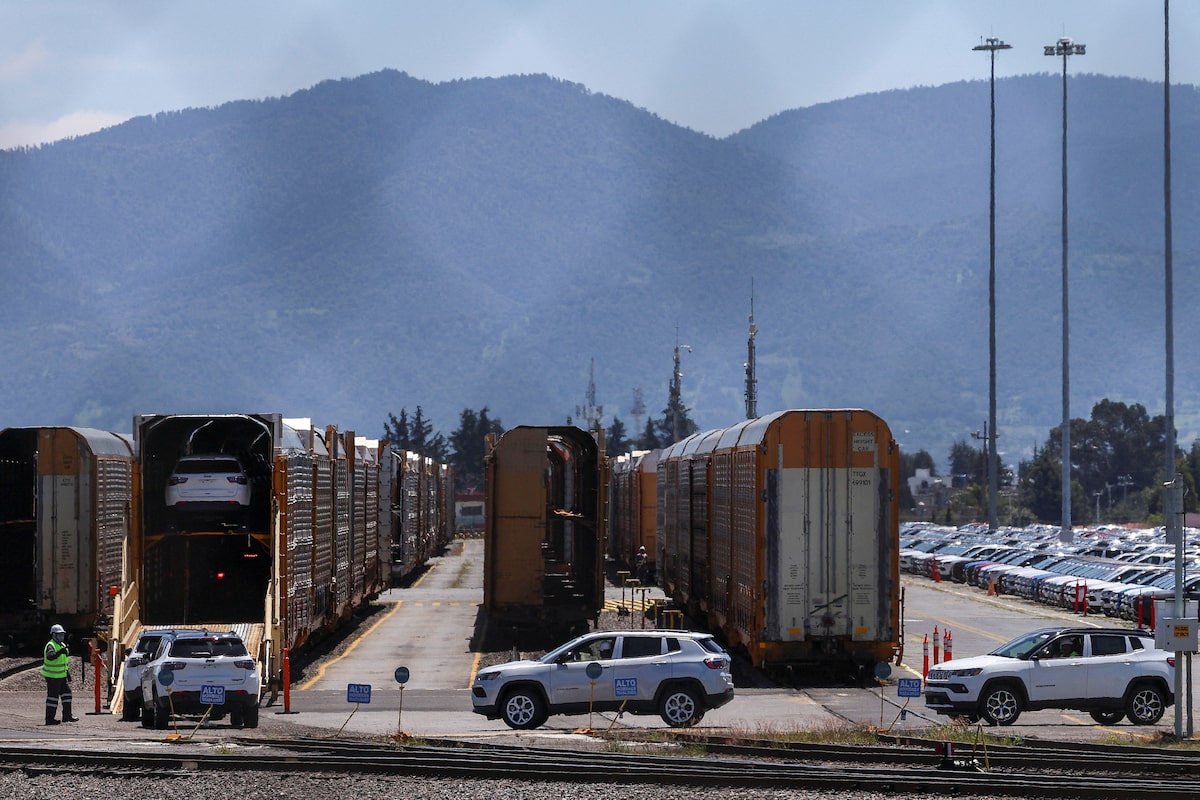
Vehicles are loaded onto a train car at the Kansas City Southern de Mexico rail yard in Santa Ana Tlapaltitlan, Mexico, on Tuesday. Goods traded in compliance with the USMCA – the vast majority of trade – remain exempt.Raquel Cunha/Reuters
There were no signs Thursday that Canada and the United States would settle a five-month trade war by an Aug. 1 deadline set by U.S. President Donald Trump before he imposes higher threatened tariffs on Canadian goods.
Barring a last-minute development, the blanket U.S. tariff on Canadian goods – which Mr. Trump refers to as “fentanyl tariffs” – will rise 35 per cent from 25 per cent. This won’t affect the vast majority of Canada-U.S. trade, which receives an exemption because it meets the United States-Mexico-Canada Agreement (USMCA) rules of origin.
In an afternoon White House press conference, Mr. Trump suggested to reporters that Prime Minister Mark Carney had called him but they hadn’t spoken.
“We haven’t spoken to Canada today. He’s called,” Mr. Trump said.
Earlier Thursday, the U.S. President announced Mexico had won a 90-day extension from his threat to increase tariffs but offered no such concession to Canada.
Mr. Trump in his later remarks suggested Canada needs to pay a “fair rate” of tariff when selling goods to the United States.
He criticized Canadian political leadership, saying “They’ve been very poorly led” and repeated his contention that Canada has treated U.S. farmers “very badly” with protectionist policies.
Explainer: What are the current tariffs between Canada and the U.S.?
Mr. Trump said Canada wants to be protected by his planned Golden Dome missile shield but for years has benefited from U.S. military protection without spending sufficiently on its own defence.
“You’re going to have to pay for it,” he said of the Golden Dome.
The White House on Thursday said countries that have yet to strike a new trade deal with the United States will be notified that night of tariff increases and Mr. Trump would be signing executive orders for the changes later Thursday.
“They will be hearing from his administration by the midnight deadline tonight,” spokesperson Karoline Leavitt said.
The U.S. President, a big supporter of Israel, also used his Truth Social account to broadcast his dissatisfaction with Mr. Carney’s plan to recognize a Palestinian state on social media.
But he later in comments to reporters that Mr. Carney’s support for Palestine would not be a dealbreaker in reaching a trade deal with Canada.
If Ottawa is unable to reach a deal by Friday, Mr. Trump has said he will increase the blanket tariff on Canadian goods – which Mr. Trump refers to as “fentanyl tariffs” – to 35 per cent from 25 per cent. These tariffs are separate from the U.S.’s industry-specific tariffs on steel, aluminum and autos.
Both Mr. Trump and Mr. Carney have warned they think the chances are slim of a deal by Aug. 1 that would end the Canada-U.S. trade war.
Mr. Trump announced on Thursday he had agreed with Mexican President Claudia Sheinbaum to extend an existing trade arrangement with Mexico for 90 days and continue talks over that period, with the goal of signing a new deal.
“Mexico will continue to pay a 25% Fentanyl Tariff, 25% Tariff on Cars, and 50% Tariff on Steel, Aluminum, and Copper. Additionally, Mexico has agreed to immediately terminate its Non Tariff Trade Barriers, of which there were many,” Mr. Trump said in a Truth Social post.
The White House’s Ms. Leavitt also underlined Mr. Trump’s unhappiness with countries, including Canada, for its intention to recognize a Palestinian state.
“The President expressed his displeasure and his disagreement with the leaders of France, the United Kingdom and Canada,” she said. “He feels as though that’s rewarding Hamas at a time when Hamas is the true impediment to a ceasefire and to the release of all of the hostages.”
On Wednesday, the Prime Minister said trade talks with Washington have been constructive and Canada’s negotiators will remain in Washington past Mr. Trump’s Friday deadline if they fail to reach a deal by then.
The Prime Minister’s chief of staff Marc-André Blanchard remains there with Intergovernmental Affairs Minister Dominic LeBlanc.
Mr. Trump has signed a series of agreements with trade partners in recent weeks, including with the European Union, Japan, and, on Wednesday, with South Korea. These have all left baseline U.S. tariffs in place, ranging from around 10 per cent to 20 per cent, as well as industry-specific tariffs – with some carveouts.
The agreements have also involved pledges to increase investment in the United States and buy more U.S. products.
On Wednesday, Mr. Carney opened the door to the possibility a deal might include similar purchase and investment commitments by Canada.
“There are many areas for co-operation between Canada and the United States, including defence spending, security spending, investments, which is one of the reasons why we’re having these broader discussions,” he told reporters.
Business Council of Canada chief executive Goldy Hyder said he doesn’t expect a trade deal to be announced by Friday.
After meeting with Republican Senators and U.S. trade officials in Washington this week, he came away with the impression that there’s a disconnect between what the U.S. wants and what Canada is putting on the table.
While Ottawa is trying to strike a grand bargain on trade, security and military spending, the Trump administration is focused on a handful of long-standing trade irritants, he said. “There’s a perception in the United States that Canada is busy playing chess, but there’s no one playing with it.”
Given the tariff exemption for USMCA-compliant goods, Mr. Hyder said he isn’t particularly concerned about the pending increase of the “fentanyl tariffs.”
Nearly 60 per cent Canadian goods entered the U.S. with a USMCA-compliant stamp in May, according to U.S. Census Bureau data. The Bank of Canada thinks that number could rise to as much as 95 per cent as more companies fill out the paperwork and rejig their supply chains to source more inputs from within North America.
“The only reason we’re surviving today is because of the [USMCA] exemption. Let’s be clear. If that disappeared tomorrow, we have a full-blown recession on our hands,” Mr. Hyder said.
Canadian negotiators need to shift their focus toward the renewal of the continental trade agreement, which is supposed to happen in 2026, he added. That’s a more formal venue in which to address U.S. complaints about things like automobile content rules, Canada’s supply-managed dairy industry, and softwood lumber, which appear to be tripping up the current negotiations.
The EU’s trade deal with the U.S. isn’t a blueprint for Canada, Carney says
In a Thursday press conference, Ms. Sheinbaum told reporters Mexico and the United States will keep working on a trade deal over the next 90 days. She noted that more than 84 per cent of Mexico-U.S. trade is USCMA compliant and is exempt from Mr. Trump’s 25-per-cent tariff.
A source familiar with the Canada-U.S. negotiations said the current talks do not resemble past trade talks with the United States where groups of experts sit at tables talking through technical matters to produce voluminous deals, as happened when the United States, Canada and Mexico negotiated the USMCA as a replacement for the North American free trade agreement, or NAFTA, during Mr. Trump’s first presidency.
What’s transpiring is more a political-level discussion akin to hammering out the terms for a business deal than a traditional international treaty-making process, the source said. The details would be worked out later, they said.
The Globe and Mail is not identifying the source who was not authorized to discuss the negotiations.
Since returning to office earlier this year, Mr. Trump has hit Canada with two types of tariffs. He has imposed the blanket “fentanyl tariff,” with a carve-out for USMCA-compliant goods.
And he has imposed industry-specific tariffs, known as Section 232 tariffs, on several sectors. These include a 50-per-cent levy on steel and aluminum imports, and a 25-per-cent duty on auto imports (with a carve-out for U.S. auto parts in Canadian and Mexican-made cars).
A 50-per-cent tariff on some copper products will come into force on Friday, and Mr. Trump has threatened other Section 232 tariffs on lumber, pharmaceuticals and semiconductors.
Bessent indicates U.S. willing to work with Canada on metals tariffs
Mr. Carney did not directly answer a question Wednesday about whether Canada would accept a deal like the EU that leaves a baseline tariff in place. But he suggested in the clearest terms yet that the industry-specific 232 tariffs are likely to remain in place.
“The revealed approach of the United States in all those sectors has been to have tariffs, some base-level tariffs.”
Ontario Premier Doug Ford told reporters in Thunder Bay on Thursday that he still hoped a trade deal could be reached that would spare Canada from tariffs – but warned that Trump was unpredictable.
“Prime Minister Carney’s trying his best, but this guy will say something one day, and he’ll wake up, and the cheese slips off the cracker, and then all of sudden, he goes the other way. And you’re thinking, ‘How do you deal with a guy like this?’ ” Mr. Ford said.
He said it was important to ensure that key imports from the U.S. that rely on Canadian raw materials, such as steel beams for construction and aluminum cans for pop and beer, are now completely manufactured north of the border. And he urged Canadian consumers to be careful to buy Canadian products when possible.
“Are we hoping that we can get a deal with zero tariffs? Yes. But I always say, ‘How we can kick back is – and it’s not the American people – kick back at President Trump is, let’s start onshoring everything, absolutely everything we possibly can,’” Mr. Ford said.
With a report from Jeff Gray and reports from Reuters