
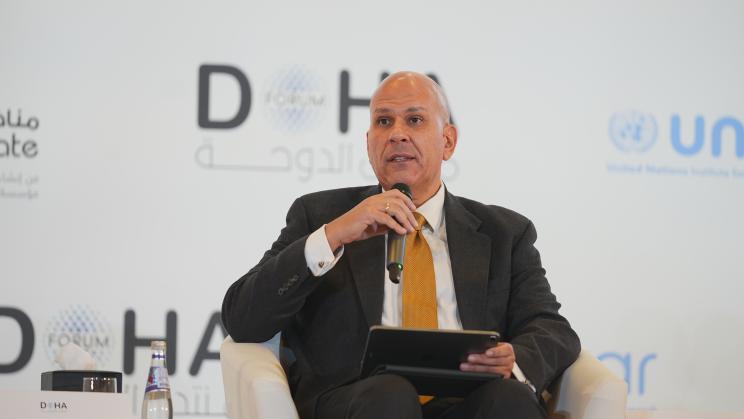
On 6–7 December, representatives from the Stockholm International Peace Research Institute (SIPRI) participated in the Doha Forum 2025, held under the theme ‘Justice in Action: Beyond Promises to Progress’. SIPRI’s delegation included Stefan Löfven, Karim Haggag, Dr Wilfred Wan, Dr Jingdong Yuan and Marie Riquier.
As part of the forum programme, Karim Haggag, SIPRI Director, moderated the session ‘Arms Control: The Nuclear Challenge of Our Era’ on 7 December. The session examined the current state of nuclear arms control amid heightened geopolitical tensions, technological change and renewed debates around nuclear strategy. Speakers discussed challenges facing existing arms control frameworks and prospects for reducing nuclear risks in an increasingly complex security environment.
In addition, Stefan Löfven, SIPRI Chair, participated as a speaker in the roundtable ‘Justice in Action: Global and Regional Governance Strategies’, which explored global and regional approaches to addressing systemic injustice through political, socio-economic and environmental perspectives. The discussion considered how multilateral and regional mechanisms can contribute to more equitable and sustainable governance outcomes.
Beyond SIPRI-organized sessions, Karim Haggag also took part in related discussions at the Qatar Mediation Forum (7–8 December) and Doha World Negotiation Day (8 December), contributing SIPRI perspectives to wider conversations on international security, diplomacy and conflict management.
About the Doha Forum
The Doha Forum is an annual global platform for dialogue that brings together heads of state, policymakers, experts and civil society representatives to address pressing international challenges. The 23rd edition was held on 6–7 December 2025 under the theme ‘Justice in Action: Beyond Promises to Progress’ and convened leaders and specialists from around the world to discuss policy, diplomacy and humanitarian development, as well as shared approaches to peace, security and sustainable cooperation. SIPRI’s participation contributed research-based perspectives to discussions on arms control and international security.