
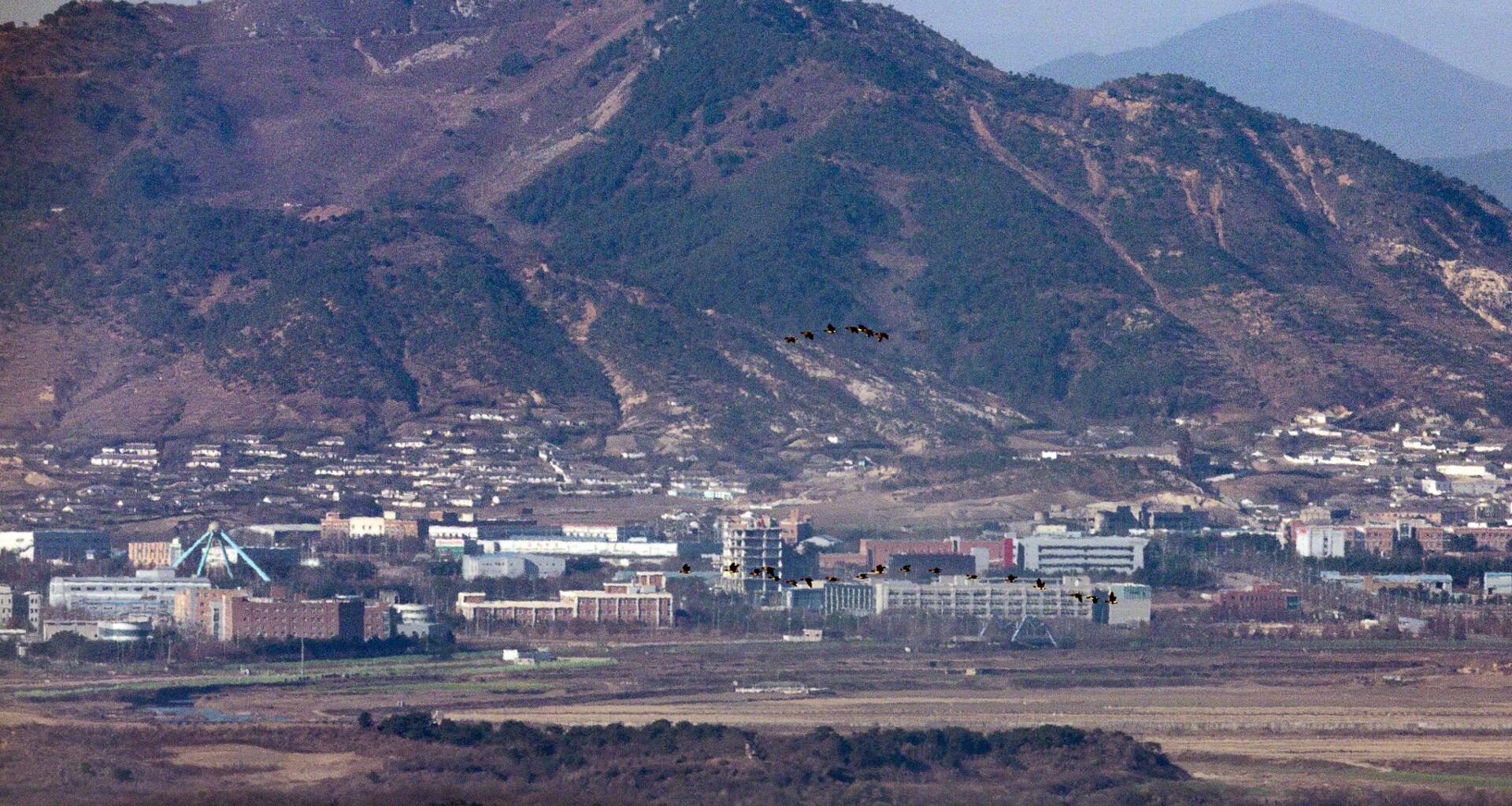
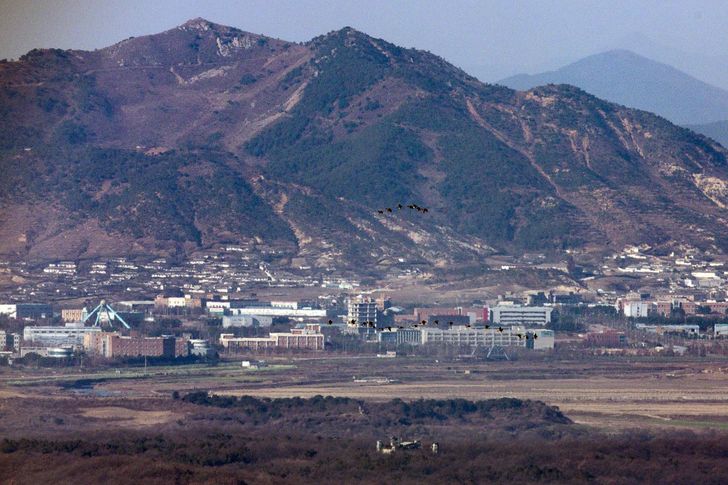
The western frontline Demilitarized Zone (DMZ) and the area around the Gaeseong Industrial Complex in North Korea are seen from a border region in the South’s Paju, Gyeonggi Province, Nov. 18. Yonhap
The United Nations Command (UNC) has issued a rare press release stressing its authority over access to the Demilitarized Zone (DMZ).
It comes amid growing debate in South Korea over proposed legislation that would allow the Korean government to approve nonmilitary access to the DMZ.
According to the release posted on its website Tuesday, the UNC said that it, through the UNC Military Armistice Commission (UNCMAC), has been the successful administrator of the DMZ, a role that has been essential in maintaining stability, especially amid periods of heightened inter-Korean tensions.
Citing the 1953 Korean Armistice Agreement, the UNC emphasized that civil administration and relief activities in the DMZ south of the Military Demarcation Line fall under its authority. It further noted that the agreement grants the UNCMAC jurisdiction over all access to the DMZ.
“No person, military or civilian, shall be permitted to enter the demilitarized zone except persons concerned with the conduct of civil administration and relief and persons specifically authorized to enter by the Military Armistice Commission,” the statement said.
It further stated that the UNCMAC reviews all DMZ access requests in accordance with established procedures, ensuring that movement within the area is not perceived as provocative and does not pose a risk to the safety of personnel or visitors. It added that the UNC will continue its efforts to maintain the armistice and stability on the Korean Peninsula, with the ultimate hope that a permanent peace treaty can be achieved.
“Through times of crisis and times of hope, the UNC, with the generous support of the ROK Government and Member States, has remained a pillar of stability, ensuring that killing and suffering would not resume,” the statement reads. “We remain committed to maintaining the Armistice and stability on the Korean Peninsula with the optimistic hope that a permanent peace treaty can be achieved.”
It is unusual for the UNC to issue a public statement addressing a specific policy issue.
Earlier, ruling Democratic Party of Korea (DPK) lawmakers Lee Jae-gang and Han Jeoung-ae each introduced bills that would give the South Korean government authority to approve access to the DMZ for nonmilitary and peaceful purposes.
Currently, access to the DMZ is controlled entirely by the UNC. However, Lee argued in his proposed legislation that, because the armistice agreement’s preamble defines it as “of a purely military character,” applying its authority to restrict civilian access goes beyond its intended scope.
The Ministry of Unification expressed support for the bills, stating its agreement with their legislative intent. In an official comment released Wednesday, the ministry said it respects the UNC’s long-standing efforts to maintain peace in the DMZ, while emphasizing that the armistice agreement, as stated in its preamble, is a military accord and does not prohibit the peaceful use of the DMZ.
“In the absence of comprehensive domestic legislation governing the DMZ, the National Assembly has introduced three bills aimed at preserving the area and enabling its peaceful utilization. The government plans to pursue consultations with the UNC in coordination with relevant ministries, while supporting the legislative process in the National Assembly,” the comment reads.
The UNC, however, has reiterated that it holds sole authority over DMZ access under the armistice agreement, regardless of the purpose of entry. The statement is seen as the UNC’s opposition to the proposed legislation.