
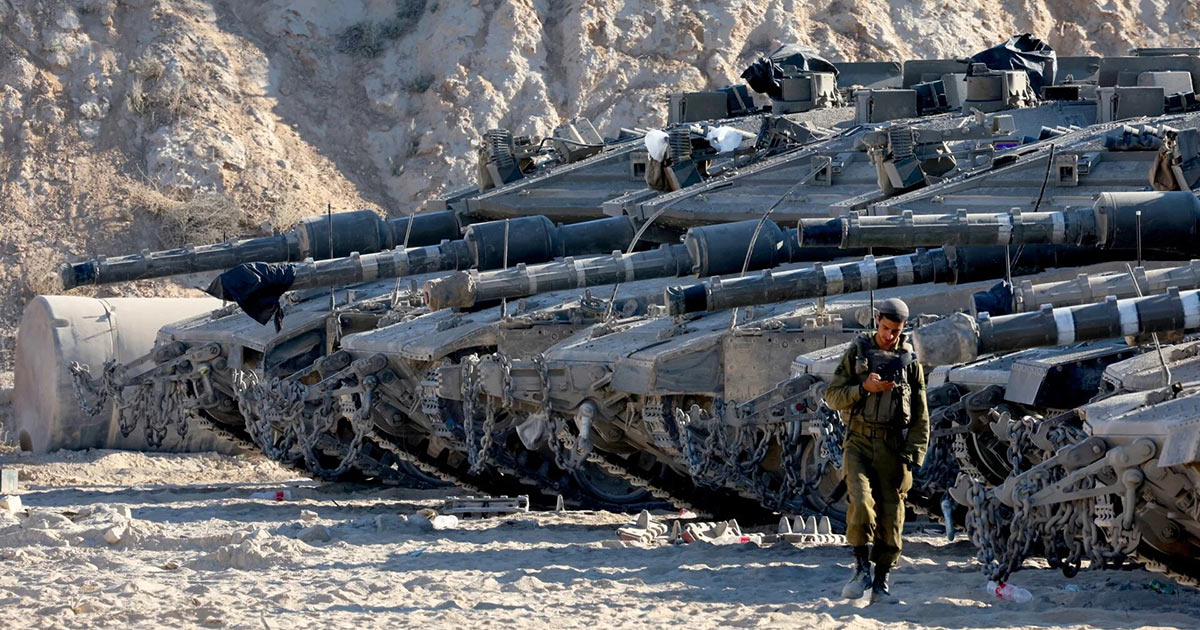
For decades, arms exports have served as a key instrument for advancing Israel’s foreign policy objectives and as a significant source of revenue. Despite its small size, Israel has emerged as one of the largest global weapons exporters. During 2020-2024, it remained the world’s eighth largest arms exporter, accounting for 3.1 percent of total global arms exports. In 2024, its arms exports set another record at US$14.8 billion, compared to US$13 billion in 2023. Israeli-made defence items are popular across Europe, Latin America, Africa, and Asia.
In 2024, air defence systems, missiles and rockets accounted for 47 percent of its arms exports, while vehicles amounted to 9 percent; satellites and related equipment 8 percent; radar and electronic warfare systems 8 percent; and manned aircraft and avionics 8 percent. The procurement of these categories of weaponry underscores the military-security challenges faced by Israeli clients, including India, one of its largest importers. This article assesses the emerging dynamics of Israel’s arms exports following the Gaza crisis, which has resulted in European clients curtailing their defence trade with Israel, while simultaneously creating growth opportunities in Asian markets, particularly India and Southeast Asia.
Arms Exports to Europe and Asia
Sustained arms exports are paramount for Israel. While its defence forces employ domestically manufactured weapons systems, the majority are exported globally, constituting a significant source of foreign earnings vital for funding defence research and development. Disruptions in the arms trade could impede the sustainability of its defence industries, including both state-owned and private firms. As a result, the Israeli governments prioritise promoting defence cooperation and partnerships with its international counterparts. A classic example is Indo-Israeli defence ties, no longer kept under wraps, unlike in the 1990s and the 2000s, when public discussion of this cooperation was widely considered taboo. A similar trend is evident with other Asian partners: Vietnam, Singapore, Thailand, and the Philippines, where military-security cooperation has become substantial. The Asia-Pacific region alone accounted for 23 percent of all Israeli arms exports last year.
Consistent with earlier patterns, Israel’s arms transfer faces rigorous scrutiny from human rights organisations, opposition political parties, and, occasionally, ruling governments. This scrutiny intensified after the Gaza crisis. A few European and Asian countries maintain defence trade ties with Israel, but expressed discernible disapproval of its military operation. For instance, Spain and Germany–both significant sources of Israeli defence imports–have publicly advocated for restrictions or suspension of arms sales to Israel as a manifestation of their condemnation of Israel’s military actions in Gaza. Italy announced suspension of “all new export licenses, and all agreements signed after October 7th were not implemented.” These restrictive policies represent a coercive diplomatic instrument employed by select nations to compel them to negotiate either a comprehensive peace settlement or ceasefire agreements during such conflicts. Despite this, Europe is Israel’s largest export destination, accounting for 54 percent of total exports in 2024.
As certain European partners curtail defence imports from Israel, the broader Asian region is emerging as an increasingly significant destination for Israeli arms. The Asia-Pacific clients accounted for 23 percent of Israel’s total defence exports last year, coinciding with the increased spending on weapons and defence-related research due to emerging security developments. Beyond arms procurement, Asian countries, including India, Vietnam, Thailand, the Philippines, Singapore, Malaysia, Indonesia, Japan, and South Korea (in East Asia), are investing in defence industrial partnerships with international counterparts through technology transfer arrangements, joint ventures, and licensed production agreements, reflecting a strategic shift towards indigenous defence capabilities.
While these countries maintain strong defence ties with traditional partners like the United States (US), Russia and China, Israel had made steady inroads over recent years. Beyond India, the largest importer of Israeli defence products in South Asia, Israeli systems and technology are increasingly popular in Vietnam, the Philippines, Thailand, and Singapore. Arms sales to these Southeast Asian nations are driven by strategic imperatives, including preservation of geopolitical influence within the Indo-Pacific region, the mitigation of China’s expanding regional presence and the reinforcement of regional stability. Israel’s readiness to supply defence systems without political conditionalities, combined with these countries’ desire to diversify suppliers, has fostered growing bilateral defence cooperation, including arms transfers and broader collaborative partnerships.
In recent years, as key European clients reduced arms trade with Israel, new defence agreements and procurement deals emerged with Asian partners, especially in Southeast Asia and India. In late 2024, Israel Aerospace Industries Ltd. (IAI) engaged with Vietnamese firms on joint development of military equipment and technology transfer. The two countries reportedly finalised a deal worth approximately US$680 million for two advanced surveillance satellites from Israel, enhancing Vietnam’s intelligence capabilities and providing critical assets to monitor Chinese assertiveness. Such joint ventures also support Hanoi’s efforts to bolster its domestic defence manufacturing.
In November 2023, Thailand’s Defence Technology Institute (DTI) and Israel’s Rafael Advanced Defence Systems signed a joint-production agreement to domestically manufacture two variants of the Israeli-made guided missile system: Spike Non-Line-of-Sight (NLOS) and Spike Extended Range (ER). The sustainability of this deal depends on Thailand’s armed forces’ procurement and contractual commitments. Despite protests by some Singaporeans against Israeli-Singaporean arms trade following the Gaza crisis, Singapore announced in November this year its selection of Israel’s Elbit Systems’ Hermes 900 unmanned aerial vehicle (UAV) to replace the Hermes 450, aligning with the Singapore Armed Forces (SAF) 2024 transformation vision.
However, a concerning development arose in 2025, when the Philippines suspended new arms contracts with Israel. This shift appears driven by Israel’s alleged refusal to recognise the Philippines’ maritime boundaries in the South China Sea and the ongoing Gaza crisis. As a key Israeli arms client in Southeast Asia, a prolonged impasse risks a significant politico-economic setback for Israel. Given the sensitivity of these issues, Israel must navigate its relations with the Philippines with diplomatic acumen. Losing a client like the Philippines in pursuit of affordable non-Western weapons systems would be strategically and commercially unwise.
India-Israel Defence Cooperation
In South Asia, India’s arms trade with Israel has been the “bedrock of a strategic partnership” and a key aspect of bilateral ties that has endured over time. In 2024, their arms trade volume was about US$185 million. Between 2020 and 2024, Israel supplied 13 percent of India’s total arms imports, while India accounted for roughly 34 percent of Israel’s defence exports. India’s imports are mainly driven by tensions with Pakistan and China. Despite growing indigenous defence manufacturing, partners like Israel, which develops advanced technologies to meet evolving security challenges, remain vital to India’s defence framework.
The India-Israel MoU on defence cooperation, signed during the 17th Joint Working Group meeting on 4 November 2025, is significant. Beyond co-production and co-development, both nations have committed to deepening collaboration in defence industrial cooperation, training, technological innovation, artificial intelligence and cyber security. The operational effectiveness of jointly developed weapons systems, such as Barak-8 missiles (with India’s DRDO) and HARPY drones, was demonstrated during India’s Operation Sindoor against Pakistan in May this year. As a joint venture, Israel Weapons Industries (IWI) and India’s Adani Group have signed a deal to manufacture 425,000 close-quarters battle (CQB) carbine assault rifles for the Indian Army under the Make-in-India initiative. Reports also indicate ongoing talks on India procuring Israeli-manufactured Air Lora missiles (produced by IAI) and Rafael’s Ice Breaker cruise missiles, with co-manufacturing provisions. These systems are strategically important for India to address evolving threats to military installations, targeting of missile sites, air defence systems, and adversaries’ land and sea targets. These developments underscore the depth and robustness of Indo-Israeli defence cooperation and the strategic value of the South Asian market for Israel’s arms exports.
While European markets will remain significant for Israel’s arms exports, Asian countries, particularly India and the above-discussed Southeast Asian countries, offer comparable opportunities due to rising demand for defence materiel amid evolving security challenges. With most of these nations’ defence indigenisation programmes still nascent and facing delayed deliveries, their governments will continue relying on international suppliers for several years. Israel should, therefore, pursue concerted efforts to strengthen politico-economic ties with regional actors, thereby transforming the broader bilateral relationship and infusing greater momentum into defence cooperation.
Israel’s ‘pivot to Asia’, accelerated by Prime Minister Benjamin Netanyahu in the late 2000s, must shift from opportunistic engagement to strategic institutionalisation. As Asian defence markets grow and modernisation quickens, Israel should prioritise technology transfer and co-production over direct sales to support Asian partners’ indigenisation goals. Ultimately, the sustainability of Israel’s defence exports increasingly depends less on replacing European markets with Asian ones and more on building resilient, mutually beneficial partnerships.
Alvite Ningthoujam is the Deputy Director & Assistant Professor at the Symbiosis School of International Studies, Symbiosis International (Deemed University), Pune, India
The views expressed above belong to the author(s). ORF research and analyses now available on Telegram! Click here to access our curated content — blogs, longforms and interviews.