
p]:text-cms-story-body-color-text clearfix”>
Tunisian filmmaker Kaouther Ben Hania’s “The Voice of Hind Rajab,” about the effort to save a Palestinian girl trapped in the genocidal war zone of Gaza, is made from the stuff of your worst nightmares. That’s because — not a spoiler, if you followed the internationally reported story — the hoped-for rescue of that life on Jan. 29, 2024, despite the best efforts of the Palestine Red Crescent Society’s Ramallah-based emergency coordinators, didn’t happen.
This dramatized movie, however, seeks to retrieve something else: a spark of unignorable humanity from a media ecosystem of headlines and statistics that doesn’t always grasp how distancing it can be. Ben Hania’s notion is to fuse the tools of docudrama with the evidence of shocking tragedy: the actual audio of 6-year-old Hind Rajab’s voice as she lay trapped in a car at a gas station in a neighborhood under siege by Israeli troops, pleading to be saved.
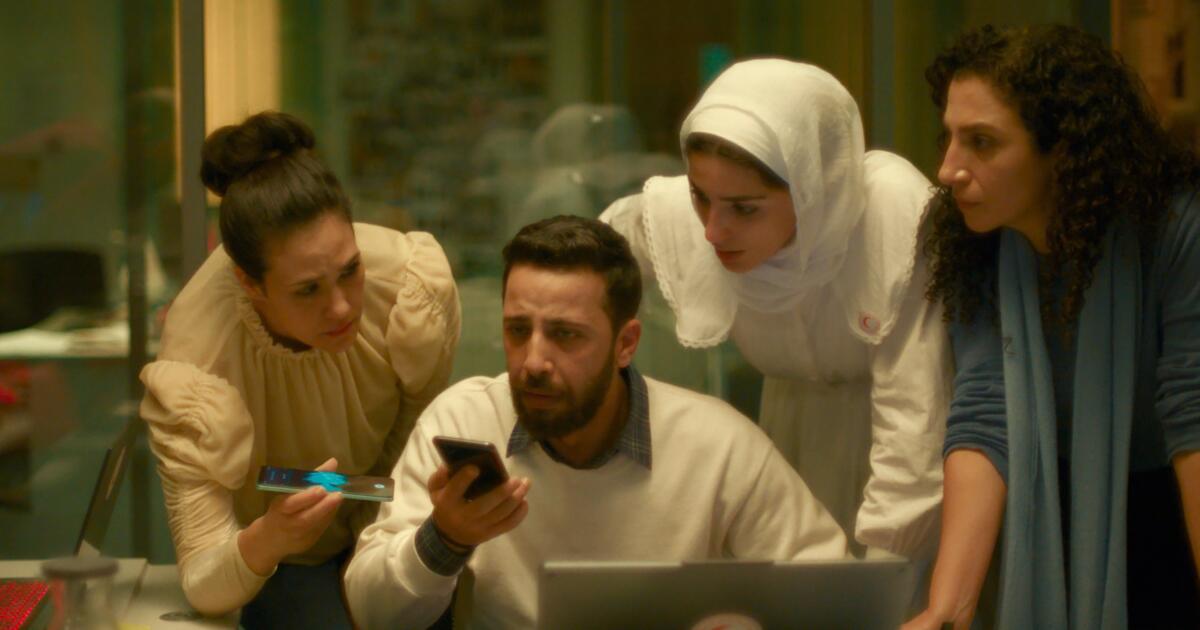
The movie is a real-time reenactment built around that 70-minute phone recording, which we hear in all its shattering desperation as a core cast plays the Red Crescent workers scrambling to break through red tape to arrange for an ambulance to come to her. All the while they keep company online with that faint, terrified voice. Her gathering awareness — Hind Rajab sat in a car among dead family members — is too heartbreaking to fully comprehend.
Inside the call center, nerves are fraying. Omar (Motaz Malhees), who initially takes the call and is increasingly fueled by outrage, chafes at the labyrinthine protocol (involving both Red Cross and the Ministry of Health) insisted upon by his level-headed overseer, Mahdi (Amer Hlehel). But Mahdi has seen too many heroic responders killed unnecessarily — a poster with images of their faces tacked to the wall is a grim reminder — to sacrifice anyone else on an unapproved mission, even one that should ostensibly take only minutes to pull off.
Helping keep Hind Rajab on the line are Omar’s colleagues Rana (Saja Kilani) and Nisreen (Clara Khoury), who bolster the girl’s fragile resilience with the touching suggestion that they are another type of family looking out for her. Ironically, it’s a tactic that backfires, if the goal is for dispatchers to keep their cool.
The movie is a powerfully blunt instrument of empathy. Ben Hania’s insistence on close-up melodramatics — faces in anguish, a handheld camera glued to them — sometimes overshadows a thirst for something more analytical. But it’s decidedly a vision, one steeped in roiling pain. And while that ghostly recording is always an anchor of genuine feeling, the one-location apparatus built around it doesn’t necessarily help the actors, who can’t help but remind us they’re in the performed portion of this wretched event.
Ben Hania’s last film was another bold meshing of the factual and the fictionalized, the hybridized Oscar-nominated documentary “Four Daughters,” in which a real Tunisian family processes personal tragedy through role-playing for the director’s camera. This time, there is nothing to process, because we are watching something that has already played out. What is being presented instead is a remembrance and a plea to keep the fires of moral urgency lighted. As shaky as it sometimes is as a work of art, there’s also an argument that a movie like this defies criticism. Hate is getting louder and louder these days and “The Voice of Hind Rajab,” whatever its well-meaning faults, prioritizes the sound of an innocent who should still be with us.
‘The Voice of Hind Rajab’
In Arabic, with English subtitles
Not rated
Running time: 1 hour, 29 minutes
Playing: Opens Friday, Dec. 19, at Laemmle Royal