
On Sunday, the lifesavers at Australia’s most iconic beach turned surfboards into stretchers and ferried wounded victims of this country’s worst terrorist attack to waiting ambulances.
According to an ABC fact check, more than 100 shots were fired by two gunmen in just under six minutes. By midweek, the death toll stood at 16, with 40 more injured, five of whom were fighting for their lives in hospital.
Those six minutes shook Australia to its core. Challenged was the assumption that we are a safe, multicultural, tolerant nation, immune from the hatreds that feed foreign conflicts. Suddenly the debates that had consumed us in recent weeks – about politicians’ travel entitlements, inflation and cost-of-living pressures – seemed irrelevant.
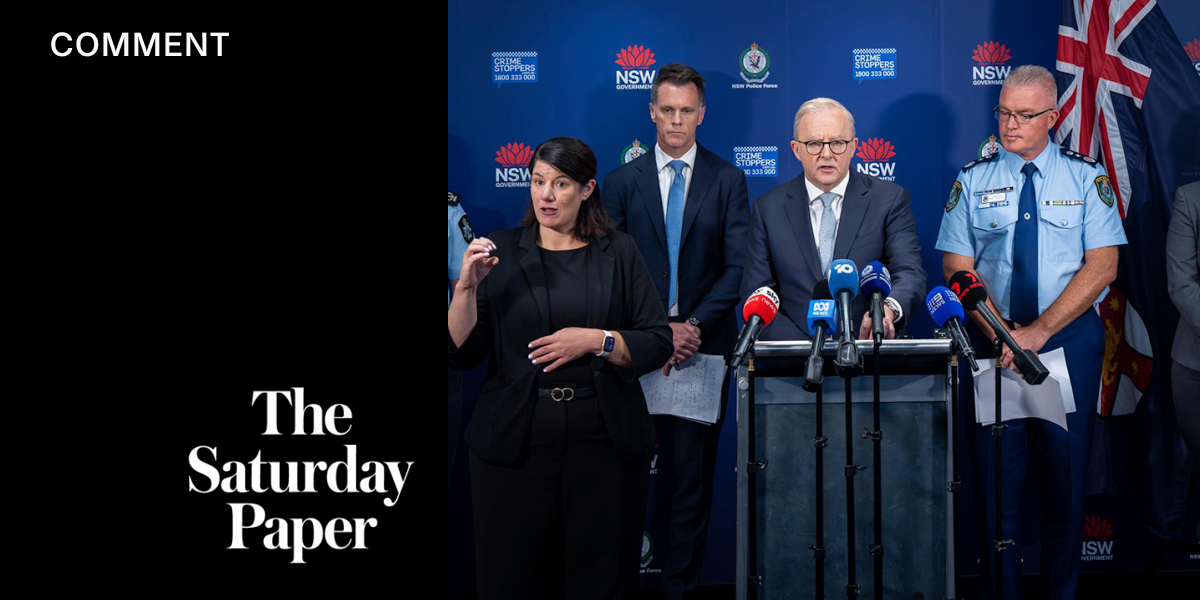
“This is a targeted attack on Jewish Australians … an act of evil, anti-Semitism, terrorism that has struck the heart of our nation,” Prime Minister Anthony Albanese said on Sunday night. “An attack on Jewish Australians is an attack on every Australian, and every Australian tonight will be, like me, devastated by this attack on our way of life. There is no place for this hate, violence and terrorism in our nation. Let me be clear – we will eradicate it. Amidst this vile act of violence and hate will emerge a moment of national unity where Australians across the board will embrace their fellow Australians of Jewish faith.”
According to the Australian Federal Police, the cowardly massacre was carried out by two men steeped in the extremism of the Islamic State. Their lethal anti-Semitism made a target of Jewish families celebrating Hanukkah, the festival marking the triumph of light over darkness.
The worrying reality is that if these two men were radicalised by the Islamic State world view, theologically and politically, others similarly influenced are out there, too.
One of the killers, 50-year-old Sajid Akram, came to Australia from southern India 27 years ago, when he received his original visa. His 24-year-old son, Naveed, who is alleged to have joined him in the massacre and has since been charged with 59 offences, was born in Australia. Naveed was investigated five years ago for his links to an IS cell in Sydney but was deemed at the time to not be a threat.
Pauline Hanson made a point of this, as she attempted to bend the tragedy to her anti-immigration rhetoric.
Albanese is convinced Australians want the nation to come together at a time like this. He says we will not allow the country to be divided, because that is what the terrorists seek. Unlike in previous disasters … the opposition and its supporters broke ranks with the government and blamed the prime minister for the atrocity.
After laying flowers at the Bondi Pavilion, she said there is a lot that can be done to make Australia safe. Hanson said Australia had to “look at the people we are bringing to the country. Certain countries, they should not be allowed to migrate here.” Potential Liberal leader Andrew Hastie made a similar point, saying the country’s immigration program should “favour those who support Australia as a Judaeo–Christian nation”.
The framing is offensive, surely, to one of the heroes of last Sunday. Ahmed Al Ahmed, a Syrian-born Muslim, risked his life to disarm Sajid Akram, only to be shot and wounded by the other gunman.
The prime minister visited Al Ahmed in hospital and has praised him as a shining example of the strength of humanity, saying he represents “the best of our country”.
Albanese is convinced Australians want the nation to come together at a time like this. He says we will not allow the country to be divided, because that is what the terrorists seek.
Unlike in previous disasters – whether they be the Bali bombings, Port Arthur or the Lindt Cafe siege – the opposition and its supporters broke ranks with the government and blamed the prime minister for the atrocity.
On Sunday night, Liberal leader Sussan Ley issued a considered and unifying statement. “Today we stand together as Australians against hate in this moment of profound tragedy and shock,” she said. She provided the prime minister and the Commonwealth and state agencies with the Coalition’s full and unconditional support.
By Monday morning, however, Ley had changed tack. A party source said this was after some conservative Liberals were angered by her initial response.
Ley said we’ve seen a “clear failure to keep Jewish Australians safe” and that the government had shown a “clear lack of leadership” in allowing anti-Semitism to fester over the past two years.
Many of the incidents Ley cited were not ignored, as she claimed, but were investigated, with people arrested and charges laid. In one rare act, the Iranian ambassador was expelled after credible intelligence emerged that Tehran was involved in orchestrating the firebombing of a synagogue.
Israel’s prime minister, Benjamin Netanyahu, accused Albanese of doing nothing to keep Australian Jews safe. He said Australia’s recognition of Palestine had emboldened “those who menace Australian Jews”. He claimed Albanese had “replaced weakness with weakness and appeasement with more appeasement”.
When asked for a response, Albanese said, “this is a moment for national unity”.
Former Liberal prime minister Malcolm Turnbull said Netanyahu’s response did not help and he should stay out of Australian politics. He said the Israeli prime minister is not right in blaming Albanese for the atrocity.
Netanyahu himself faces regular protests in Israel for his failure to protect the 1200 Israelis who lost their lives to Hamas attacks on October 7, 2023. His government’s response in Gaza since did not deliver the safe release of all the hostages. Some critics say it put them further in harm’s way.
Albanese’s response in the past two years has attempted to balance concern over rising anti-Semitism against concern in the community about the war in Gaza.
John Howard – the Liberal Party’s second-longest-serving leader – accused him of being “Mr Yes But Maybe” and failing to provide the moral leadership that a prime minister can in denouncing anti-Semitism. He said Albanese has been “asleep at the wheel” and he hoped Sunday’s tragedy would persuade the prime minister to be more serious in combating “the forces of hatred”. Howard went so far as to accuse Albanese of focusing on gun reform to avoid a debate about the spread of hatred of Jewish people.
Albanese firmly denies this, saying confronting anti-Semitism and the need for further gun control are not mutually exclusive.
Howard, with the support of Nationals leader David Littleproud, cast doubt on the need for further gun reform. He said the death toll at Bondi would have been “infinitely bigger” if not for the ban on automatic weapons instituted after the Port Arthur massacre.
New South Wales premier Chris Minns will recall parliament before Christmas to consider reforms that severely restrict the availability of the sort of guns used last weekend and modify their ability to rapid fire. Albanese is encouraging the other states and territories to match these reforms.
Despite his criticism of Albanese for not taking a strong stand against anti-Semitism, Howard does not agree with former treasurer Josh Frydenberg that the prime minister has “personal responsibility” for the killings. He says “no sensible man or woman” could say if Albanese had done “this or that” Sunday would not have happened.
Parliament’s most senior Jewish member, former attorney-general Mark Dreyfus, says the issue confronting Australia is “not some sort of partisan political contest”. He says some people seem to think the best way to combat anti-Semitism is to attack the prime minister. “The best way,” he says, “is to work together.”
Dreyfus, who was the architect of Australia’s hate speech laws in the last term of parliament, says there is a need for continuous review and even reworking of the laws to better address violence.
On Wednesday, after “difficult conversations” with grieving families and Bondi’s Jewish leaders, Albanese said he was “certainly up for whatever is necessary” to strengthen Australia’s response to dangerous hate directed at the community. On Thursday, he held another national security committee meeting and announced that his government “adopts and fully supports” the report of the special envoy to combat anti-Semitism, Jillian Segal. She delivered the report in July but until this week there had not been a detailed response to its 13 recommendations.
Albanese promised to “continue to work through” implementation in consultation with Segal and the Jewish community, and confirmed he had accepted her first proposal, to adopt the definition of anti-Semitism formulated by the International Holocaust Remembrance Alliance.
Cabinet was concerned the definition is open to overreach, especially when combined with proposals to withhold public funding from universities, programs or academics who fail to act against anti-Semitism. Those proposals would also affect arts funding. Critics say the definition could be used to outlaw free speech and restrict criticism of Israel. Arbitrary application of the prohibitions could inhibit valid differences of view and interpretation of history or events.
Albanese says he will work across the parliament for the broadest possible support for the new laws, giving unprecedented powers to ministers and security agencies. The Greens say they will closely review what is proposed. Their votes in the Senate may be needed, with the opposition coming up with a package of its own detailed prescriptions, heavily influenced by Jewish leaders.
The Coalition is demanding the immediate recall of parliament and the introduction of its suite of laws.
Home Affairs Minister Tony Burke said whatever is done with the Segal report, the first priority now is “the safety of people”.
This article was first published in the print edition of The Saturday Paper on
December 19, 2025 as “An attack on our way of life”.
For almost a decade, The Saturday Paper has published Australia’s leading writers and thinkers.
We have pursued stories that are ignored elsewhere, covering them with sensitivity and depth.
We have done this on refugee policy, on government integrity, on robo-debt, on aged care,
on climate change, on the pandemic.
All our journalism is fiercely independent. It relies on the support of readers.
By subscribing to The Saturday Paper, you are ensuring that we can continue to produce essential,
issue-defining coverage, to dig out stories that take time, to doggedly hold to account
politicians and the political class.
There are very few titles that have the freedom and the space to produce journalism like this.
In a country with a concentration of media ownership unlike anything else in the world,
it is vitally important. Your subscription helps make it possible.
Send this article to a friend for free.
Share this subscriber exclusive article with a friend or family member using share credits.

Used 1 of … credits
use share credits to share this article with friend or family.
You’ve shared all of your credits for this month. They will refresh on January 1. If you would like to share more, you can buy a gift subscription for a friend.
SHARE WITH A FRIEND
? CREDITS REMAIN
SHARE WITH A SUBSCRIBER
UNLIMITED
Loading…