
This article is an on-site version of our Swamp Notes newsletter. Premium subscribers can sign up here to get the newsletter delivered every Monday and Friday. Standard subscribers can upgrade to Premium here, or explore all FT newsletters
The late regency British prime minister, George Canning, famously “called the New World into existence to redress the balance of the old”. It is too early to hope that America’s punch drunk allies will be capable of doing the same in reverse. But America under Trump 2.0, and his gang of proud boys, is no longer the city on the hill. Nor, in contrast to what Isaiah Berlin said about Franklin Roosevelt’s broadcasts in the second world war, is the US nowadays even a source of light. However dim western Europe’s bulbs have grown — and they have dimmed — the rest of the west can still emit light. In my final Swamp Notes of what has been the strangest year of my life (though I’m delighted to say that description doesn’t extend to my personal life), my mind turns with increasing frequency to the survival and the rebirth of the rest of the west.
People have rightly commented at length on the Trump administration’s national security strategy’s hostility to liberal democratic Europe, though Canada, Japan, Australia and others were implicitly targeted as well. What I find most offensive is the report’s meta-theme. Trump and the likes of Elon Musk have taken to lecturing us about western civilisation — a subject on which both would get fail grades at junior school. Musk frequently says that “western civilisation’s greatest weakness is empathy”. This was the man who boasted of his gutting of America’s aid budget. “The picture of the world’s richest man killing the world’s poorest children is not a pretty one,” Bill Gates told my colleague David Pilling in what was one of the quotes of the year. Most things that I value, including our collective capacity for decency, are now at stake. I also fear our historic capacity for indecency.
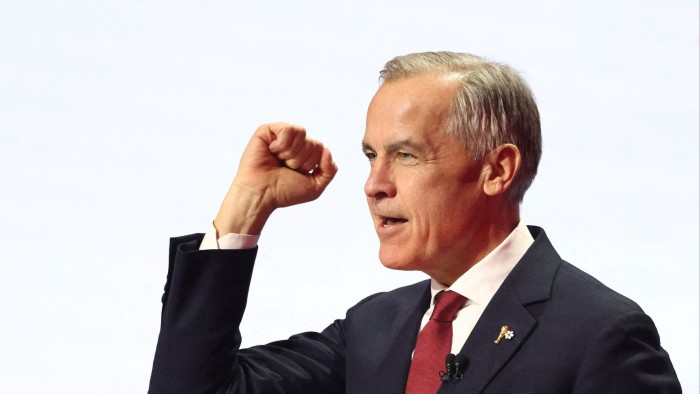
In the last year I’ve visited Canada five times. America’s northern neighbour is among the best vantage points to measure the shock of today’s change. There is no doubt among almost every Canadian to whom I’ve spoken that the US is no longer their ally. In Mark Carney, Canada has the west’s most effective contemporary leader. Unlike most of his counterparts across the Atlantic, Carney has a theory of the case. It is very simple. His goal is to sharply reduce Canada’s dependence on the US both economically and in terms of national security.
Carney also has the advantage in that most Canadians understand his theory of the case and agree with it — the “Canadiano” has replaced the Americano in Canada’s coffee shops. Unless you know what you are aiming to do, and that destination is clear to your electorate, you stand no chance of success. To be sure, barring Greenland, Trump hasn’t coveted the sovereign territory of any other western ally. But it is notable that since Carney replaced the somewhat feckless Justin Trudeau last March, we have heard a lot less from Trump about Canada becoming the 51st state.
Carney’s short prime ministership to date is proof of two things — both examples that Europe’s main leaders, and Keir Starmer in particular, can emulate. The first is the need to diversify. I appreciate that nowadays even Republican investors cannot talk of diversifying their portfolios for fear of being branded pro-DEI. But diversity is a valuable goal in many realms. Almost three quarters of Canada’s exports go to the US. Carney’s goal is to reduce that to well below half. This means making arrangements with others.
Carney inherited terrible bilateral relations with China and India. In the first, Xi Jinping reacted badly to Canada’s detention of a senior Huawei executive at the request of the US. In the second, Canada uncovered “irrefutable evidence” that Indian officials were involved with the 2023 assassinations of two pro-Khalistani Sikh Canadians. Both of these vital bilateral relationships had been consigned to the deep freeze. At the Asia Pacific summit in late October, Xi Jinping and Narendra Modi each made overtures to Carney. Both bilateral relationships have been reset. Carney is exploiting that Trump effect. The rest of the west also needs to think and act boldly to reduce their America exposure.
Carney’s second quality is his willingness to stand up to Trump. In contrast to Britain’s cringeworthy self-abasement — the worst example of which was the then UK ambassador Peter Mandelson’s Ditchley lecture in September — Carney has not been delivering fruits to the volcano. Though he has mostly avoided picking fights with Trump, Carney has been consistently resolute in refusing to cede an inch to Trump’s most egregious demands. They are still trying to negotiate a Nafta 3.0, which includes Mexico’s equally resolute leader, Claudia Sheinbaum. To date, Carney has not been punished for his lack of flattery. Trump clearly respects him in a way he evidently disrespects Starmer and Emmanuel Macron. The jury is still out on Germany’s Friedrich Merz.
Either way, we need more Carneys. If the rest of the west cannot defend our way of life and liberty, it will assuredly fall apart. In the best-case scenario, we can become a refuge or source of inspiration to the millions of Americans who feel the same way. By refusing to bend the knee, we can help redress America’s maladies. I’m turning this week to my redoubtable friend and colleague, Gideon Rachman, our world affairs columnist. Gideon, I’ve no doubt you share my view on Trump’s darkness but am I being too optimistic about the capacity of the rest of the west to reboot our world? What practical steps can the EU take to insulate against Trump’s worst instincts?
Recommended reading
My column this week declares Xi Jinping’s China as the winner of 2025 — China has escalation dominance over Trump. “America first works as an election slogan,” I write. “In the real world, China is pulling ahead.”
For more on the Trump administration’s uniquely monetised style of foreign policy, do read my colleagues Abigail Hauslohner and Alec Russell on “The Trump back channel: how diplomacy works in Washington”. There are a lot of interesting nuggets in there.
On this theme, I advise you to read Matthias Matthijs and Nathalie Tocci in Foreign Affairs on “How Europe Lost”. In the same periodical, I also strongly recommend Elizabeth Economy’s essay on Beijing’s strategy to seize the new frontiers of power.
For a reminder of what’s wrong with the American (and much of the rest of the west’s) left, read this brilliant Susan Neiman essay in the New York Review of Books on “Where wokeness went wrong”. My favourite example is the American Medical Association, which virtue signalled its support for social justice for every marginalised group under the sun while blocking any chance of reforming America’s ravenous hospital payments system. That’s wokeness in a nutshell.
Finally, Swampians might be interested in my talk to the Canada 2020 conference in Ottawa last week. I then had the somewhat surreal but enjoyable role of being interviewed by my old friend, Diana Fox Carney, who happens to be married to Canada’s prime minister. Just to underline, my positive reviews on her husband are unswayed by bias and are shared by many.
Gideon Rachman replies
Hi Ed. Thanks for the note and Happy Christmas. Your thoughts on the contrast between Carney and the EU/UK reaction to Trump are interesting. For me one of the low points of the year was the EU’s failure to hit back against the Trump tariffs. The meeting at Turnberry, where Ursula von der Leyen was pictured giving the thumbs-up next to a grinning Trump, after the EU meekly assented to a 15 per cent tariff was humiliating. And Britain’s response has been no more robust.
There are many reasons for this contrast in responses. But I would point to the difference in the nature of the security threat. Canada has been directly threatened by Trump and the Canadian people responded in the election and by boycotting some American goods. So Carney has a clear mandate to distance himself from the US — which is much harder for Canada in economic terms. The EU and UK, however, see Russia as their principal security threat. And they still see the US as critical to their defences against Russia. The US provides over 40 per cent of Nato assets in Europe, including some that are very hard to replace — such as intelligence, heavy lift aircraft and so on.
The Europeans know that they cannot depend on America in the long term. But they reckon it could take a decade to get themselves to a position where they can provide completely for their own defence. So they’re appeasing Trump and playing for time, as they try to quietly diversify.
That’s the strategy. But who knows if it really makes sense. Why do we think we have a decade? And who thinks that Trump’s guarantees are reliable, even now? Plus, never forget that the EU is a coalition of states, which is always liable to fall apart under pressure — see the struggle to get the loan to Ukraine, backed by Russian assets, through. As for the UK, we are painfully aware of our own particular dependencies on America — in nuclear weapons and intelligence — and our reliance on Washington has only increased because of Brexit.
So those are the explanations. But they are not really excuses. The EU and UK should clearly be moving faster to reduce dependency on Trump’s America.
Swamp Notes is taking a break over the Christmas holiday. Normal service resumes on January 5, 2026. Ed, Rana and the team thank you for reading this year.
Your feedback
We’d love to hear from you. You can email the team on swampnotes@ft.com, contact Ed on edward.luce@ft.com and Rana on rana.foroohar@ft.com, and follow them on X at @RanaForoohar and @EdwardGLuce. We may feature an excerpt of your response in the next newsletter
Recommended newsletters for you
The AI Shift — John Burn-Murdoch and Sarah O’Connor dive into how AI is transforming the world of work. Sign up here
Unhedged — Robert Armstrong dissects the most important market trends and discusses how Wall Street’s best minds respond to them. Sign up here