
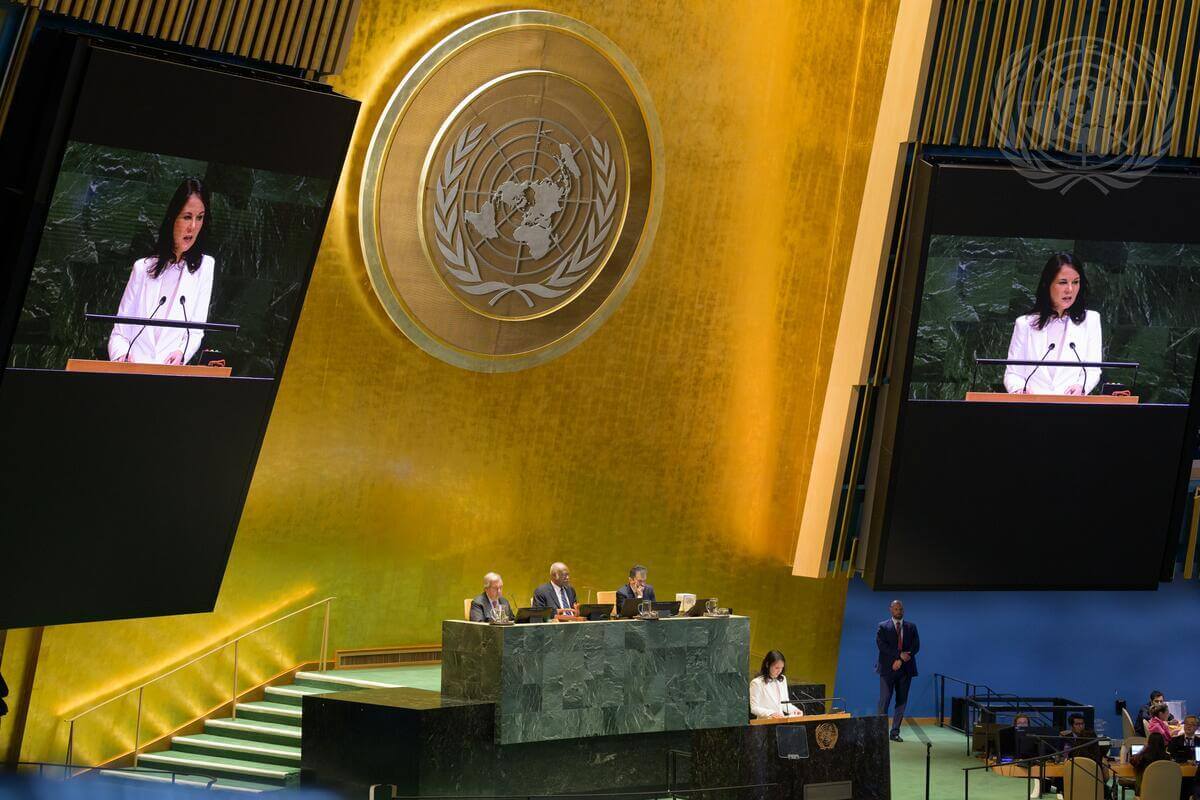
Editor’s Note: Nicole Crawford is a young expert in the Global Governance Innovation Network. This commentary is part of the GGIN’s Next Generation Experts series, which aims to elevate youth research and writing. Nicole Crawford’s interest and research center on global security, gender equality, and foreign policy.
By Rebecca Snyder, Research Associate, Global Governance, Justice and Security Program
Against the backdrop of declining public trust in multilateralism, the 2026 Secretary-General (S-G) race takes on new urgency. Yet, after eight decades, the position of S-G has never been held by a woman. On November 25th, a joint letter from the President of the General Assembly and the President of the Security Council formally set in motion the 2026 S-G election, encouraging Member States to nominate women candidates. Three candidates have been nominated so far: Michelle Bachelet of Chile, Rebeca Grynspan of Costa Rica, and Rafael Grossi of Argentina. António Guterres has led the UN as Secretary-General since 2016, but with his term coming to an end in 2027, is the UN ready for a woman to hold the title?
As multilateralism loses trust, the UN needs an S-G whose problem-solving, discipline, and coalition-building can restore the UNs credibility across peace, security, and humanitarian action agendas. In an era of rising geopolitical tension, electing a woman S-G would signal that the UN is committed to addressing today’s challenges with renewed leadership rather than remaining constrained by its male-dominated past.
The Secretary-General’s Role: Power, Voice, and Judgment
The S-G is described as the UN’s “chief administrative officer,” but the role also shapes global priorities and challenges Member State behavior when necessary. António Guterres has placed climate at the center of the UN agenda during his term, advocating for net-zero emissions by 2050, convening high-level summits, raising climate finance goals to $1.3 trillion, and linking climate and food security through the Black Sea Grain Initiative. These examples underscore the S-G’s capacity to set global priorities and drive multilateral action.
The next S-G must sustain ambition on the SDGs while confronting a severe financial and legitimacy crisis. The UN faces $760 million in unpaid assessments, a $577 million budget shortfall, and only 18% of SDGs on track for 2030 due to a $2.5–4 trillion annual financing gap. The Pact for the Future provides a strong consensus-driven roadmap and commitment to multilateralism, but its true value will depend on rigorous implementation following its adoption in September 2024. The next S-G must demonstrate that even under a reduced budget and operational strain, the UN can still deliver measurable progress, or otherwise risk losing its remaining credibility.
Why Has a Woman Never Been Elected?
Despite the UN Charter Preamble claiming equality by stating “We the Peoples of the United Nations,” it has never elected a woman to its highest office. Evident in the 2016 S-G election, several accomplished female candidates – some arguably more experienced than the final nominee, António Guterres – were sidelined by the P5’s veto power, which ended their campaigns. The results of the 2016 S-G election disappointed those who were eager for the first female S-G and showcased that gender bias will remain a barrier. Female leaders are proven to bring strength in problem-solving, conflict resolution, coalition-building, and empathy, but too often, implicit gender bias favors men over equally qualified women in a “paradox of meritocracy.”
Why 2026 Matters
The 2026 election comes at a pivotal moment, as climate change, Russia’s war in Ukraine, conflict in Gaza, Sudan’s humanitarian crisis, and democratic backsliding are destabilizing regions. As the UN faces a deep financial crisis, impeding its ability to meet SDGs and the 2030 Agenda, along with mistrust from the international community, the new S-G needs to elevate global priorities, lead on peace and security, and mobilize humanitarian responses with courage and coalition-building.
If the “rule” of regional rotation applies — where the S-G role rotates among the UN’s five geographic regions — it’s Latin America’s turn. The recent and historic democratic elections of two female presidents, Claudia Sheinbaum in Mexico and Xiomara Castro in Honduras, demonstrate the region’s growing commitment to inclusive governance. Since being elected, Sheinbaum has proclaimed an “era of women,” secured constitutional reforms for women’s substantive equality, and established a ministry-level office for women’s issues.
In this context, electing a woman is both symbolic and strategic. At a moment when global cooperation is failing, a strong female leader could usher in a revitalized era of diplomacy and collective action. As the Pact for the Future urges Member States to recommit to preventative diplomacy, electing a strong female leader would reposition the UN as an active, credible leader in global governance and demonstrate the organization’s commitment to gender equality.
Building Early Consensus
As observed in the 2016 S-G election, many qualified female candidates were vetoed while consensus coalesced around a single male nominee. With the final decision resting in the hands of the P5 and their political interests, the priority now is ensuring that each female candidate has a genuine opportunity to compete on equal terms. Recent reforms, such as requiring CVs, vision statements, and financial disclosures being made publicly available have strengthened transparency, but they alone cannot counteract the P5 influence over candidate selection. Member States and civil society can build on these reforms by building early consensus around a single female candidate, encouraging her to engage in informal dialogues with Member States, helping her secure coordinated support, and enabling her to lead decisively under political and public scrutiny. These steps will not override P5 preferences, but they can help ensure the process is not predetermined and that qualified women are evaluated on merit.
A Chance to Lead by Example
A female Secretary-General will not solve every institutional or geopolitical challenge, but electing a strong woman signals that the UN could lead by example. For decades, the organization has urged Member States to expand women’s leadership and promote gender equality. In 2026, the organization has the chance to follow its own advice and shape the future of multilateralism. A female S-G would reflect nearly half the world’s population, introduce fresh perspectives into global problem-solving, and navigate institutional hurdles with skill, authority, and resilience. After 80 years, the question is no longer whether the world is ready for a woman Secretary-General, it is whether the UN is.