
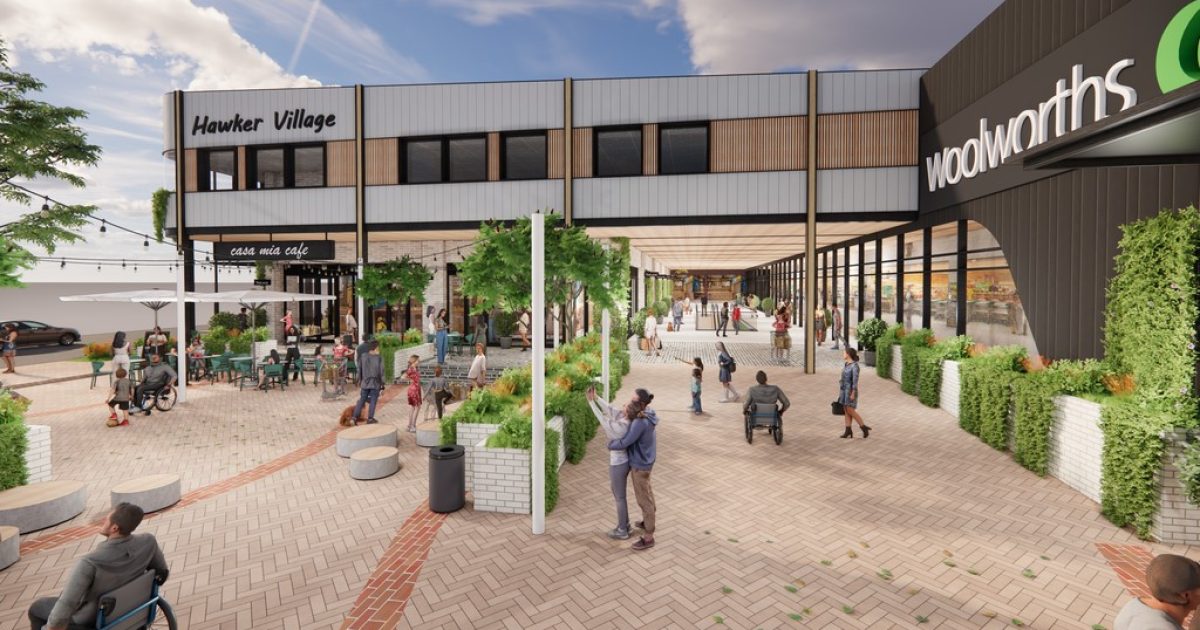
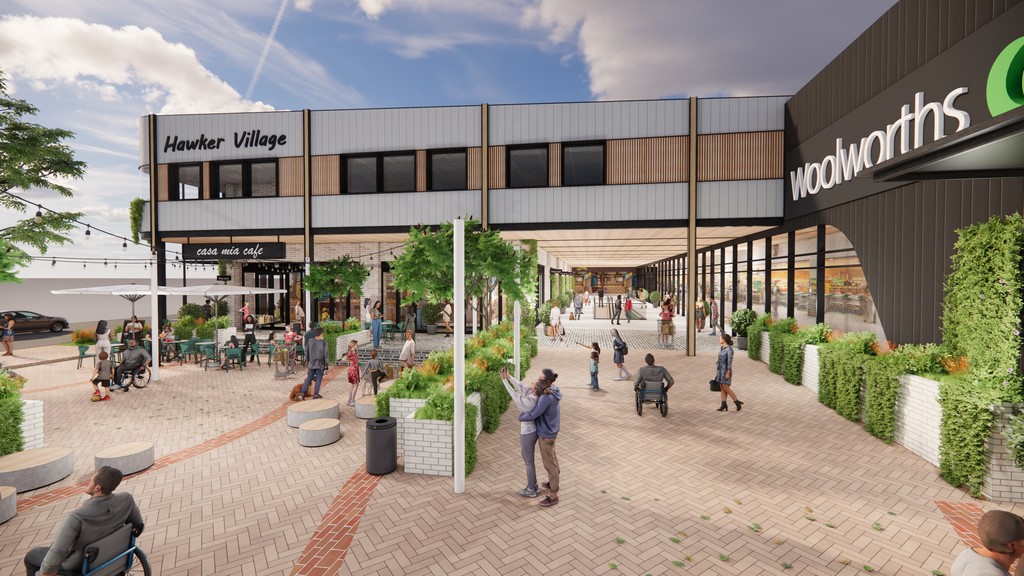
A conceptual illustration of the proposed redevelopment of Hawker shops. Image: Woolworths.
The ACT Government has been urged to conduct a wide-ranging consultation process on the future of the Hawker Group Centre and take the lead in guiding how the shops should be upgraded.
A Legislative Assembly Committee also recommended the government not consider any direct sale of land application from Woolworths until the consultation had been concluded.
The Standing Committee on Environment and Planning launched its inquiry into Hawker Village in response to a petition opposing Woolworths’ direct sale application and its redevelopment proposal, particularly the replacement of the surface car park with underground parking.
The idea of refreshing Hawker shops has been on the table for 15 years but no proposal has managed to find favour from the diverse community they serve.
The latest proposal from Woolworths is for it to replace the current Metro with a full-line store and add specialty shops, new walkways, public areas, a playground and car parking.
To do this, Woolworths sought to acquire four parcels of land, including the current car park, for the expansion.
But in March this year the government told the supermarket giant that housing would have to be part of the proposal, something Woolworths is now considering.
Woolworths told the committee that it was comparing plans for possible developments that included housing at Hawker Village and assessing the viability of such a proposal. This would take about 12 months.
The committee found that despite the divergence of views about the direct sale bid and the Woolworths proposal, there was broad agreement that the shops were tired and needed upgrading.
While some accepted the need for a full-line supermarket, others believed the Metro was sufficient and that there were already bigger stores close by, including those at Westfield Belconnen.
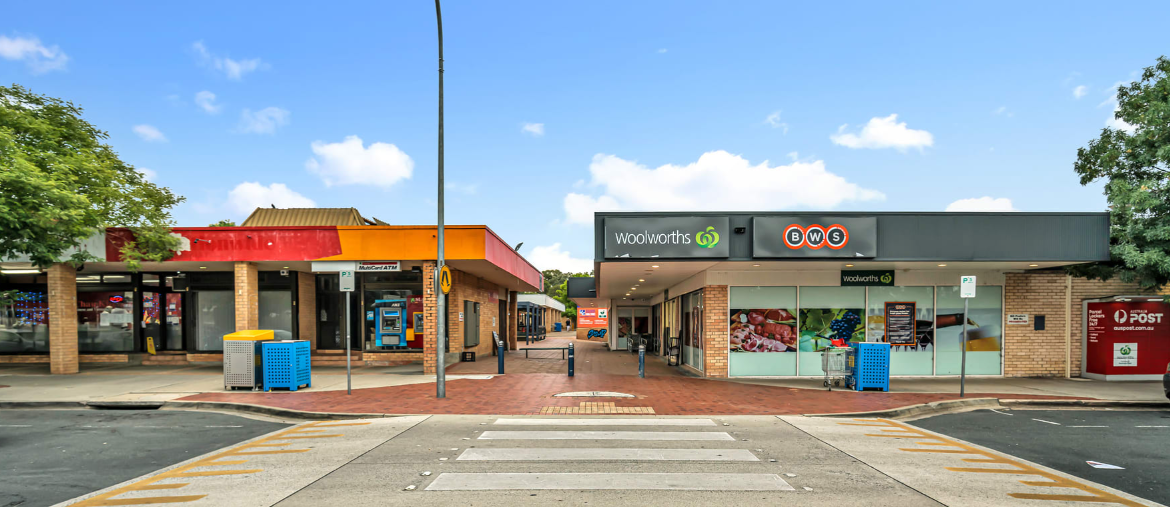
Hawker Village is tired and in need of upgrades. Photo: CBRE.
Some feared the loss of a village character and feel, while others believed an underground car park would not be as convenient or accessible as the present surface facility.
Opinions were also divided on the question of housing. Some were opposed to densification but other believed a residential component would be good for Village businesses.
“Many local residents are clearly very attached to the existing layout and atmosphere provided by the existing shops,” the committee found.
“Others have outlined a vision for the future that involves substantial change. Still others have presented views that sit somewhere in between.”
The Belconnen Community Council told the committee that the government needed to take a more active role and be clear on what it actually wanted at Hawker Village, inspired by community feedback.
The committee agreed, urging the government to consult as widely as possible on the future of Hawker Village, noting that this could be done in tandem with the current survey of group centres across the ACT.
“The committee believes there is an opportunity for the ACT Government to take the lead in developing and implementing a vision for the future of the Hawker Group Centre,” it said.
“Rather than waiting for a specific proposal to drive consultation, the committee believes there is value in developing a plan for the area via consultation that can drive specific proposals in the future which would then be reflected in the necessary planning documents.”
The committee found that consultation to date had not been a positive experience for the Hawker community.
It said that by conducting a long-term consultation with multiple ways to contribute and at convenient times, the government could form a view on the future of Hawker Village that better reflected the wishes of local residents and visitors.
“Conducting this consultation parallel to the survey work to determine the future potential of the site could be used to form a plan for the future of Hawker Village,” the committee said.
“This information could be used by government to help guide potential developers and existing leaseholders in developing proposals which meet local needs and satisfy as many residents as possible.”
This would provide more certainty for residents and potential developers such as Woolworths, in that community views would be more effectively factored in before a development application was lodged, the committee said.
The committee comprised Chair Jo Clay (Greens), Independent Fiona Carrick, Liberal Peter Cain and Labor’s Caitlin Tough. It received 71 submissions.